

168
DYNAMICAL OCEANOGRAPHY
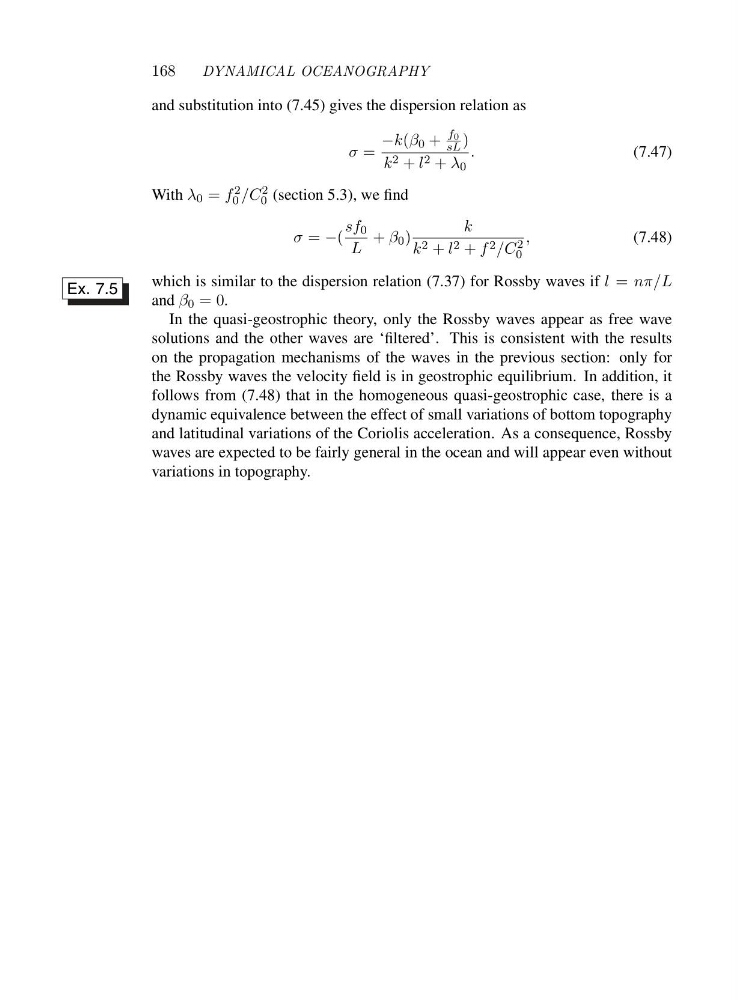
and substitution into (7.45) gives the dispersion relation as
σ =
−k(β 0 +
f0
sL )
k 2 + l 2 + λ 0
.
(7.47)
With λ 0 = f 2
0 /C 2
0 (section 5.3), we find
σ = −(
sf 0
L
+ β 0 )
k
k 2 + l 2 + f 2 /C 2
0
,
(7.48)
which is similar to the dispersion relation (7.37) for Rossby waves if l = nπ/L
and β 0 =0.
Ex. 7.5
In the quasi-geostrophic theory, only the Rossby waves appear as free wave
solutions and the other waves are ‘filtered’. This is consistent with the results
on the propagation mechanisms of the waves in the previous section: only for
the Rossby waves the velocity field is in geostrophic equilibrium. In addition, it
follows from (7.48) that in the homogeneous quasi-geostrophic case, there is a
dynamic equivalence between the effect of small variations of bottom topography
and latitudinal variations of the Coriolis acceleration. As a consequence, Rossby
waves are expected to be fairly general in the ocean and will appear even without
variations in topography.
DYNAMICAL OCEANOGRAPHY
and substitution into (7.45) gives the dispersion relation as
σ =
−k(β 0 +
f0
sL )
k 2 + l 2 + λ 0
.
(7.47)
With λ 0 = f 2
0 /C 2
0 (section 5.3), we find
σ = −(
sf 0
L
+ β 0 )
k
k 2 + l 2 + f 2 /C 2
0
,
(7.48)
which is similar to the dispersion relation (7.37) for Rossby waves if l = nπ/L
and β 0 =0.
Ex. 7.5
In the quasi-geostrophic theory, only the Rossby waves appear as free wave
solutions and the other waves are ‘filtered’. This is consistent with the results
on the propagation mechanisms of the waves in the previous section: only for
the Rossby waves the velocity field is in geostrophic equilibrium. In addition, it
follows from (7.48) that in the homogeneous quasi-geostrophic case, there is a
dynamic equivalence between the effect of small variations of bottom topography
and latitudinal variations of the Coriolis acceleration. As a consequence, Rossby
waves are expected to be fairly general in the ocean and will appear even without
variations in topography.