

Free waves
157
∂˜ v
∂t
+ f ˜
u = −g
∂ ˜
h
∂y
,
(7.3b)
∂ ˜
h
∂t
+
∂
∂x
(H 0 ˜
u)+
∂
∂y
(H 0 ˜
v)=0 .
(7.3c)
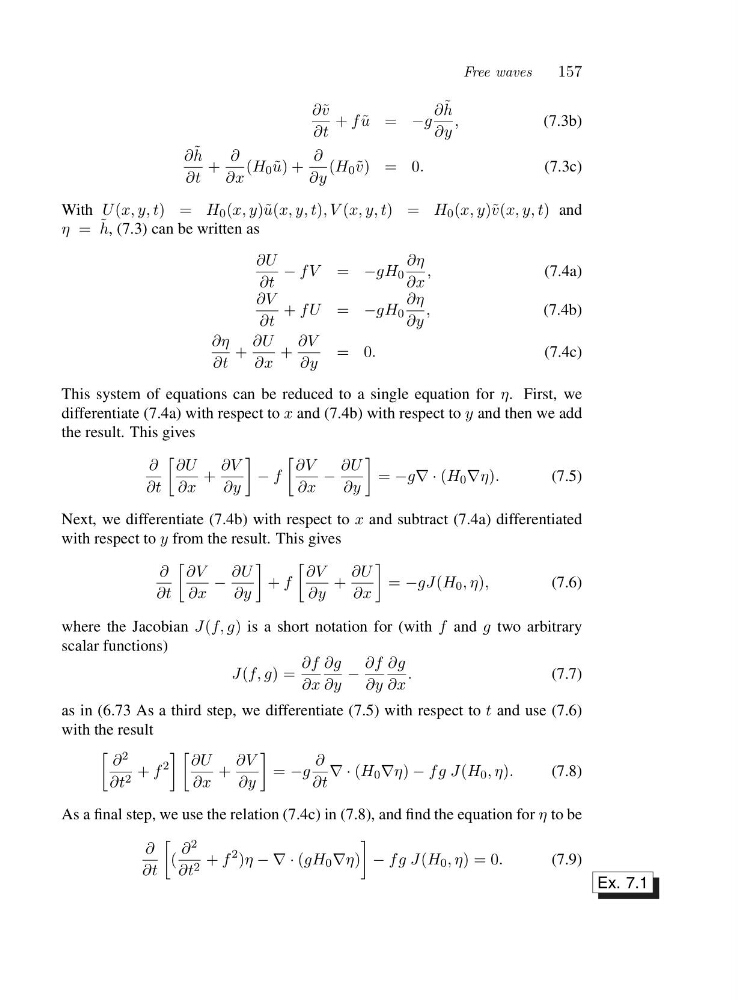
With U (x, y, t)=H 0 (x, y)˜ u(x, y, t),V(x, y, t)=H 0 (x, y)˜ v(x, y, t) and
η = ˜
h, (7.3) can be written as
∂U
∂t
− fV = −gH 0
∂η
∂x
,
(7.4a)
∂V
∂t
+ fU = −gH 0
∂η
∂y
,
(7.4b)
∂η
∂t
+
∂U
∂x
+
∂V
∂y
=0 .
(7.4c)
This system of equations can be reduced to a single equation for η. First, we
differentiate (7.4a) with respect to x and (7.4b) with respect to y and then we add
the result. This gives
∂
∂t
∂U
∂x
+
∂V
∂y
− f
∂V
∂x
−
∂U
∂y
= −g∇·(H 0 ∇η).
(7.5)
Next, we differentiate (7.4b) with respect to x and subtract (7.4a) differentiated
with respect to y from the result. This gives
∂
∂t
∂V
∂x
−
∂U
∂y
+ f
∂V
∂y
+
∂U
∂x
= −gJ(H 0 ,η),
(7.6)
where the Jacobian J(f, g) is a short notation for (with f and g two arbitrary
scalar functions)
J(f, g)=
∂f
∂x
∂g
∂y
−
∂f
∂y
∂g
∂x
.
(7.7)
as in (6.73 As a third step, we differentiate (7.5) with respect to t and use (7.6)
with the result
∂ 2
∂t 2 + f
2
∂U
∂x
+
∂V
∂y
= −g
∂
∂t
∇·(H 0 ∇η) − fg J(H 0 ,η).
(7.8)
As a final step, we use the relation (7.4c) in (7.8), and find the equation for η to be
∂
∂t
(
∂ 2
∂t 2 + f
2 )η −∇·(gH 0 ∇η)
− fg J(H 0 ,η)=0.
(7.9)
Ex. 7.1
157
∂˜ v
∂t
+ f ˜
u = −g
∂ ˜
h
∂y
,
(7.3b)
∂ ˜
h
∂t
+
∂
∂x
(H 0 ˜
u)+
∂
∂y
(H 0 ˜
v)=0 .
(7.3c)
With U (x, y, t)=H 0 (x, y)˜ u(x, y, t),V(x, y, t)=H 0 (x, y)˜ v(x, y, t) and
η = ˜
h, (7.3) can be written as
∂U
∂t
− fV = −gH 0
∂η
∂x
,
(7.4a)
∂V
∂t
+ fU = −gH 0
∂η
∂y
,
(7.4b)
∂η
∂t
+
∂U
∂x
+
∂V
∂y
=0 .
(7.4c)
This system of equations can be reduced to a single equation for η. First, we
differentiate (7.4a) with respect to x and (7.4b) with respect to y and then we add
the result. This gives
∂
∂t
∂U
∂x
+
∂V
∂y
− f
∂V
∂x
−
∂U
∂y
= −g∇·(H 0 ∇η).
(7.5)
Next, we differentiate (7.4b) with respect to x and subtract (7.4a) differentiated
with respect to y from the result. This gives
∂
∂t
∂V
∂x
−
∂U
∂y
+ f
∂V
∂y
+
∂U
∂x
= −gJ(H 0 ,η),
(7.6)
where the Jacobian J(f, g) is a short notation for (with f and g two arbitrary
scalar functions)
J(f, g)=
∂f
∂x
∂g
∂y
−
∂f
∂y
∂g
∂x
.
(7.7)
as in (6.73 As a third step, we differentiate (7.5) with respect to t and use (7.6)
with the result
∂ 2
∂t 2 + f
2
∂U
∂x
+
∂V
∂y
= −g
∂
∂t
∇·(H 0 ∇η) − fg J(H 0 ,η).
(7.8)
As a final step, we use the relation (7.4c) in (7.8), and find the equation for η to be
∂
∂t
(
∂ 2
∂t 2 + f
2 )η −∇·(gH 0 ∇η)
− fg J(H 0 ,η)=0.
(7.9)
Ex. 7.1