

Western intensification
141
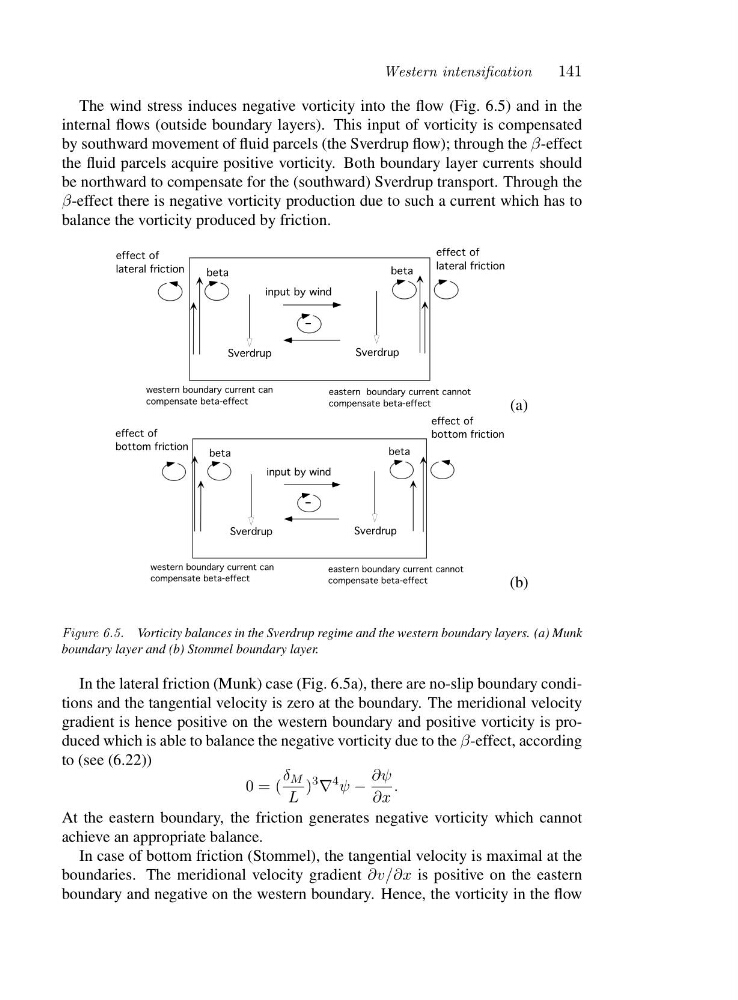
The wind stress induces negative vorticity into the flow (Fig. 6.5) and in the
internal flows (outside boundary layers). This input of vorticity is compensated
by southward movement of fluid parcels (the Sverdrup flow); through the β-effect
the fluid parcels acquire positive vorticity. Both boundary layer currents should
be northward to compensate for the (southward) Sverdrup transport. Through the
β-effect there is negative vorticity production due to such a current which has to
balance the vorticity produced by friction.
-
input by wind
Sverdrup
Sverdrup
beta
beta
western boundary current can
compensate beta-effect
eastern boundary current cannot
compensate beta-effect
effect of
lateral friction
effect of
lateral friction
(a)
-
input by wind
Sverdrup
Sverdrup
beta
beta
western boundary current can
compensate beta-effect
eastern boundary current cannot
compensate beta-effect
effect of
bottom friction
effect of
bottom friction
(b)
Figure 6.5. Vorticity balances in the Sverdrup regime and the western boundary layers. (a) Munk
boundary layer and (b) Stommel boundary layer.
In the lateral friction (Munk) case (Fig. 6.5a), there are no-slip boundary conditions and the tangential velocity is zero at the boundary. The meridional velocity
gradient is hence positive on the western boundary and positive vorticity is produced which is able to balance the negative vorticity due to the β-effect, according
to (see (6.22))
0=(
δ M
L
)
3 ∇
4 ψ −
∂ψ
∂x
.
At the eastern boundary, the friction generates negative vorticity which cannot
achieve an appropriate balance.
In case of bottom friction (Stommel), the tangential velocity is maximal at the
boundaries. The meridional velocity gradient ∂v/∂x is positive on the eastern
boundary and negative on the western boundary. Hence, the vorticity in the flow
141
The wind stress induces negative vorticity into the flow (Fig. 6.5) and in the
internal flows (outside boundary layers). This input of vorticity is compensated
by southward movement of fluid parcels (the Sverdrup flow); through the β-effect
the fluid parcels acquire positive vorticity. Both boundary layer currents should
be northward to compensate for the (southward) Sverdrup transport. Through the
β-effect there is negative vorticity production due to such a current which has to
balance the vorticity produced by friction.
-
input by wind
Sverdrup
Sverdrup
beta
beta
western boundary current can
compensate beta-effect
eastern boundary current cannot
compensate beta-effect
effect of
lateral friction
effect of
lateral friction
(a)
-
input by wind
Sverdrup
Sverdrup
beta
beta
western boundary current can
compensate beta-effect
eastern boundary current cannot
compensate beta-effect
effect of
bottom friction
effect of
bottom friction
(b)
Figure 6.5. Vorticity balances in the Sverdrup regime and the western boundary layers. (a) Munk
boundary layer and (b) Stommel boundary layer.
In the lateral friction (Munk) case (Fig. 6.5a), there are no-slip boundary conditions and the tangential velocity is zero at the boundary. The meridional velocity
gradient is hence positive on the western boundary and positive vorticity is produced which is able to balance the negative vorticity due to the β-effect, according
to (see (6.22))
0=(
δ M
L
)
3 ∇
4 ψ −
∂ψ
∂x
.
At the eastern boundary, the friction generates negative vorticity which cannot
achieve an appropriate balance.
In case of bottom friction (Stommel), the tangential velocity is maximal at the
boundaries. The meridional velocity gradient ∂v/∂x is positive on the eastern
boundary and negative on the western boundary. Hence, the vorticity in the flow