

Wind-driven circulation
119
ζ
0 =
∂v 0
∂x
−
∂u 0
∂y
,
(5.90b)
v
0 =
∂p 0
∂x
; u
0 = −
∂p 0
∂y
,
(5.90c)
η
0 = p
0 .
(5.90d)
Equation (5.90) is a scalar equation for the pressure p 0 (x, y). It is remarkable
that the O(ǫ) balance in the flow outside the Ekman boundary layers eventually
determines the O(1) pressure field and hence the O(1) geostrophic flow field. The
lateral boundary conditions for p 0 will be considered in later sections.
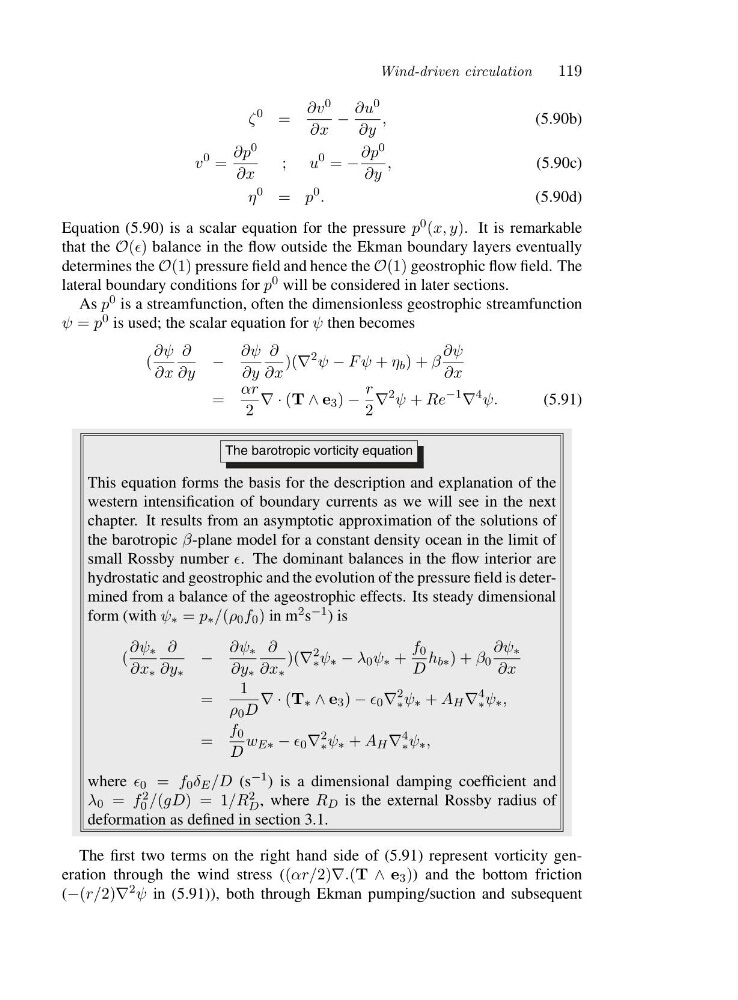
As p 0 is a streamfunction, often the dimensionless geostrophic streamfunction
ψ = p 0 is used; the scalar equation for ψ then becomes
(
∂ψ
∂x
∂
∂y
−
∂ψ
∂y
∂
∂x
)(∇
2 ψ − Fψ + η b )+β
∂ψ
∂x
=
αr
2
∇·(T ∧ e 3 ) −
r
2
∇
2 ψ + Re
−1 ∇
4 ψ.
(5.91)
The barotropic vorticity equation
This equation forms the basis for the description and explanation of the
western intensification of boundary currents as we will see in the next
chapter. It results from an asymptotic approximation of the solutions of
the barotropic β-plane model for a constant density ocean in the limit of
small Rossby number ǫ. The dominant balances in the flow interior are
hydrostatic and geostrophic and the evolution of the pressure field is determined from a balance of the ageostrophic effects. Its steady dimensional
form (with ψ ∗ = p ∗ /(ρ 0 f 0 ) in m 2 s −1 )is
(
∂ψ ∗
∂x ∗
∂
∂y ∗
−
∂ψ ∗
∂y ∗
∂
∂x ∗
)(∇
2
∗ ψ ∗ − λ 0 ψ ∗ +
f 0
D
h b∗ )+β 0
∂ψ ∗
∂x
=
1
ρ 0 D
∇·(T ∗ ∧ e 3 ) − ǫ 0 ∇
2
∗ ψ ∗ + A H ∇
4
∗ ψ ∗ ,
=
f 0
D
w E∗ − ǫ 0 ∇
2
∗ ψ ∗ + A H ∇
4
∗ ψ ∗ ,
where ǫ 0 = f 0 δ E /D (s −1 ) is a dimensional damping coefficient and
λ 0 = f 2
0 /(gD)=1 /R 2
D , where R D is the external Rossby radius of
deformation as defined in section 3.1.
The first two terms on the right hand side of (5.91) represent vorticity generation through the wind stress ((αr/2)∇.(T ∧ e 3 )) and the bottom friction
(−(r/2)∇ 2 ψ in (5.91)), both through Ekman pumping/suction and subsequent
119
ζ
0 =
∂v 0
∂x
−
∂u 0
∂y
,
(5.90b)
v
0 =
∂p 0
∂x
; u
0 = −
∂p 0
∂y
,
(5.90c)
η
0 = p
0 .
(5.90d)
Equation (5.90) is a scalar equation for the pressure p 0 (x, y). It is remarkable
that the O(ǫ) balance in the flow outside the Ekman boundary layers eventually
determines the O(1) pressure field and hence the O(1) geostrophic flow field. The
lateral boundary conditions for p 0 will be considered in later sections.
As p 0 is a streamfunction, often the dimensionless geostrophic streamfunction
ψ = p 0 is used; the scalar equation for ψ then becomes
(
∂ψ
∂x
∂
∂y
−
∂ψ
∂y
∂
∂x
)(∇
2 ψ − Fψ + η b )+β
∂ψ
∂x
=
αr
2
∇·(T ∧ e 3 ) −
r
2
∇
2 ψ + Re
−1 ∇
4 ψ.
(5.91)
The barotropic vorticity equation
This equation forms the basis for the description and explanation of the
western intensification of boundary currents as we will see in the next
chapter. It results from an asymptotic approximation of the solutions of
the barotropic β-plane model for a constant density ocean in the limit of
small Rossby number ǫ. The dominant balances in the flow interior are
hydrostatic and geostrophic and the evolution of the pressure field is determined from a balance of the ageostrophic effects. Its steady dimensional
form (with ψ ∗ = p ∗ /(ρ 0 f 0 ) in m 2 s −1 )is
(
∂ψ ∗
∂x ∗
∂
∂y ∗
−
∂ψ ∗
∂y ∗
∂
∂x ∗
)(∇
2
∗ ψ ∗ − λ 0 ψ ∗ +
f 0
D
h b∗ )+β 0
∂ψ ∗
∂x
=
1
ρ 0 D
∇·(T ∗ ∧ e 3 ) − ǫ 0 ∇
2
∗ ψ ∗ + A H ∇
4
∗ ψ ∗ ,
=
f 0
D
w E∗ − ǫ 0 ∇
2
∗ ψ ∗ + A H ∇
4
∗ ψ ∗ ,
where ǫ 0 = f 0 δ E /D (s −1 ) is a dimensional damping coefficient and
λ 0 = f 2
0 /(gD)=1 /R 2
D , where R D is the external Rossby radius of
deformation as defined in section 3.1.
The first two terms on the right hand side of (5.91) represent vorticity generation through the wind stress ((αr/2)∇.(T ∧ e 3 )) and the bottom friction
(−(r/2)∇ 2 ψ in (5.91)), both through Ekman pumping/suction and subsequent