

106
DYNAMICAL OCEANOGRAPHY
δ E = ¯
E
1/2
V D = ℓD the Ekman layer thickness. The inner expansion therefore
becomes
(˜ u, ˜
v, ˜
w, ˜
p)
T =(˜ u
0 , ˜
v
0 , ¯
E
1/2
V ˜
w
0 , ˜
p
0 )
T + ǫ(˜ u
1 , ˜
v
1 , ¯
E
1/2
V ˜
w
1 , ˜
p
1 )
T + ... (5.43)
and the O(1) system of equations is
−˜ v
0 = −
∂ ˜
p
∂x
0
+
1
2
∂ 2 ˜
u
∂ξ 2
0
,
(5.44a)
˜
u
0 = −
∂ ˜
p
∂y
0
+
1
2
∂ 2 ˜
v
∂ξ 2
0
,
(5.44b)
0=
∂ ˜
p
∂ξ
0
,
(5.44c)
∂ ˜
w
∂ξ
0
= −
∂˜ v
∂y
0
+
∂ ˜
u
∂x
0
.
(5.44d)
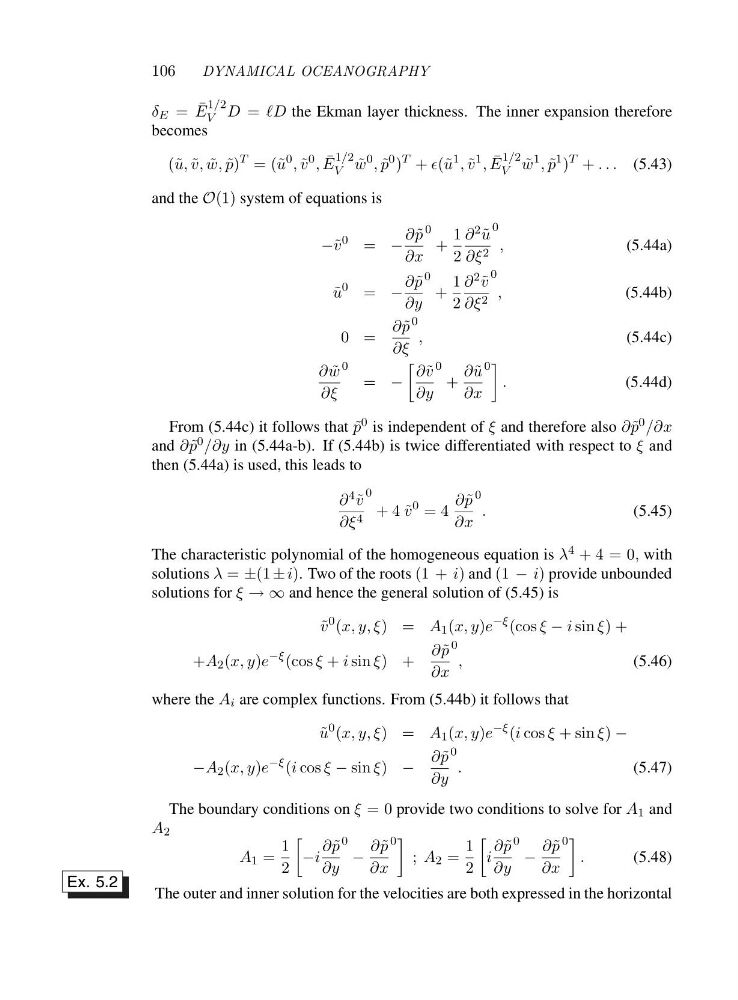
From (5.44c) it follows that ˜
p 0 is independent of ξ and therefore also ∂ ˜
p 0 /∂x
and ∂ ˜
p 0 /∂y in (5.44a-b). If (5.44b) is twice differentiated with respect to ξ and
then (5.44a) is used, this leads to
∂ 4 ˜
v
∂ξ 4
0
+4˜ v
0 =4
∂ ˜
p
∂x
0
.
(5.45)
The characteristic polynomial of the homogeneous equation is λ 4 +4=0, with
solutions λ = ±(1 ± i). Two of the roots (1 + i) and (1 − i) provide unbounded
solutions for ξ →∞and hence the general solution of (5.45) is
˜
v
0 (x, y, ξ)=A 1 (x, y)e
−ξ (cos ξ − i sin ξ)+
+A 2 (x, y)e
−ξ (cos ξ + i sin ξ)+
∂ ˜
p
∂x
0
,
(5.46)
where the A i are complex functions. From (5.44b) it follows that
˜
u
0 (x, y, ξ)=A 1 (x, y)e
−ξ (i cos ξ +sinξ) −
−A 2 (x, y)e
−ξ (i cos ξ − sin ξ) −
∂ ˜
p
∂y
0
.
(5.47)
The boundary conditions on ξ =0provide two conditions to solve for A 1 and
A 2
A 1 =
1
2
−i
∂ ˜
p
∂y
0
−
∂ ˜
p
∂x
0
; A 2 =
1
2
i
∂ ˜
p
∂y
0
−
∂ ˜
p
∂x
0
.
(5.48)
The outer and inner solution for the velocities are both expressed in the horizontal
Ex. 5.2
DYNAMICAL OCEANOGRAPHY
δ E = ¯
E
1/2
V D = ℓD the Ekman layer thickness. The inner expansion therefore
becomes
(˜ u, ˜
v, ˜
w, ˜
p)
T =(˜ u
0 , ˜
v
0 , ¯
E
1/2
V ˜
w
0 , ˜
p
0 )
T + ǫ(˜ u
1 , ˜
v
1 , ¯
E
1/2
V ˜
w
1 , ˜
p
1 )
T + ... (5.43)
and the O(1) system of equations is
−˜ v
0 = −
∂ ˜
p
∂x
0
+
1
2
∂ 2 ˜
u
∂ξ 2
0
,
(5.44a)
˜
u
0 = −
∂ ˜
p
∂y
0
+
1
2
∂ 2 ˜
v
∂ξ 2
0
,
(5.44b)
0=
∂ ˜
p
∂ξ
0
,
(5.44c)
∂ ˜
w
∂ξ
0
= −
∂˜ v
∂y
0
+
∂ ˜
u
∂x
0
.
(5.44d)
From (5.44c) it follows that ˜
p 0 is independent of ξ and therefore also ∂ ˜
p 0 /∂x
and ∂ ˜
p 0 /∂y in (5.44a-b). If (5.44b) is twice differentiated with respect to ξ and
then (5.44a) is used, this leads to
∂ 4 ˜
v
∂ξ 4
0
+4˜ v
0 =4
∂ ˜
p
∂x
0
.
(5.45)
The characteristic polynomial of the homogeneous equation is λ 4 +4=0, with
solutions λ = ±(1 ± i). Two of the roots (1 + i) and (1 − i) provide unbounded
solutions for ξ →∞and hence the general solution of (5.45) is
˜
v
0 (x, y, ξ)=A 1 (x, y)e
−ξ (cos ξ − i sin ξ)+
+A 2 (x, y)e
−ξ (cos ξ + i sin ξ)+
∂ ˜
p
∂x
0
,
(5.46)
where the A i are complex functions. From (5.44b) it follows that
˜
u
0 (x, y, ξ)=A 1 (x, y)e
−ξ (i cos ξ +sinξ) −
−A 2 (x, y)e
−ξ (i cos ξ − sin ξ) −
∂ ˜
p
∂y
0
.
(5.47)
The boundary conditions on ξ =0provide two conditions to solve for A 1 and
A 2
A 1 =
1
2
−i
∂ ˜
p
∂y
0
−
∂ ˜
p
∂x
0
; A 2 =
1
2
i
∂ ˜
p
∂y
0
−
∂ ˜
p
∂x
0
.
(5.48)
The outer and inner solution for the velocities are both expressed in the horizontal
Ex. 5.2