

90
V. Liapidevskii and N. Gavrilov
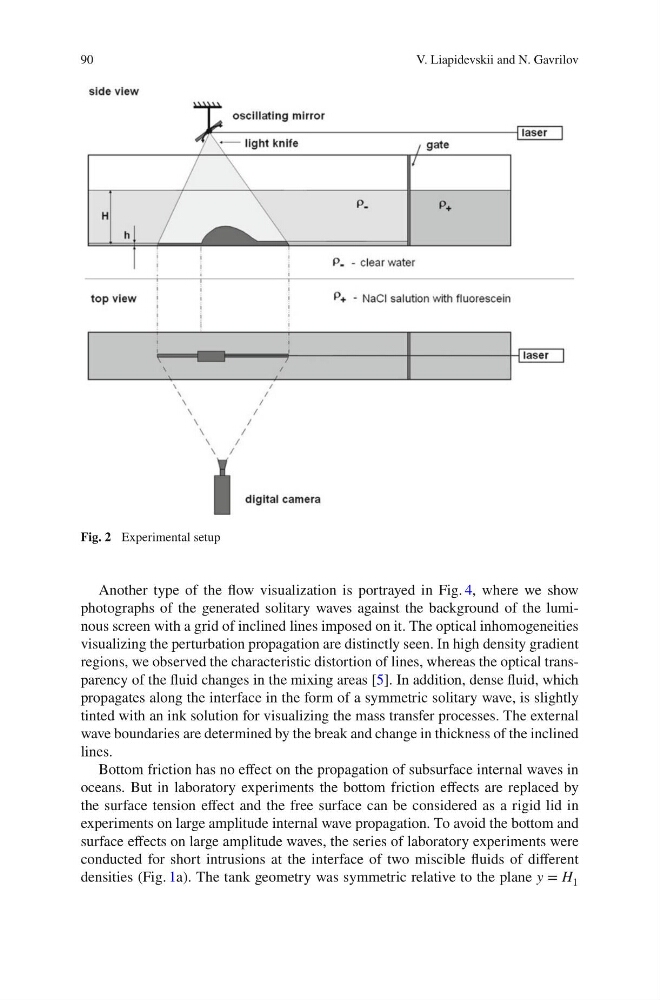
Fig. 2 Experimental setup
Another type of the flow visualization is portrayed in Fig. 4, where we show
photographs of the generated solitary waves against the background of the luminous screen with a grid of inclined lines imposed on it. The optical inhomogeneities
visualizing the perturbation propagation are distinctly seen. In high density gradient
regions, we observed the characteristic distortion of lines, whereas the optical transparency of the fluid changes in the mixing areas [5]. In addition, dense fluid, which
propagates along the interface in the form of a symmetric solitary wave, is slightly
tinted with an ink solution for visualizing the mass transfer processes. The external
wave boundaries are determined by the break and change in thickness of the inclined
lines.
Bottom friction has no effect on the propagation of subsurface internal waves in
oceans. But in laboratory experiments the bottom friction effects are replaced by
the surface tension effect and the free surface can be considered as a rigid lid in
experiments on large amplitude internal wave propagation. To avoid the bottom and
surface effects on large amplitude waves, the series of laboratory experiments were
conducted for short intrusions at the interface of two miscible fluids of different
densities (Fig. 1a). The tank geometry was symmetric relative to the plane y = H 1
V. Liapidevskii and N. Gavrilov
Fig. 2 Experimental setup
Another type of the flow visualization is portrayed in Fig. 4, where we show
photographs of the generated solitary waves against the background of the luminous screen with a grid of inclined lines imposed on it. The optical inhomogeneities
visualizing the perturbation propagation are distinctly seen. In high density gradient
regions, we observed the characteristic distortion of lines, whereas the optical transparency of the fluid changes in the mixing areas [5]. In addition, dense fluid, which
propagates along the interface in the form of a symmetric solitary wave, is slightly
tinted with an ink solution for visualizing the mass transfer processes. The external
wave boundaries are determined by the break and change in thickness of the inclined
lines.
Bottom friction has no effect on the propagation of subsurface internal waves in
oceans. But in laboratory experiments the bottom friction effects are replaced by
the surface tension effect and the free surface can be considered as a rigid lid in
experiments on large amplitude internal wave propagation. To avoid the bottom and
surface effects on large amplitude waves, the series of laboratory experiments were
conducted for short intrusions at the interface of two miscible fluids of different
densities (Fig. 1a). The tank geometry was symmetric relative to the plane y = H 1