

Large Internal Solitary Waves in Shallow Waters
89
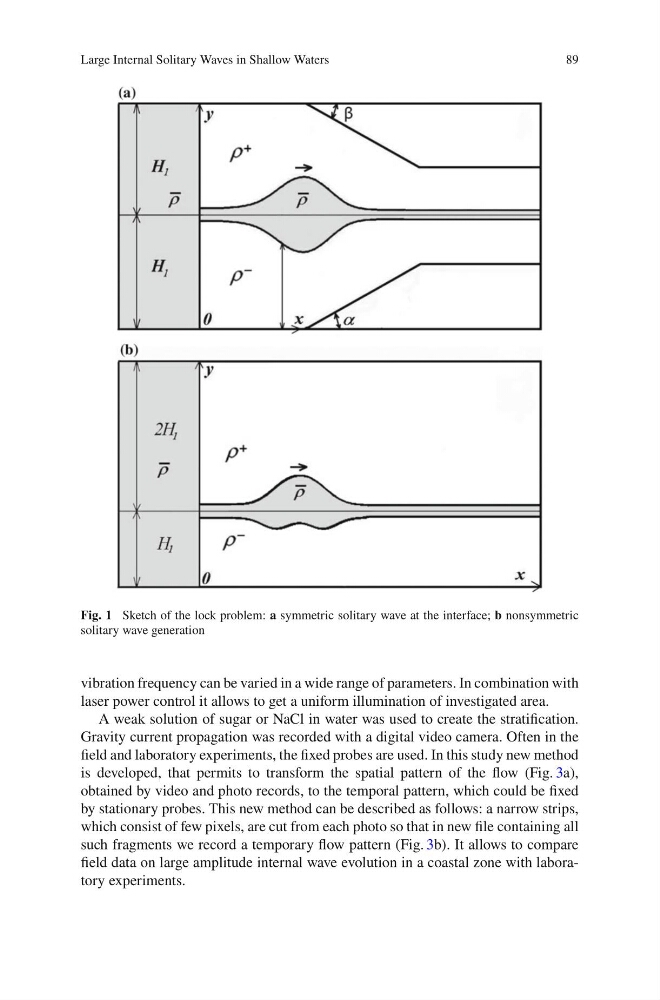
Fig. 1 Sketch of the lock problem: a symmetric solitary wave at the interface; b nonsymmetric
solitary wave generation
vibration frequency can be varied in a wide range of parameters. In combination with
laser power control it allows to get a uniform illumination of investigated area.
A weak solution of sugar or NaCl in water was used to create the stratification.
Gravity current propagation was recorded with a digital video camera. Often in the
field and laboratory experiments, the fixed probes are used. In this study new method
is developed, that permits to transform the spatial pattern of the flow (Fig. 3a),
obtained by video and photo records, to the temporal pattern, which could be fixed
by stationary probes. This new method can be described as follows: a narrow strips,
which consist of few pixels, are cut from each photo so that in new file containing all
such fragments we record a temporary flow pattern (Fig. 3b). It allows to compare
field data on large amplitude internal wave evolution in a coastal zone with laboratory experiments.
89
Fig. 1 Sketch of the lock problem: a symmetric solitary wave at the interface; b nonsymmetric
solitary wave generation
vibration frequency can be varied in a wide range of parameters. In combination with
laser power control it allows to get a uniform illumination of investigated area.
A weak solution of sugar or NaCl in water was used to create the stratification.
Gravity current propagation was recorded with a digital video camera. Often in the
field and laboratory experiments, the fixed probes are used. In this study new method
is developed, that permits to transform the spatial pattern of the flow (Fig. 3a),
obtained by video and photo records, to the temporal pattern, which could be fixed
by stationary probes. This new method can be described as follows: a narrow strips,
which consist of few pixels, are cut from each photo so that in new file containing all
such fragments we record a temporary flow pattern (Fig. 3b). It allows to compare
field data on large amplitude internal wave evolution in a coastal zone with laboratory experiments.