

phase velocities of internal waves; hence, they should be taken into account in the
theoretical model. The model, described in detail in Bondur et al. [11, 12] is based
on the Taylor-Goldstein equations
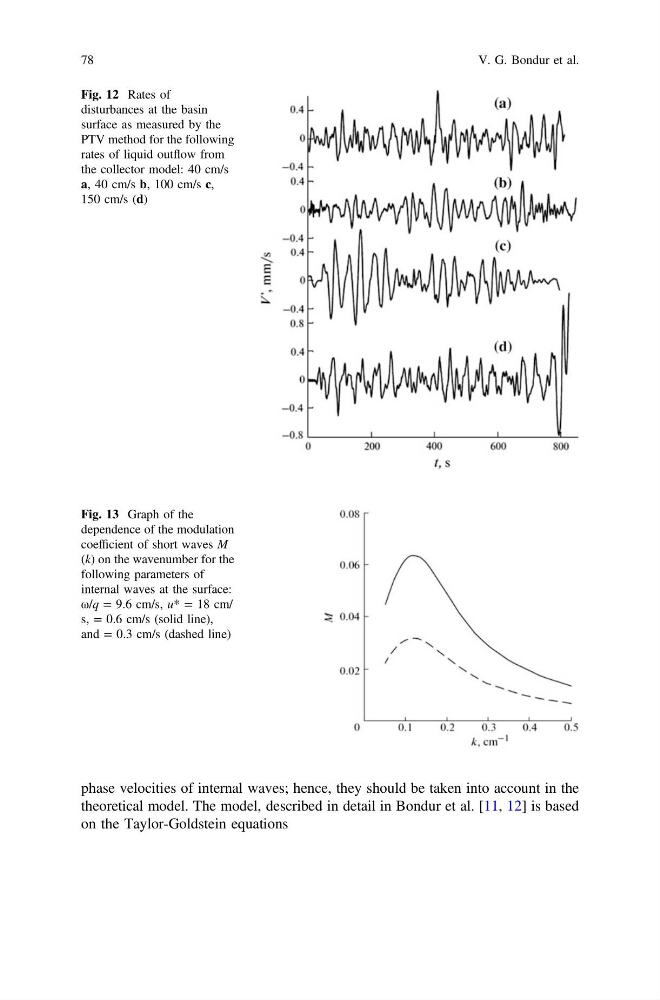
Fig. 12 Rates of
disturbances at the basin
surface as measured by the
PTV method for the following
rates of liquid outflow from
the collector model: 40 cm/s
a, 40 cm/s b, 100 cm/s c,
150 cm/s (d)
Fig. 13 Graph of the
dependence of the modulation
coefficient of short waves M
(k) on the wavenumber for the
following parameters of
internal waves at the surface:
ω/q = 9.6 cm/s, u* = 18 cm/
s, = 0.6 cm/s (solid line),
and = 0.3 cm/s (dashed line)
78
V. G. Bondur et al.
theoretical model. The model, described in detail in Bondur et al. [11, 12] is based
on the Taylor-Goldstein equations
Fig. 12 Rates of
disturbances at the basin
surface as measured by the
PTV method for the following
rates of liquid outflow from
the collector model: 40 cm/s
a, 40 cm/s b, 100 cm/s c,
150 cm/s (d)
Fig. 13 Graph of the
dependence of the modulation
coefficient of short waves M
(k) on the wavenumber for the
following parameters of
internal waves at the surface:
ω/q = 9.6 cm/s, u* = 18 cm/
s, = 0.6 cm/s (solid line),
and = 0.3 cm/s (dashed line)
78
V. G. Bondur et al.