

most efficiently and trapped in the water column. A typical diffuser of a modern
outfall system contains several outlet nozzles allowing generally positively buoyant
effluent to be discharged horizontally into the denser oceanic waters [34]. The
effluent forms turbulent buoyant plumes rising towards the surface. More effective
dilution is achieved by placing the outlet nozzles at a considerable distance from
each other to avoid plume coalescence, since turbulent entrainment by separate
plumes is more effective (e.g., [16]. In addition, stratification of coastal waters is
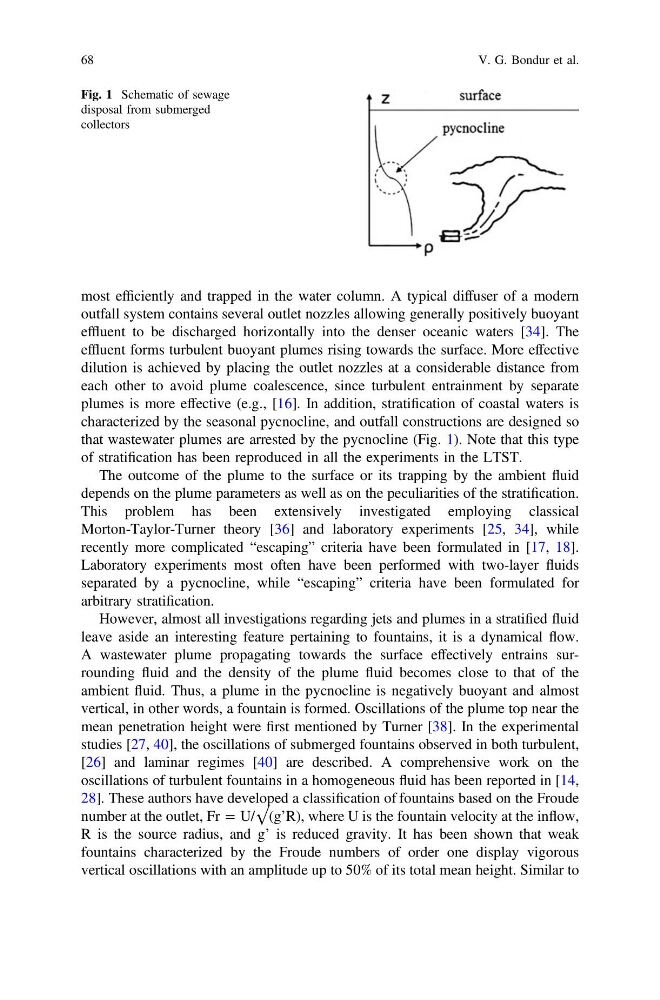
characterized by the seasonal pycnocline, and outfall constructions are designed so
that wastewater plumes are arrested by the pycnocline (Fig. 1). Note that this type
of stratification has been reproduced in all the experiments in the LTST.
The outcome of the plume to the surface or its trapping by the ambient fluid
depends on the plume parameters as well as on the peculiarities of the stratification.
This problem has been extensively investigated employing classical
Morton-Taylor-Turner theory [36] and laboratory experiments [25, 34], while
recently more complicated “escaping” criteria have been formulated in [17, 18].
Laboratory experiments most often have been performed with two-layer fluids
separated by a pycnocline, while “escaping” criteria have been formulated for
arbitrary stratification.
However, almost all investigations regarding jets and plumes in a stratified fluid
leave aside an interesting feature pertaining to fountains, it is a dynamical flow.
A wastewater plume propagating towards the surface effectively entrains surrounding fluid and the density of the plume fluid becomes close to that of the
ambient fluid. Thus, a plume in the pycnocline is negatively buoyant and almost
vertical, in other words, a fountain is formed. Oscillations of the plume top near the
mean penetration height were first mentioned by Turner [38]. In the experimental
studies [27, 40], the oscillations of submerged fountains observed in both turbulent,
[26] and laminar regimes [40] are described. A comprehensive work on the
oscillations of turbulent fountains in a homogeneous fluid has been reported in [14,
28]. These authors have developed a classification of fountains based on the Froude
number at the outlet, Fr = U/√(g’R), where U is the fountain velocity at the inflow,
R is the source radius, and g’ is reduced gravity. It has been shown that weak
fountains characterized by the Froude numbers of order one display vigorous
vertical oscillations with an amplitude up to 50% of its total mean height. Similar to
Fig. 1 Schematic of sewage
disposal from submerged
collectors
68
V. G. Bondur et al.
outfall system contains several outlet nozzles allowing generally positively buoyant
effluent to be discharged horizontally into the denser oceanic waters [34]. The
effluent forms turbulent buoyant plumes rising towards the surface. More effective
dilution is achieved by placing the outlet nozzles at a considerable distance from
each other to avoid plume coalescence, since turbulent entrainment by separate
plumes is more effective (e.g., [16]. In addition, stratification of coastal waters is
characterized by the seasonal pycnocline, and outfall constructions are designed so
that wastewater plumes are arrested by the pycnocline (Fig. 1). Note that this type
of stratification has been reproduced in all the experiments in the LTST.
The outcome of the plume to the surface or its trapping by the ambient fluid
depends on the plume parameters as well as on the peculiarities of the stratification.
This problem has been extensively investigated employing classical
Morton-Taylor-Turner theory [36] and laboratory experiments [25, 34], while
recently more complicated “escaping” criteria have been formulated in [17, 18].
Laboratory experiments most often have been performed with two-layer fluids
separated by a pycnocline, while “escaping” criteria have been formulated for
arbitrary stratification.
However, almost all investigations regarding jets and plumes in a stratified fluid
leave aside an interesting feature pertaining to fountains, it is a dynamical flow.
A wastewater plume propagating towards the surface effectively entrains surrounding fluid and the density of the plume fluid becomes close to that of the
ambient fluid. Thus, a plume in the pycnocline is negatively buoyant and almost
vertical, in other words, a fountain is formed. Oscillations of the plume top near the
mean penetration height were first mentioned by Turner [38]. In the experimental
studies [27, 40], the oscillations of submerged fountains observed in both turbulent,
[26] and laminar regimes [40] are described. A comprehensive work on the
oscillations of turbulent fountains in a homogeneous fluid has been reported in [14,
28]. These authors have developed a classification of fountains based on the Froude
number at the outlet, Fr = U/√(g’R), where U is the fountain velocity at the inflow,
R is the source radius, and g’ is reduced gravity. It has been shown that weak
fountains characterized by the Froude numbers of order one display vigorous
vertical oscillations with an amplitude up to 50% of its total mean height. Similar to
Fig. 1 Schematic of sewage
disposal from submerged
collectors
68
V. G. Bondur et al.