

Internal Solitary Waves in a Layered Weakly Stratified Flow
63
so function Q(s; F 1 , F 2 ) is positive in the vicinity of point s = 0. Therefore, function
D plays determining role here. This function depends on F 1 and F 2 and can change
the sign even at small s, where the leading-order coefficient D 0 from formula (18)
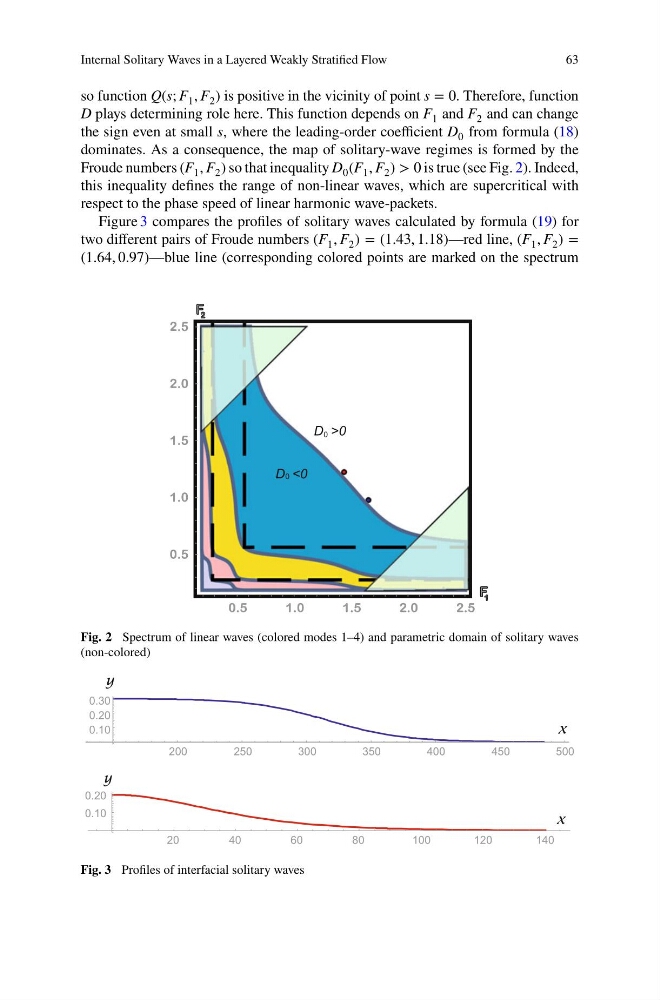
dominates. As a consequence, the map of solitary-wave regimes is formed by the
Froude numbers (F 1 , F 2 ) so that inequality D 0 (F 1 , F 2 ) > 0 is true (see Fig. 2). Indeed,
this inequality defines the range of non-linear waves, which are supercritical with
respect to the phase speed of linear harmonic wave-packets.
Figure 3 compares the profiles of solitary waves calculated by formula (19) for
two different pairs of Froude numbers (F 1 , F 2 ) = (1.43, 1.18)—red line, (F 1 , F 2 ) =
(1.64, 0.97)—blue line (corresponding colored points are marked on the spectrum
0.5
1.0
1.5
2.0
2.5
0.5
1.0
1.5
2.0
2.5
F 2
1
F
0
0
0.5
1.0
1.5
2.0
2.5
0.5
1.0
1.5
2.0
2.5
F 2
1
F
D >0
D <0
Fig. 2 Spectrum of linear waves (colored modes 1–4) and parametric domain of solitary waves
(non-colored)
200
250
300
350
400
450
500
0.10
0.20
0.30
20
40
60
80
100
120
140
0.10
0.20
Fig. 3 Profiles of interfacial solitary waves
63
so function Q(s; F 1 , F 2 ) is positive in the vicinity of point s = 0. Therefore, function
D plays determining role here. This function depends on F 1 and F 2 and can change
the sign even at small s, where the leading-order coefficient D 0 from formula (18)
dominates. As a consequence, the map of solitary-wave regimes is formed by the
Froude numbers (F 1 , F 2 ) so that inequality D 0 (F 1 , F 2 ) > 0 is true (see Fig. 2). Indeed,
this inequality defines the range of non-linear waves, which are supercritical with
respect to the phase speed of linear harmonic wave-packets.
Figure 3 compares the profiles of solitary waves calculated by formula (19) for
two different pairs of Froude numbers (F 1 , F 2 ) = (1.43, 1.18)—red line, (F 1 , F 2 ) =
(1.64, 0.97)—blue line (corresponding colored points are marked on the spectrum
0.5
1.0
1.5
2.0
2.5
0.5
1.0
1.5
2.0
2.5
F 2
1
F
0
0
0.5
1.0
1.5
2.0
2.5
0.5
1.0
1.5
2.0
2.5
F 2
1
F
D >0
D <0
Fig. 2 Spectrum of linear waves (colored modes 1–4) and parametric domain of solitary waves
(non-colored)
200
250
300
350
400
450
500
0.10
0.20
0.30
20
40
60
80
100
120
140
0.10
0.20
Fig. 3 Profiles of interfacial solitary waves