

Internal Solitary Waves in a Layered Weakly Stratified Flow
61
í µí¼
(0)
= ry − rí µí¼
sin í µí»¼ 2 (y)
sin í µí»¼ 2 (í µí¼)
(í µí¼ < y < í µí¼∕r),
where is denoted
í µí»¼ 1 (y) = í µí¼ 1 (í µí¼ + y),
í µí»¼ 2 (y) = í µí¼ 2 (í µí¼ − ry).
The dispersive term í µí¼
(1) is much more complicated, it has the form
í µí¼
(1)
=
í µí¼(í µí¼−y)
2
sin í µí»¼ 1 (y)
sin í µí»¼ 1 (í µí¼)
+
+
sin í µí»¼ 1 (y)
2í µí¼ 1
(
í µí¼
sin í µí»¼ 1 (í µí¼)
)
í µí¼í µí¼
{
(í µí¼ + í µí¼) cot í µí»¼ 1 (í µí¼) − (í µí¼ + y) cot í µí»¼ 1 (y)
}
+
+
í µí¼ 2
6
{
sin í µí¼ 1 (y−í µí¼)−sin í µí»¼ 1 (y)
sin
3
í µí»¼ 1 (í µí¼)
+
1+ sin
2
í µí»¼ 1 (y)
sin
2
í µí»¼ 1 (í µí¼)
−
sin í µí»¼ 1 (y)
sin í µí»¼ 1 (í µí¼)
}
in lower layer, and
í µí¼
(1)
=
r 2 í µí¼(í µí¼−y)
2
sin í µí»¼ 2 (y)
sin í µí»¼ 2 (í µí¼)
+
+
sin í µí»¼ 2 (y)
2í µí¼ 2
(
í µí¼
sin í µí»¼ 2 (í µí¼)
)
í µí¼í µí¼
{
(y − í µí¼∕r) cot í µí»¼ 2 (y) − (í µí¼ − í µí¼∕r) cot í µí»¼ 2 (í µí¼)
}
+
+
r
2
í µí¼
2
6
{
sin í µí¼ 2 r(í µí¼−y)−sin í µí»¼ 2 (y)
sin
3
í µí»¼ 2 (í µí¼)
+
1+ sin
2
í µí»¼ 2 (y)
sin
2
í µí»¼ 2 (í µí¼)
−
sin í µí»¼ 2 (y)
sin í µí»¼ 2 (í µí¼)
}
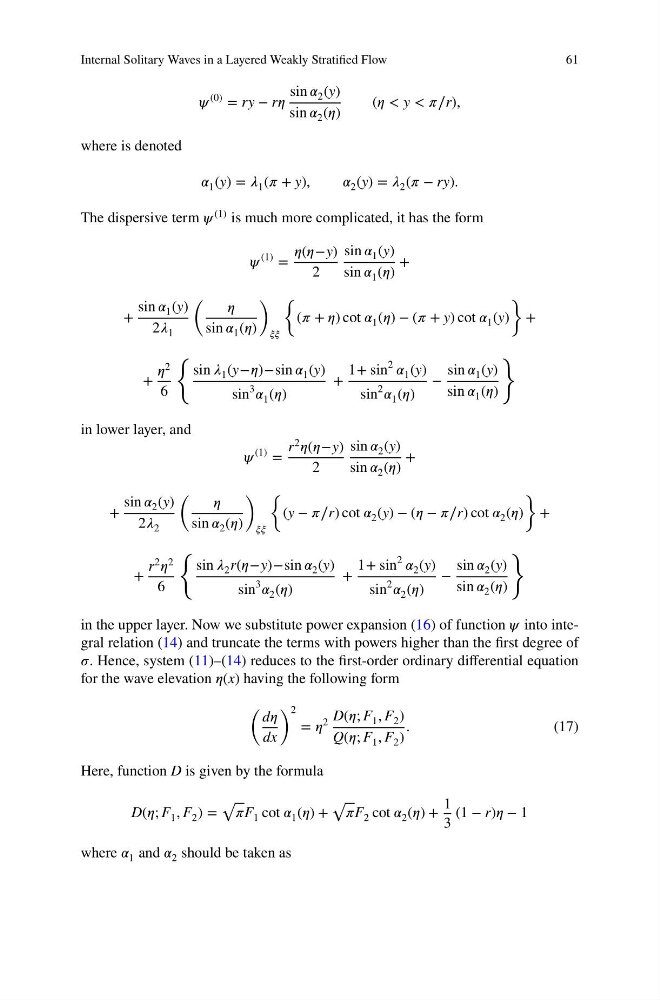
in the upper layer. Now we substitute power expansion (16) of function í µí¼ into integral relation (14) and truncate the terms with powers higher than the first degree of
í µí¼. Hence, system (11)–(14) reduces to the first-order ordinary differential equation
for the wave elevation í µí¼(x) having the following form
(
dí µí¼
dx
) 2
= í µí¼
2 D(í µí¼; F 1 , F 2 )
Q(í µí¼; F 1 , F 2 )
.
(17)
Here, function D is given by the formula
D(í µí¼; F 1 , F 2 ) =
√
í µí¼F 1 cot í µí»¼ 1 (í µí¼) +
√ í µí¼F 2 cot í µí»¼ 2 (í µí¼) +
1
3
(1 − r)í µí¼ − 1
where í µí»¼ 1 and í µí»¼ 2 should be taken as
61
í µí¼
(0)
= ry − rí µí¼
sin í µí»¼ 2 (y)
sin í µí»¼ 2 (í µí¼)
(í µí¼ < y < í µí¼∕r),
where is denoted
í µí»¼ 1 (y) = í µí¼ 1 (í µí¼ + y),
í µí»¼ 2 (y) = í µí¼ 2 (í µí¼ − ry).
The dispersive term í µí¼
(1) is much more complicated, it has the form
í µí¼
(1)
=
í µí¼(í µí¼−y)
2
sin í µí»¼ 1 (y)
sin í µí»¼ 1 (í µí¼)
+
+
sin í µí»¼ 1 (y)
2í µí¼ 1
(
í µí¼
sin í µí»¼ 1 (í µí¼)
)
í µí¼í µí¼
{
(í µí¼ + í µí¼) cot í µí»¼ 1 (í µí¼) − (í µí¼ + y) cot í µí»¼ 1 (y)
}
+
+
í µí¼ 2
6
{
sin í µí¼ 1 (y−í µí¼)−sin í µí»¼ 1 (y)
sin
3
í µí»¼ 1 (í µí¼)
+
1+ sin
2
í µí»¼ 1 (y)
sin
2
í µí»¼ 1 (í µí¼)
−
sin í µí»¼ 1 (y)
sin í µí»¼ 1 (í µí¼)
}
in lower layer, and
í µí¼
(1)
=
r 2 í µí¼(í µí¼−y)
2
sin í µí»¼ 2 (y)
sin í µí»¼ 2 (í µí¼)
+
+
sin í µí»¼ 2 (y)
2í µí¼ 2
(
í µí¼
sin í µí»¼ 2 (í µí¼)
)
í µí¼í µí¼
{
(y − í µí¼∕r) cot í µí»¼ 2 (y) − (í µí¼ − í µí¼∕r) cot í µí»¼ 2 (í µí¼)
}
+
+
r
2
í µí¼
2
6
{
sin í µí¼ 2 r(í µí¼−y)−sin í µí»¼ 2 (y)
sin
3
í µí»¼ 2 (í µí¼)
+
1+ sin
2
í µí»¼ 2 (y)
sin
2
í µí»¼ 2 (í µí¼)
−
sin í µí»¼ 2 (y)
sin í µí»¼ 2 (í µí¼)
}
in the upper layer. Now we substitute power expansion (16) of function í µí¼ into integral relation (14) and truncate the terms with powers higher than the first degree of
í µí¼. Hence, system (11)–(14) reduces to the first-order ordinary differential equation
for the wave elevation í µí¼(x) having the following form
(
dí µí¼
dx
) 2
= í µí¼
2 D(í µí¼; F 1 , F 2 )
Q(í µí¼; F 1 , F 2 )
.
(17)
Here, function D is given by the formula
D(í µí¼; F 1 , F 2 ) =
√
í µí¼F 1 cot í µí»¼ 1 (í µí¼) +
√ í µí¼F 2 cot í µí»¼ 2 (í µí¼) +
1
3
(1 − r)í µí¼ − 1
where í µí»¼ 1 and í µí»¼ 2 should be taken as