

56
N. Makarenko et al.
developed in [1, 10] for continuous stratification. The parametric range of solitary
wave is considered in the framework of the constructed mathematical model. It is
demonstrated that these wave regimes can exist close to the parametric domain of
the Kelvin–Helmholtz instability. Such a marginal stability of long internal waves
could explain the formation mechanism of very long billow trains, which intensify
mixing of the abyssal waters.
Basic Equations
We consider 2D motion of inviscid two-layered fluid, which is weakly stratified due
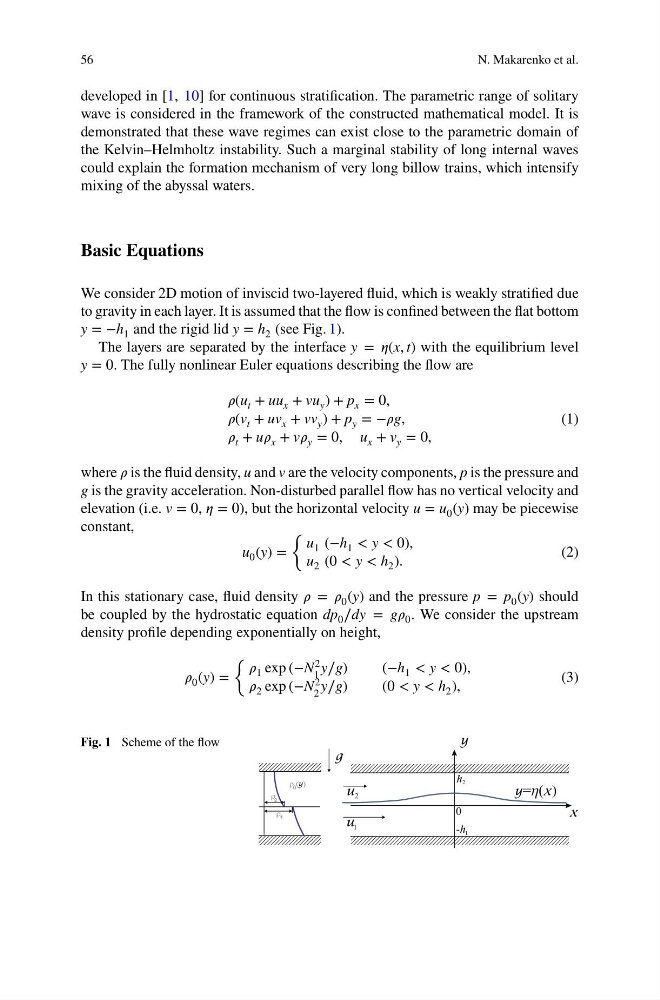
to gravity in each layer. It is assumed that the flow is confined between the flat bottom
y = −h 1 and the rigid lid y = h 2 (see Fig. 1).
The layers are separated by the interface y = í µí¼(x, t) with the equilibrium level
y = 0. The fully nonlinear Euler equations describing the flow are
í µí¼(u t + uu x + vu y ) + p x = 0,
í µí¼(v t + uv x + vv y ) + p y = −í µí¼g,
í µí¼ t + uí µí¼ x + ví µí¼ y = 0, u x + v y = 0,
(1)
where í µí¼ is the fluid density, u and v are the velocity components, p is the pressure and
g is the gravity acceleration. Non-disturbed parallel flow has no vertical velocity and
elevation (i.e. v = 0, í µí¼ = 0), but the horizontal velocity u = u 0 (y) may be piecewise
constant,
u 0 (y) =
{
u 1 (−h 1 < y < 0),
u 2 (0 < y < h 2 ).
(2)
In this stationary case, fluid density í µí¼ = í µí¼ 0 (y) and the pressure p = p 0 (y) should
be coupled by the hydrostatic equation dp 0 ∕dy = gí µí¼ 0 . We consider the upstream
density profile depending exponentially on height,
í µí¼ 0 (y) =
{ í µí¼ 1 exp (−N
2
1
y∕g)
(−h 1 < y < 0),
í µí¼ 2 exp (−N
2
2
y∕g)
(0< y < h 2 ),
(3)
Fig. 1 Scheme of the flow
0
2
2
1
0
- 1
2
1
N. Makarenko et al.
developed in [1, 10] for continuous stratification. The parametric range of solitary
wave is considered in the framework of the constructed mathematical model. It is
demonstrated that these wave regimes can exist close to the parametric domain of
the Kelvin–Helmholtz instability. Such a marginal stability of long internal waves
could explain the formation mechanism of very long billow trains, which intensify
mixing of the abyssal waters.
Basic Equations
We consider 2D motion of inviscid two-layered fluid, which is weakly stratified due
to gravity in each layer. It is assumed that the flow is confined between the flat bottom
y = −h 1 and the rigid lid y = h 2 (see Fig. 1).
The layers are separated by the interface y = í µí¼(x, t) with the equilibrium level
y = 0. The fully nonlinear Euler equations describing the flow are
í µí¼(u t + uu x + vu y ) + p x = 0,
í µí¼(v t + uv x + vv y ) + p y = −í µí¼g,
í µí¼ t + uí µí¼ x + ví µí¼ y = 0, u x + v y = 0,
(1)
where í µí¼ is the fluid density, u and v are the velocity components, p is the pressure and
g is the gravity acceleration. Non-disturbed parallel flow has no vertical velocity and
elevation (i.e. v = 0, í µí¼ = 0), but the horizontal velocity u = u 0 (y) may be piecewise
constant,
u 0 (y) =
{
u 1 (−h 1 < y < 0),
u 2 (0 < y < h 2 ).
(2)
In this stationary case, fluid density í µí¼ = í µí¼ 0 (y) and the pressure p = p 0 (y) should
be coupled by the hydrostatic equation dp 0 ∕dy = gí µí¼ 0 . We consider the upstream
density profile depending exponentially on height,
í µí¼ 0 (y) =
{ í µí¼ 1 exp (−N
2
1
y∕g)
(−h 1 < y < 0),
í µí¼ 2 exp (−N
2
2
y∕g)
(0< y < h 2 ),
(3)
Fig. 1 Scheme of the flow
0
2
2
1
0
- 1
2
1