

manufacturer, the accuracy of temperature registration with the GP5W-Shell thermistors is ±0.25 °C, in a temperature range from −10 to +30 °C.
Model Description
The freezing of water and sub-water sediment layers in the Gulf of Tiksi was
studied by employing the modified one-dimensional thermodynamic model originally proposed by Bogorodskii and Pnyushkov [4] to describe ground freezing over
the Laptev Sea shelf. The applied model simulates the heat and salt transfer
accompanied by phase transitions in a system consisting of a semi-infinite layer of
initially thawed saline bottom soil (subscript “th”) underlying the layer of sea water
(subscript “w”). The formation of ice (subscript “i”) in the water layer is described
by the classical Stefan problem, in which phase transitions are localized at the
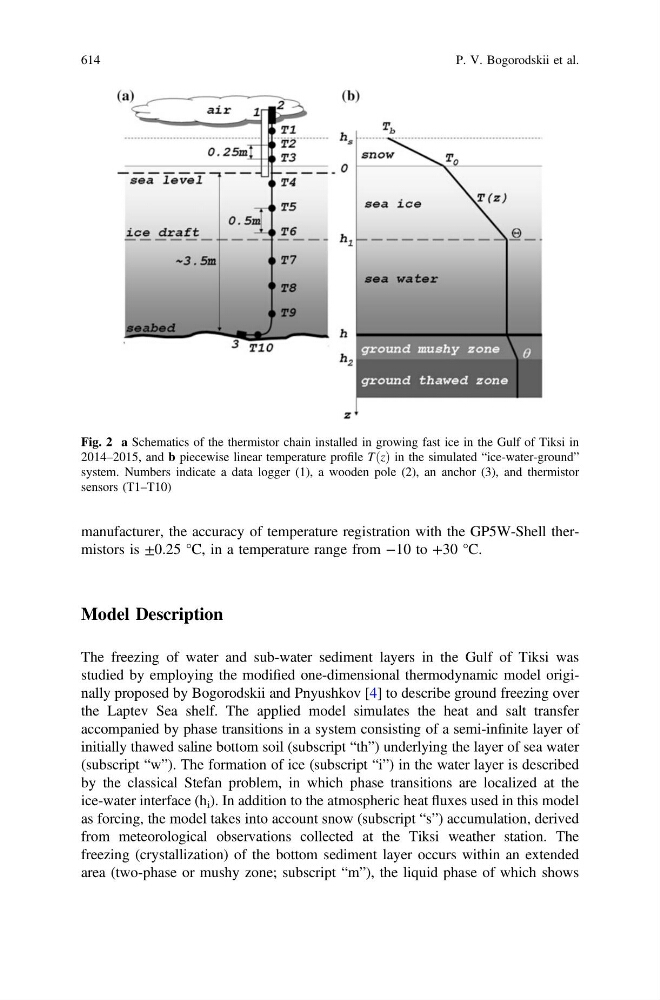
ice-water interface (h i ). In addition to the atmospheric heat fluxes used in this model
as forcing, the model takes into account snow (subscript “s”) accumulation, derived
from meteorological observations collected at the Tiksi weather station. The
freezing (crystallization) of the bottom sediment layer occurs within an extended
area (two-phase or mushy zone; subscript “m”), the liquid phase of which shows
Fig. 2 a Schematics of the thermistor chain installed in growing fast ice in the Gulf of Tiksi in
2014–2015, and b piecewise linear temperature profile TðzÞ in the simulated “ice-water-ground”
system. Numbers indicate a data logger (1), a wooden pole (2), an anchor (3), and thermistor
sensors (T1–T10)
614
P. V. Bogorodskii et al.