

• Compressive strength of sea ice is in the range of 3.6–4.1 MPa and practically
coincides with the indenter pressure (4.0 MPa) given in Table 2. It should be
noted that in the clamped ice beam case we have constrained compression rather
than uniaxial compression.
• The last column of the table contains compressive/flexural strength ratios found
from formulas (3) and (2), respectively. It is seen that in the sea ice this strength
ratio is close to 10, while in the model ice it is about 1.
Ice Failure Diagrams
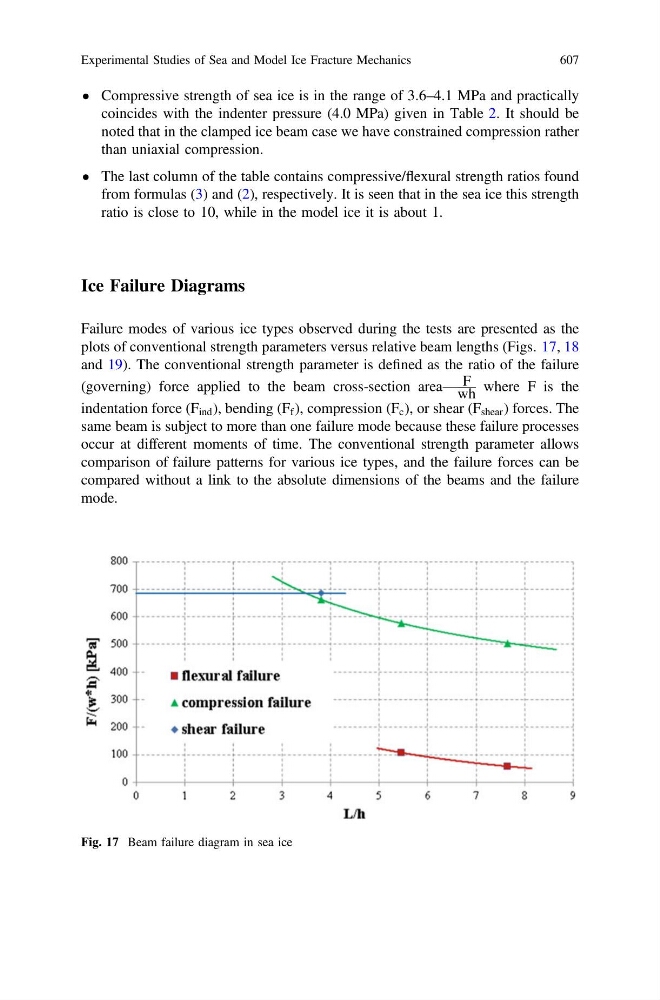
Failure modes of various ice types observed during the tests are presented as the
plots of conventional strength parameters versus relative beam lengths (Figs. 17, 18
and 19). The conventional strength parameter is defined as the ratio of the failure
(governing) force applied to the beam cross-section area— F
wh where F is the
indentation force (F ind ), bending (F f ), compression (F c ), or shear (F shear ) forces. The
same beam is subject to more than one failure mode because these failure processes
occur at different moments of time. The conventional strength parameter allows
comparison of failure patterns for various ice types, and the failure forces can be
compared without a link to the absolute dimensions of the beams and the failure
mode.
Fig. 17 Beam failure diagram in sea ice
Experimental Studies of Sea and Model Ice Fracture Mechanics
607