

4 < L ̸ h < 15, while the width-to-height ratio was 1 < w ̸ h < 2. Some test data and
results of analysis for sea- and fresh-water ice were published earlier by the authors
in Marchenko et al. [8] and in Sakharov et al. [9]. Marchenko et al. [8] give the first
ever description of various beam failure scenarios, while the Sodhi experiment
examined only one failure scenario typical for relatively long beams. The failure
processes of floating fixed-end ice beams are described and analysed in Sakharov
et al. [9], where it is shown how geometrical dimensions of beams influence the
failure pattern in case of seawater and freshwater ice.
Following a series of full-scale loading tests on ice beams with fixed ends, which
showed a range of various failure patterns, it was decided to carry out similar tests
in the model ice in the ice basin and compare the model test results with the field
data.
Physical modeling of structure/ice interaction processes in ice model basins is a
potential tool for studying ice loads on engineering structures. Preparation of model
ice is itself a challenging experimental task [10–14]. Currently there is no technology so far to prepare ideal environment for such experiments, i.e. model ice that
would provide ice failure patterns identical to the full scale field conditions. The
point is that it is not feasible to simultaneously meet similarity the criteria for
different physical and mechanical parameters of ice: flexural strength, compressive
strength, crushing strength, shear strength, elasticity modulus.
The goal of this study is to compare failure patterns of the natural sea ice and two
model ice types both qualitatively and quantitatively. These investigations are based
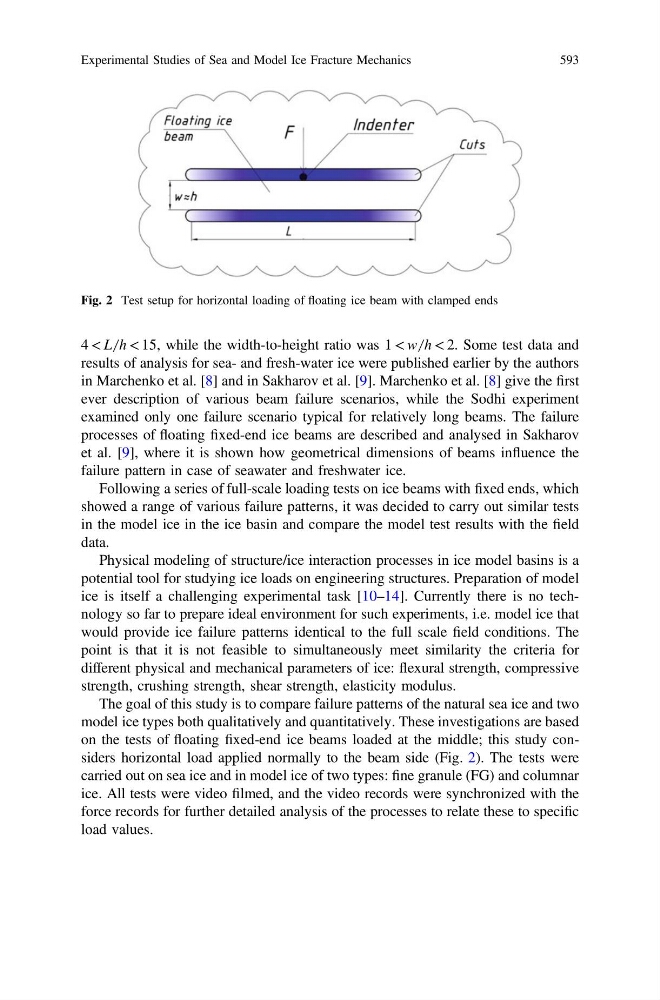
on the tests of floating fixed-end ice beams loaded at the middle; this study considers horizontal load applied normally to the beam side (Fig. 2). The tests were
carried out on sea ice and in model ice of two types: fine granule (FG) and columnar
ice. All tests were video filmed, and the video records were synchronized with the
force records for further detailed analysis of the processes to relate these to specific
load values.
Fig. 2 Test setup for horizontal loading of floating ice beam with clamped ends
Experimental Studies of Sea and Model Ice Fracture Mechanics
593