

dence of its strength on external factors, primarily temperature, salinity, porosity as
well as time history of ice cover formation [1–6].
One of the interesting tests in ice failure mechanism studies is loading of floating
ice beams with fixed ends. The force is applied at mid-length of an ice beam and
normally to its upper or side surface. Such tests provide good insights because the
ice beam behavior under load is governed by the relationships of various ice
strength parameters (flexural, compressive, crushing or shear strength) and the
beam geometry.
The first systematic loading tests on beams with fixed ends were carried out by
Sodhi [7]. These tests were combined with the other experiments, which were
primarily intended for appraisal of ice sheet bearing capacity. The tests were
conducted in an ice basin with freshwater columnar ice. The ice sheet was made by
seeding ice nuclei over water surface at 0 °C, after that the ice cover was grown to
the specified thickness at an ambient temperature of −25 °C. The set-up of Sodhi
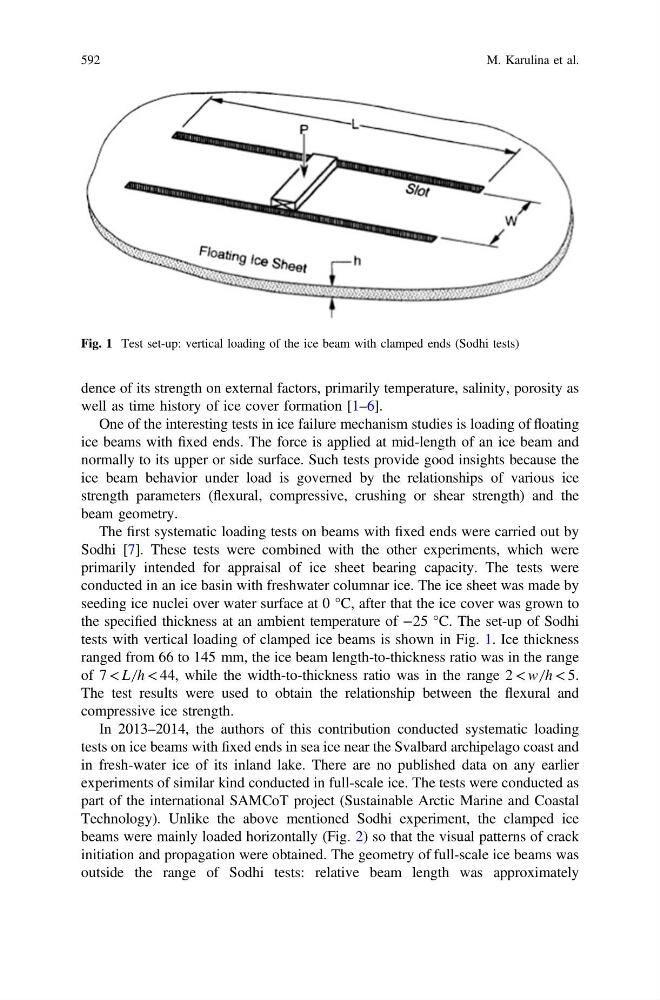
tests with vertical loading of clamped ice beams is shown in Fig. 1. Ice thickness
ranged from 66 to 145 mm, the ice beam length-to-thickness ratio was in the range
of 7 < L ̸ h < 44, while the width-to-thickness ratio was in the range 2 < w ̸ h < 5.
The test results were used to obtain the relationship between the flexural and
compressive ice strength.
In 2013–2014, the authors of this contribution conducted systematic loading
tests on ice beams with fixed ends in sea ice near the Svalbard archipelago coast and
in fresh-water ice of its inland lake. There are no published data on any earlier
experiments of similar kind conducted in full-scale ice. The tests were conducted as
part of the international SAMCoT project (Sustainable Arctic Marine and Coastal
Technology). Unlike the above mentioned Sodhi experiment, the clamped ice
beams were mainly loaded horizontally (Fig. 2) so that the visual patterns of crack
initiation and propagation were obtained. The geometry of full-scale ice beams was
outside the range of Sodhi tests: relative beam length was approximately
Fig. 1 Test set-up: vertical loading of the ice beam with clamped ends (Sodhi tests)
592
M. Karulina et al.