

52
J. Grue
x 1
/h 0
x
2
/h
0
−50
−40
−30
−20
−10
0
10
−25
−20
−15
−10
−5
x 1
/h 0
x
2
/h
0
−50
−40
−30
−20
−10
0
10
−25
−20
−15
−10
−5
x 1 /h 0
x
2
/h
0
−50
−40
−30
−20
−10
0
10
−25
−20
−15
−10
−5
0
−0.5
0
0.5
−0.5
0
0.5
−0.05
0
0.05
(a)
(b)
(c)
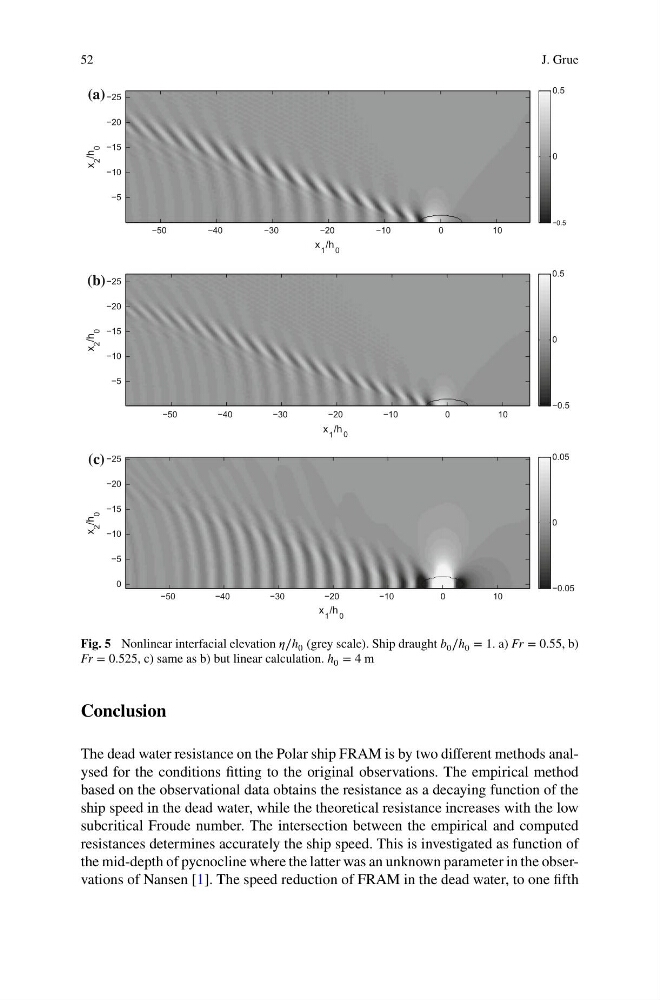
Fig. 5 Nonlinear interfacial elevation í µí¼∕h 0 (grey scale). Ship draught b 0 ∕h 0 = 1. a) Fr = 0.55, b)
Fr = 0.525, c) same as b) but linear calculation. h 0 = 4 m
Conclusion
The dead water resistance on the Polar ship FRAM is by two different methods analysed for the conditions fitting to the original observations. The empirical method
based on the observational data obtains the resistance as a decaying function of the
ship speed in the dead water, while the theoretical resistance increases with the low
subcritical Froude number. The intersection between the empirical and computed
resistances determines accurately the ship speed. This is investigated as function of
the mid-depth of pycnocline where the latter was an unknown parameter in the observations of Nansen [1]. The speed reduction of FRAM in the dead water, to one fifth
J. Grue
x 1
/h 0
x
2
/h
0
−50
−40
−30
−20
−10
0
10
−25
−20
−15
−10
−5
x 1
/h 0
x
2
/h
0
−50
−40
−30
−20
−10
0
10
−25
−20
−15
−10
−5
x 1 /h 0
x
2
/h
0
−50
−40
−30
−20
−10
0
10
−25
−20
−15
−10
−5
0
−0.5
0
0.5
−0.5
0
0.5
−0.05
0
0.05
(a)
(b)
(c)
Fig. 5 Nonlinear interfacial elevation í µí¼∕h 0 (grey scale). Ship draught b 0 ∕h 0 = 1. a) Fr = 0.55, b)
Fr = 0.525, c) same as b) but linear calculation. h 0 = 4 m
Conclusion
The dead water resistance on the Polar ship FRAM is by two different methods analysed for the conditions fitting to the original observations. The empirical method
based on the observational data obtains the resistance as a decaying function of the
ship speed in the dead water, while the theoretical resistance increases with the low
subcritical Froude number. The intersection between the empirical and computed
resistances determines accurately the ship speed. This is investigated as function of
the mid-depth of pycnocline where the latter was an unknown parameter in the observations of Nansen [1]. The speed reduction of FRAM in the dead water, to one fifth