

under-ice boundary layer. This would tend to result in the increased heat flux to the
Arctic sea ice from the warmest Arctic Ocean water masses: Atlantic and Summer
Pacific; hence, a positive climate feedback appears that would melt more ice.
To estimate the energy of internal waves of the Arctic in the years, in which the
extent of ice clearly decreased and the records of low extent followed one by one, a
series of measurements with the use of ice tethered CTD (ConductivityTemperature-Depth) instruments has been carried out in April of 2007, 2009,
2010, and 2012. The estimates are compared in this research with the estimates of
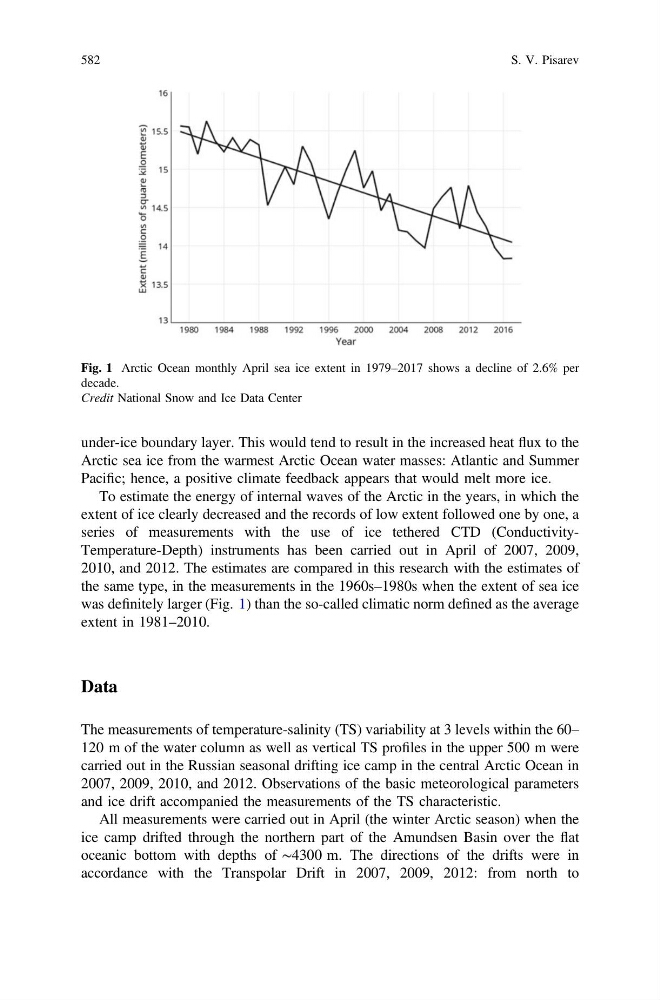
the same type, in the measurements in the 1960s–1980s when the extent of sea ice
was definitely larger (Fig. 1) than the so-called climatic norm defined as the average
extent in 1981–2010.
Data
The measurements of temperature-salinity (TS) variability at 3 levels within the 60–
120 m of the water column as well as vertical TS profiles in the upper 500 m were
carried out in the Russian seasonal drifting ice camp in the central Arctic Ocean in
2007, 2009, 2010, and 2012. Observations of the basic meteorological parameters
and ice drift accompanied the measurements of the TS characteristic.
All measurements were carried out in April (the winter Arctic season) when the
ice camp drifted through the northern part of the Amundsen Basin over the flat
oceanic bottom with depths of ∼4300 m. The directions of the drifts were in
accordance with the Transpolar Drift in 2007, 2009, 2012: from north to
Fig. 1 Arctic Ocean monthly April sea ice extent in 1979–2017 shows a decline of 2.6% per
decade.
Credit National Snow and Ice Data Center
582
S. V. Pisarev