

The typical frequencies/periods of the modeled waves can be estimated from
their amplitude spectrum shown in Fig. 7. The most pronounced components of the
wave field are localized in space by the semidiurnal baroclinic motions of the period
T M 2 , and waves with multiple frequencies ω = 2 ω M 2 , 3 ω M 2 , etc. The amplitudes of
the spectral peaks of the second and third harmonics are of the order of half of the
first harmonic amplitude. The higher harmonics are still visible, but their spectral
peaks are much lower and narrower.
Within the context of the linear non-hydrostatic model (e.g., [20]) the oscillatory
flow over an uneven bottom produces resonant baroclinic motions of frequency ω,
when condition α ≤ γ is satisfied for inclination α of the characteristic lines of the
hyperbolic wave equation
α
2
ðzÞ =
ω
2
− f
2
N 2 ðzÞ − ω 2
and slope γ of the bottom relief γ = dH/dx. We analyzed this condition for
ω = 2ω M2 in our model setup (H(x) given by (1) and N(z) shown in Fig. 3) and
selected intervals of horizontal coordinate x, where α ≤ γ. These ‘supercritical’
regions, where the motion is essentially baroclinic in the entire water column, and
radiated waves can propagate, creating wave “beams” are marked by red circles on
the bottom profile in Fig. 8. Though we solve a nonlinear problem, it is clearly seen
that the regions selected with the use of linear criterion α ≤ γ, perfectly correlate
with the locations of the strongest density perturbations shown in the left column in
Fig. 4. Rotation suppresses the generation of IWs at high latitudes; therefore, the
amplitude of radiated waves rapidly decreases.
Vlasenko et al. [19] suggest another classification of the processes of IW generation based on the magnitude of the Froude number Fr = u max /c. Here, u max is the
maximal velocity of the barotropic tidal flow in the x-cross-section (u max = V T H
(x 0 )/H(x)) and c is the phase speed of the long lowest-mode IWs. In the
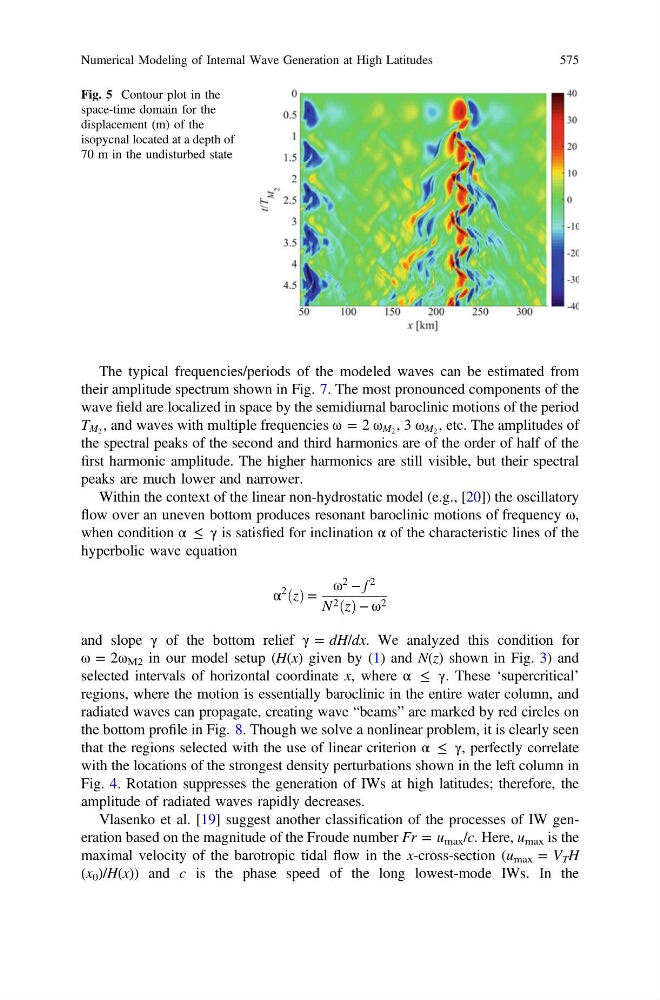
Fig. 5 Contour plot in the
space-time domain for the
displacement (m) of the
isopycnal located at a depth of
70 m in the undisturbed state
Numerical Modeling of Internal Wave Generation at High Latitudes
575