

2P
*
3
dh
dx
= ρ i fhv y ,
2P
*
3
ffiffiffiffiffi
3γ
p
dh
dx
= δρ w C w v
2
y ,
ð8Þ
−
2P
*
3
dh
dr
= ρ i fhv θ ,
2P
*
3
ffiffiffiffiffi
3γ
p
dh
dr
+
2h
r
= − δρ w C w v
2
θ ,
ð9Þ
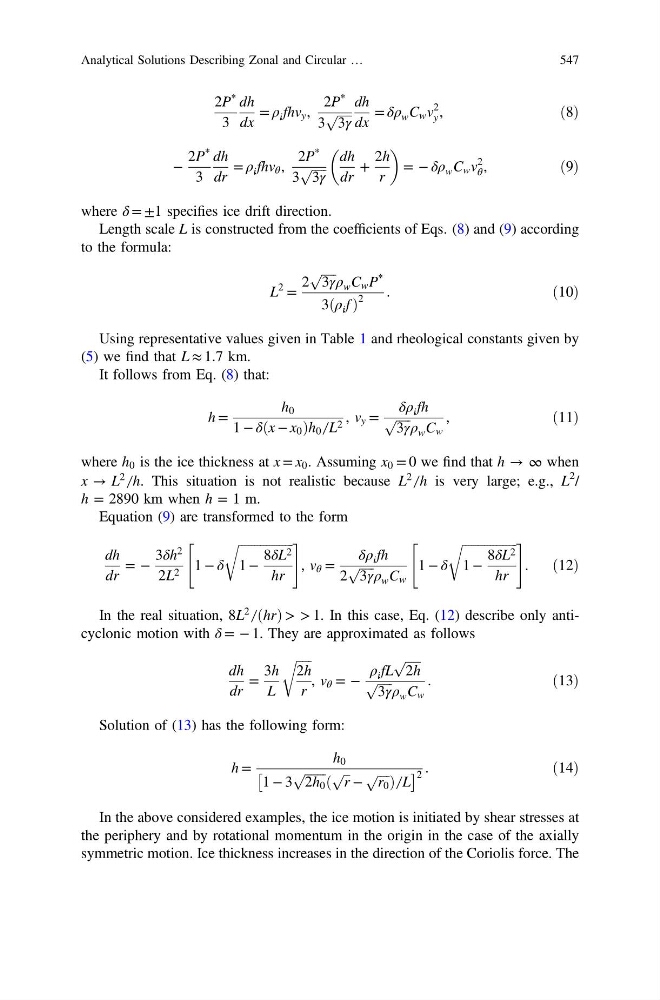
where δ = ±1 specifies ice drift direction.
Length scale L is constructed from the coefficients of Eqs. (8) and (9) according
to the formula:
L
2 =
2
ffiffiffiffiffi
3γ
p ρ w C w P
*
3ðρ i f Þ
2
.
ð10Þ
Using representative values given in Table 1 and rheological constants given by
(5) we find that L ≈ 1.7 km.
It follows from Eq. (8) that:
h =
h 0
1 − δðx − x 0 Þh 0 ̸ L 2 , v y =
δρ i fh
ffiffiffiffiffi
3γ
p ρ w C w
,
ð11Þ
where h 0 is the ice thickness at x = x 0 . Assuming x 0 = 0 we find that h → ∞ when
x → L
2
̸ h. This situation is not realistic because L
2
̸ h is very large; e.g., L
2 /
h = 2890 km when h = 1 m.
Equation (9) are transformed to the form
dh
dr
= −
3δh
2
2L 2 1 − δ
ffiffiffiffiffiffiffiffiffiffiffiffiffiffiffiffiffi ffi
1 −
8δL 2
hr
r
"
#
, v θ =
δρ i fh
2
ffiffiffiffiffi
3γ
p ρ w C w
1 − δ
ffiffiffiffiffiffiffiffiffiffiffiffiffiffiffiffiffi ffi
1 −
8δL 2
hr
r
"
#
.
ð12Þ
In the real situation, 8L
2
̸ ðhrÞ > > 1. In this case, Eq. (12) describe only anticyclonic motion with δ = − 1. They are approximated as follows
dh
dr
=
3h
L
ffiffiffiffiffi
2h
r
r
, v θ = −
ρ i fL
ffiffiffiffiffi
2h
p
ffiffiffiffiffi
3γ
p ρ w C w
.
ð13Þ
Solution of (13) has the following form:
h =
h 0
1 − 3
ffiffiffiffiffiffiffi
2h 0
p ð
ffiffi
r
p −
ffiffiffiffi
r 0
p Þ ̸ L
Â
à 2 .
ð14Þ
In the above considered examples, the ice motion is initiated by shear stresses at
the periphery and by rotational momentum in the origin in the case of the axially
symmetric motion. Ice thickness increases in the direction of the Coriolis force. The
Analytical Solutions Describing Zonal and Circular …
547
*
3
dh
dx
= ρ i fhv y ,
2P
*
3
ffiffiffiffiffi
3γ
p
dh
dx
= δρ w C w v
2
y ,
ð8Þ
−
2P
*
3
dh
dr
= ρ i fhv θ ,
2P
*
3
ffiffiffiffiffi
3γ
p
dh
dr
+
2h
r
= − δρ w C w v
2
θ ,
ð9Þ
where δ = ±1 specifies ice drift direction.
Length scale L is constructed from the coefficients of Eqs. (8) and (9) according
to the formula:
L
2 =
2
ffiffiffiffiffi
3γ
p ρ w C w P
*
3ðρ i f Þ
2
.
ð10Þ
Using representative values given in Table 1 and rheological constants given by
(5) we find that L ≈ 1.7 km.
It follows from Eq. (8) that:
h =
h 0
1 − δðx − x 0 Þh 0 ̸ L 2 , v y =
δρ i fh
ffiffiffiffiffi
3γ
p ρ w C w
,
ð11Þ
where h 0 is the ice thickness at x = x 0 . Assuming x 0 = 0 we find that h → ∞ when
x → L
2
̸ h. This situation is not realistic because L
2
̸ h is very large; e.g., L
2 /
h = 2890 km when h = 1 m.
Equation (9) are transformed to the form
dh
dr
= −
3δh
2
2L 2 1 − δ
ffiffiffiffiffiffiffiffiffiffiffiffiffiffiffiffiffi ffi
1 −
8δL 2
hr
r
"
#
, v θ =
δρ i fh
2
ffiffiffiffiffi
3γ
p ρ w C w
1 − δ
ffiffiffiffiffiffiffiffiffiffiffiffiffiffiffiffiffi ffi
1 −
8δL 2
hr
r
"
#
.
ð12Þ
In the real situation, 8L
2
̸ ðhrÞ > > 1. In this case, Eq. (12) describe only anticyclonic motion with δ = − 1. They are approximated as follows
dh
dr
=
3h
L
ffiffiffiffiffi
2h
r
r
, v θ = −
ρ i fL
ffiffiffiffiffi
2h
p
ffiffiffiffiffi
3γ
p ρ w C w
.
ð13Þ
Solution of (13) has the following form:
h =
h 0
1 − 3
ffiffiffiffiffiffiffi
2h 0
p ð
ffiffi
r
p −
ffiffiffiffi
r 0
p Þ ̸ L
Â
à 2 .
ð14Þ
In the above considered examples, the ice motion is initiated by shear stresses at
the periphery and by rotational momentum in the origin in the case of the axially
symmetric motion. Ice thickness increases in the direction of the Coriolis force. The
Analytical Solutions Describing Zonal and Circular …
547