

that these faults are formed when local cyclone is in the region (Fig. 4). The faults
are not perfectly of the round shape, but their fragments have circular or elliptic
shapes. The radius of the faults is estimated at approximately 500 km. The centres
of the circles or ellipses are around the centre of the cyclone. Figure 5 shows the
development of the circular faults over 49 days from the end of March to the
beginning of May, 2016. It shows stability and spatial localization of the faults.
Model Equations
One dimensional steady motion of solid drift ice with 100% surface concentration is
considered in the plane and axially symmetric cases. The motion can be caused by
ice stresses, wind and sea surface tilt. It is assumed that ice velocity is perpendicular
to the spatial direction where the ice characteristics (thickness, stresses, and
velocity) and the drag forces are changed. It means that pure shear motion of drift
ice is considered. In this case the equation of mass balance is satisfied. The
momentum balance equations are written as follows:
dσ xx
dx
= ρ i hð − fv y + gη x Þ − F x ,
dσ xy
dx
= − F y ,
ð1Þ
dσ rr
dr
+
σ rr − σ θθ
r
= ρ i hðfv θ + gη r Þ − F r ,
dσ rθ
dr
+
2σ rθ
r
= − F θ .
ð2Þ
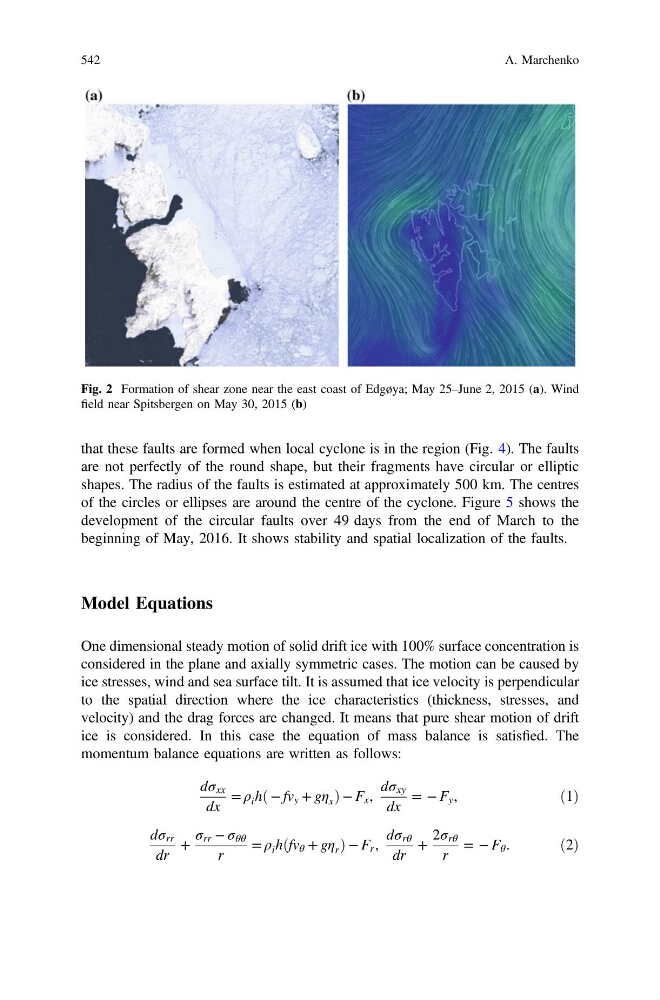
Fig. 2 Formation of shear zone near the east coast of Edgøya; May 25–June 2, 2015 (a). Wind
field near Spitsbergen on May 30, 2015 (b)
542
A. Marchenko
are not perfectly of the round shape, but their fragments have circular or elliptic
shapes. The radius of the faults is estimated at approximately 500 km. The centres
of the circles or ellipses are around the centre of the cyclone. Figure 5 shows the
development of the circular faults over 49 days from the end of March to the
beginning of May, 2016. It shows stability and spatial localization of the faults.
Model Equations
One dimensional steady motion of solid drift ice with 100% surface concentration is
considered in the plane and axially symmetric cases. The motion can be caused by
ice stresses, wind and sea surface tilt. It is assumed that ice velocity is perpendicular
to the spatial direction where the ice characteristics (thickness, stresses, and
velocity) and the drag forces are changed. It means that pure shear motion of drift
ice is considered. In this case the equation of mass balance is satisfied. The
momentum balance equations are written as follows:
dσ xx
dx
= ρ i hð − fv y + gη x Þ − F x ,
dσ xy
dx
= − F y ,
ð1Þ
dσ rr
dr
+
σ rr − σ θθ
r
= ρ i hðfv θ + gη r Þ − F r ,
dσ rθ
dr
+
2σ rθ
r
= − F θ .
ð2Þ
Fig. 2 Formation of shear zone near the east coast of Edgøya; May 25–June 2, 2015 (a). Wind
field near Spitsbergen on May 30, 2015 (b)
542
A. Marchenko