

methods of local reconstruction of the velocity field. More sophisticated global
interpolation methods use linear combinations of radial velocities at all measurement points in conjunction with additional kinematic and/or dynamical constraints
to reconstruct the entire velocity field (e.g., [11, 33, 34]).
The Open-boundary Mode Analysis (OMA) method of Kaplan and Lekien [11]
performs an expansion of the interpolated velocity field in the eigenfunctions of the
2D Laplacian operator in the interior of the domain with the additional control at the
open boundaries by the eigenfunctions of the 1D Lapalcian.
Yaremchuk and Sentchev [33] proposed a more general and versatile 2D variational method of interpolation (2dVar) based on the direct minimization of the cost
function with respect to the interpolated velocity field v(x). Apart from attracting
v to the available observations, the cost function penalizes high-frequency components of the curl and divergence of v(x). This feature can help to overcome some
limitations related to a lack of data. Additional smoothness of the interpolated field
is enforced by penalizing the squared Laplacian of velocity, thus providing the
algorithm with flexibility and efficient noise control. Kinematic constraints (zero
flux on rigid boundary) incorporated into 2dVar, appear particularly useful in
regions complicated topography. Yaremchuk and Sentchev [34] also developed a
gap-filling technique for HFR observations based on the EOF analysis of the
observational errors. In the subsequent presentation, the 2dVar interpolation scheme
developed by the authors was used for the reconstructing the velocity fields.
HFR observations in the English Channel In this section, we describe applications
of the long-term monitoring technique by HFRs in two regions where implementation of traditional in situ observational platforms is difficult due to extremely
strong tidal currents or due to busy shipping traffic, economic and environmental
constraints.
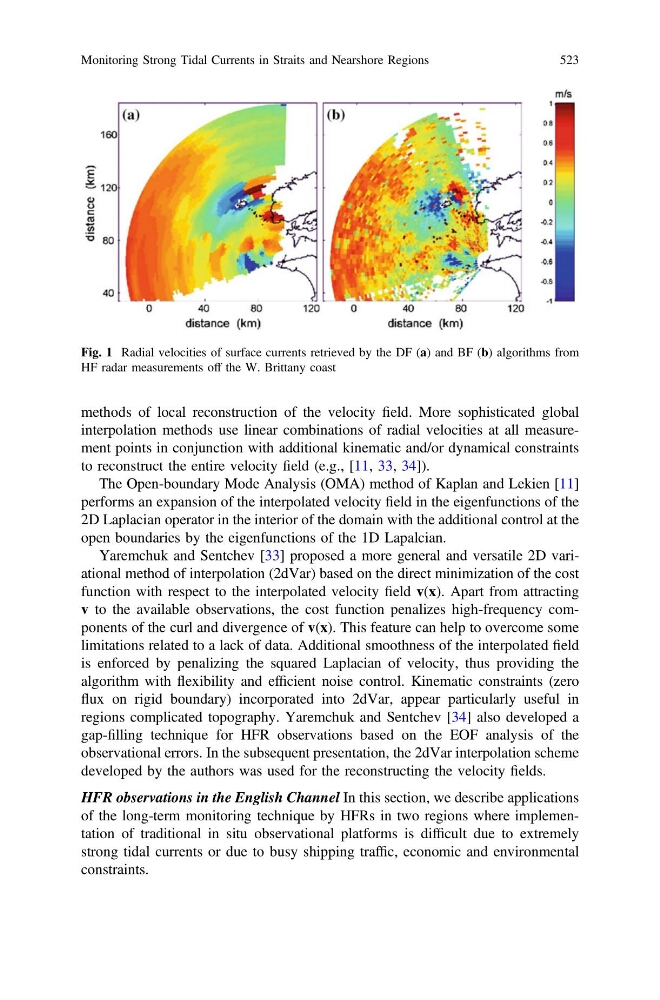
Fig. 1 Radial velocities of surface currents retrieved by the DF (a) and BF (b) algorithms from
HF radar measurements off the W. Brittany coast
Monitoring Strong Tidal Currents in Straits and Nearshore Regions
523
interpolation methods use linear combinations of radial velocities at all measurement points in conjunction with additional kinematic and/or dynamical constraints
to reconstruct the entire velocity field (e.g., [11, 33, 34]).
The Open-boundary Mode Analysis (OMA) method of Kaplan and Lekien [11]
performs an expansion of the interpolated velocity field in the eigenfunctions of the
2D Laplacian operator in the interior of the domain with the additional control at the
open boundaries by the eigenfunctions of the 1D Lapalcian.
Yaremchuk and Sentchev [33] proposed a more general and versatile 2D variational method of interpolation (2dVar) based on the direct minimization of the cost
function with respect to the interpolated velocity field v(x). Apart from attracting
v to the available observations, the cost function penalizes high-frequency components of the curl and divergence of v(x). This feature can help to overcome some
limitations related to a lack of data. Additional smoothness of the interpolated field
is enforced by penalizing the squared Laplacian of velocity, thus providing the
algorithm with flexibility and efficient noise control. Kinematic constraints (zero
flux on rigid boundary) incorporated into 2dVar, appear particularly useful in
regions complicated topography. Yaremchuk and Sentchev [34] also developed a
gap-filling technique for HFR observations based on the EOF analysis of the
observational errors. In the subsequent presentation, the 2dVar interpolation scheme
developed by the authors was used for the reconstructing the velocity fields.
HFR observations in the English Channel In this section, we describe applications
of the long-term monitoring technique by HFRs in two regions where implementation of traditional in situ observational platforms is difficult due to extremely
strong tidal currents or due to busy shipping traffic, economic and environmental
constraints.
Fig. 1 Radial velocities of surface currents retrieved by the DF (a) and BF (b) algorithms from
HF radar measurements off the W. Brittany coast
Monitoring Strong Tidal Currents in Straits and Nearshore Regions
523