

velocities at these stations varied from 15 to 30 cm/s. The bottom potential temperatures ranged from 0.18 to 0.33 °C. The current turns to the east at 32° 00′–32°
30′ S and flows along the northern boundary of the Argentine Basin. Part of these
waters can flow back to the Vema Channel.
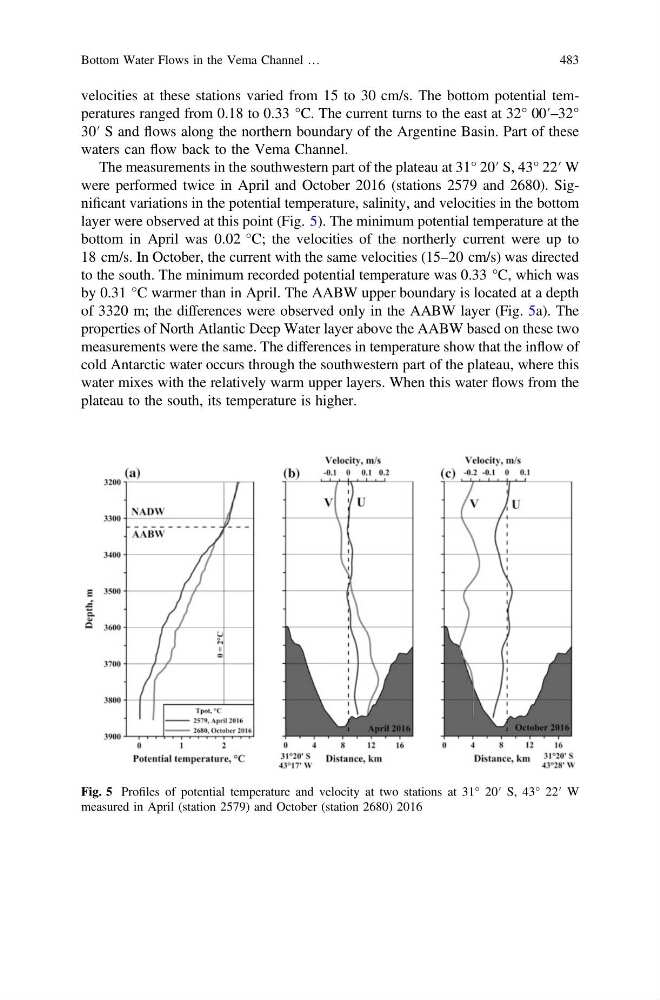
The measurements in the southwestern part of the plateau at 31° 20′ S, 43° 22′ W
were performed twice in April and October 2016 (stations 2579 and 2680). Significant variations in the potential temperature, salinity, and velocities in the bottom
layer were observed at this point (Fig. 5). The minimum potential temperature at the
bottom in April was 0.02 °C; the velocities of the northerly current were up to
18 cm/s. In October, the current with the same velocities (15–20 cm/s) was directed
to the south. The minimum recorded potential temperature was 0.33 °C, which was
by 0.31 °C warmer than in April. The AABW upper boundary is located at a depth
of 3320 m; the differences were observed only in the AABW layer (Fig. 5a). The
properties of North Atlantic Deep Water layer above the AABW based on these two
measurements were the same. The differences in temperature show that the inflow of
cold Antarctic water occurs through the southwestern part of the plateau, where this
water mixes with the relatively warm upper layers. When this water flows from the
plateau to the south, its temperature is higher.
Fig. 5 Profiles of potential temperature and velocity at two stations at 31° 20′ S, 43° 22′ W
measured in April (station 2579) and October (station 2680) 2016
Bottom Water Flows in the Vema Channel …
483
30′ S and flows along the northern boundary of the Argentine Basin. Part of these
waters can flow back to the Vema Channel.
The measurements in the southwestern part of the plateau at 31° 20′ S, 43° 22′ W
were performed twice in April and October 2016 (stations 2579 and 2680). Significant variations in the potential temperature, salinity, and velocities in the bottom
layer were observed at this point (Fig. 5). The minimum potential temperature at the
bottom in April was 0.02 °C; the velocities of the northerly current were up to
18 cm/s. In October, the current with the same velocities (15–20 cm/s) was directed
to the south. The minimum recorded potential temperature was 0.33 °C, which was
by 0.31 °C warmer than in April. The AABW upper boundary is located at a depth
of 3320 m; the differences were observed only in the AABW layer (Fig. 5a). The
properties of North Atlantic Deep Water layer above the AABW based on these two
measurements were the same. The differences in temperature show that the inflow of
cold Antarctic water occurs through the southwestern part of the plateau, where this
water mixes with the relatively warm upper layers. When this water flows from the
plateau to the south, its temperature is higher.
Fig. 5 Profiles of potential temperature and velocity at two stations at 31° 20′ S, 43° 22′ W
measured in April (station 2579) and October (station 2680) 2016
Bottom Water Flows in the Vema Channel …
483