

Conclusions
In the field survey conducted in May 2015 on the eastern shelf of the Crimea
Peninsula in the Black Sea, it was observed that stratification of the water column
was largely controlled by wind-driven dynamics of buoyant surface plume originating from the discharges of the Sea of Azov water through the Kerch Strait.
Further, it was observed that the cross-shore components of the current velocity in
the surface and bottom layers were strongly anti-correlated during the periods of
stratification, but completely uncorrelated during the periods when stratification
relaxed. This suggests that the buoyant discharges from the Kerch Strait may
enhance wind-driven currents responsible for cross-shelf exchanges. To verify this
hypothesis, we developed two idealized semi-analytical 2D models of wind-driven
flow on the Crimean shelf, aimed to simulate the effect of damping vertical mixing
on the cross-shelf transport. One model represented the two-layered stratification,
and the other one continuous stratification with turbulent viscosity linearly
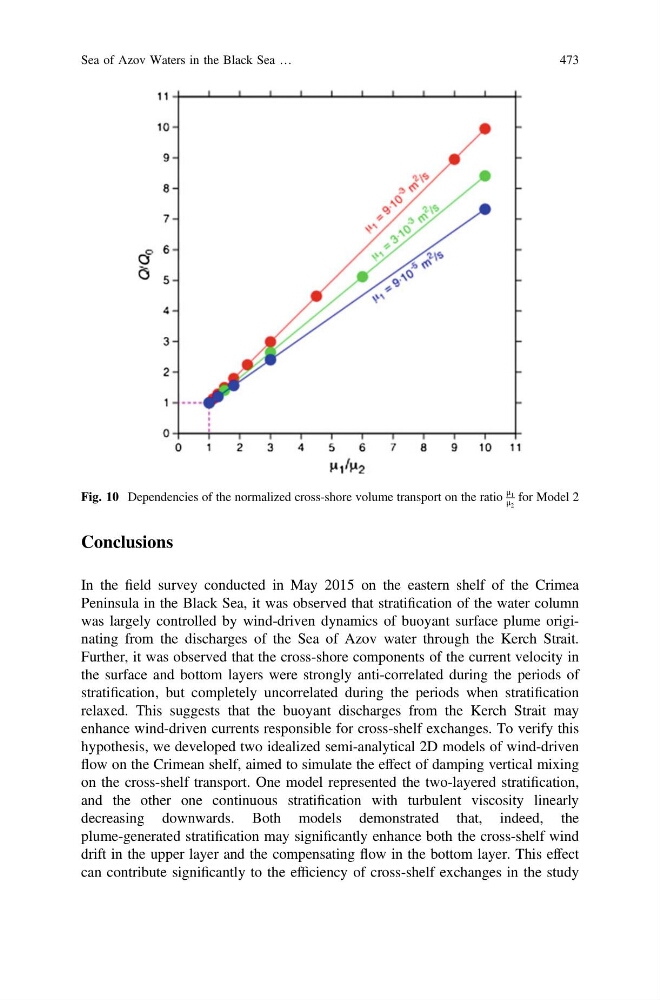
decreasing downwards. Both models demonstrated that, indeed, the
plume-generated stratification may significantly enhance both the cross-shelf wind
drift in the upper layer and the compensating flow in the bottom layer. This effect
can contribute significantly to the efficiency of cross-shelf exchanges in the study
Fig. 10 Dependencies of the normalized cross-shore volume transport on the ratio
μ 1
μ 2
for Model 2
Sea of Azov Waters in the Black Sea …
473
In the field survey conducted in May 2015 on the eastern shelf of the Crimea
Peninsula in the Black Sea, it was observed that stratification of the water column
was largely controlled by wind-driven dynamics of buoyant surface plume originating from the discharges of the Sea of Azov water through the Kerch Strait.
Further, it was observed that the cross-shore components of the current velocity in
the surface and bottom layers were strongly anti-correlated during the periods of
stratification, but completely uncorrelated during the periods when stratification
relaxed. This suggests that the buoyant discharges from the Kerch Strait may
enhance wind-driven currents responsible for cross-shelf exchanges. To verify this
hypothesis, we developed two idealized semi-analytical 2D models of wind-driven
flow on the Crimean shelf, aimed to simulate the effect of damping vertical mixing
on the cross-shelf transport. One model represented the two-layered stratification,
and the other one continuous stratification with turbulent viscosity linearly
decreasing downwards. Both models demonstrated that, indeed, the
plume-generated stratification may significantly enhance both the cross-shelf wind
drift in the upper layer and the compensating flow in the bottom layer. This effect
can contribute significantly to the efficiency of cross-shelf exchanges in the study
Fig. 10 Dependencies of the normalized cross-shore volume transport on the ratio
μ 1
μ 2
for Model 2
Sea of Azov Waters in the Black Sea …
473