

the model values at the time step preceding to assimilation. The procedure of the
definition of covariance matrix Q was the following: ensemble statistics from the
spin up run was taken at the observational points and calculation was done
according to its formula. Matrix R for temperature was set at 0.1 for salinity 0.01 on
the diagonal and zero at the other positions.
Figure 5 demonstrates the difference between the model and reference experiments after and before assimilation at the sea surface for temperature (Fig. 5a) and
salinity (Fig. 5b). It is seen that the main difference in both figures is concentrated
in the Guinea Gulf, where the pattern has an ellipsoidal shape in the southern
direction. The difference is mostly negative for temperature except two pronounced
spots in the western part of the gulf, which appeared due to the occurrence of the
local eddies with negative vorticity. This means that the model mostly overestimates the reality. It is reasonable that salinity pattern has an opposite structure,
since the total density energy balance must be conserved. The difference along track
in Fig. 5a is weakly manifested, and almost disappears in Fig. 5b. This can be
explained due to the relatively weak observed difference at these points and due to
the fact that the covariance mostly facilitates the propagation of the signal along the
track because of the equatorial current.
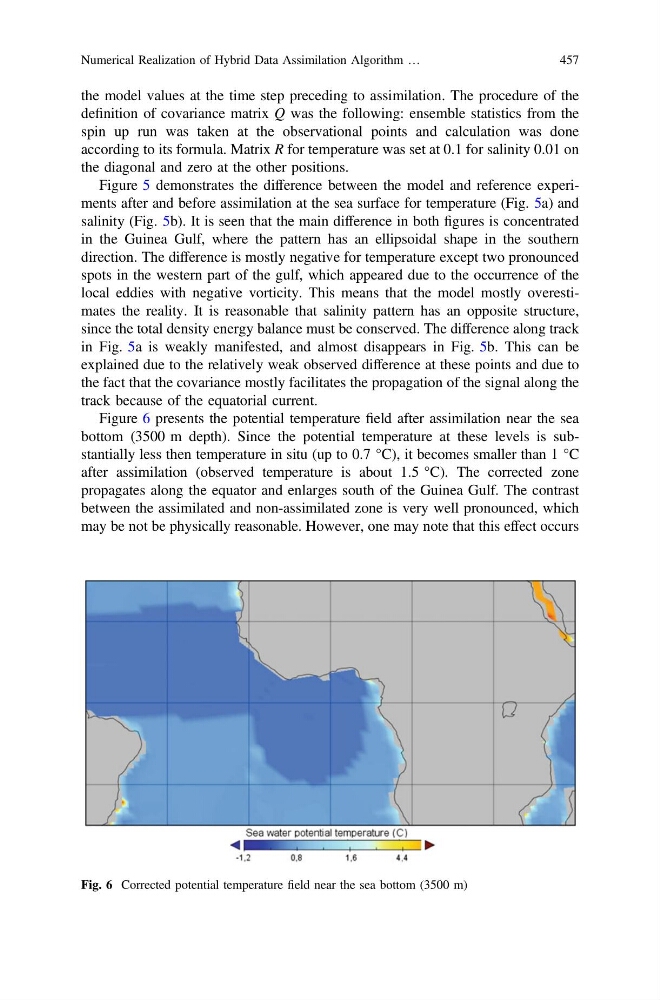
Figure 6 presents the potential temperature field after assimilation near the sea
bottom (3500 m depth). Since the potential temperature at these levels is substantially less then temperature in situ (up to 0.7 °C), it becomes smaller than 1 °C
after assimilation (observed temperature is about 1.5 °C). The corrected zone
propagates along the equator and enlarges south of the Guinea Gulf. The contrast
between the assimilated and non-assimilated zone is very well pronounced, which
may be not be physically reasonable. However, one may note that this effect occurs
Fig. 6 Corrected potential temperature field near the sea bottom (3500 m)
Numerical Realization of Hybrid Data Assimilation Algorithm …
457
definition of covariance matrix Q was the following: ensemble statistics from the
spin up run was taken at the observational points and calculation was done
according to its formula. Matrix R for temperature was set at 0.1 for salinity 0.01 on
the diagonal and zero at the other positions.
Figure 5 demonstrates the difference between the model and reference experiments after and before assimilation at the sea surface for temperature (Fig. 5a) and
salinity (Fig. 5b). It is seen that the main difference in both figures is concentrated
in the Guinea Gulf, where the pattern has an ellipsoidal shape in the southern
direction. The difference is mostly negative for temperature except two pronounced
spots in the western part of the gulf, which appeared due to the occurrence of the
local eddies with negative vorticity. This means that the model mostly overestimates the reality. It is reasonable that salinity pattern has an opposite structure,
since the total density energy balance must be conserved. The difference along track
in Fig. 5a is weakly manifested, and almost disappears in Fig. 5b. This can be
explained due to the relatively weak observed difference at these points and due to
the fact that the covariance mostly facilitates the propagation of the signal along the
track because of the equatorial current.
Figure 6 presents the potential temperature field after assimilation near the sea
bottom (3500 m depth). Since the potential temperature at these levels is substantially less then temperature in situ (up to 0.7 °C), it becomes smaller than 1 °C
after assimilation (observed temperature is about 1.5 °C). The corrected zone
propagates along the equator and enlarges south of the Guinea Gulf. The contrast
between the assimilated and non-assimilated zone is very well pronounced, which
may be not be physically reasonable. However, one may note that this effect occurs
Fig. 6 Corrected potential temperature field near the sea bottom (3500 m)
Numerical Realization of Hybrid Data Assimilation Algorithm …
457