

that only the DA validation and feasibility is presented using this set of observations, their full analysis is not conducted in this study.
The same assimilation technique as in the previous series of experiments has
been used. The initial fields, spin up run, and all forces were the same. To create
vector C the similar procedure has been applied, namely, for the observed values
temperature and salinity at each level independently, C was calculated as the difference between the observed values at the observational time-step minus the model
values at the previous time-step at each grid point. For non-observed values, vector
C was set up as the model time-average values during the entire spin up run minus
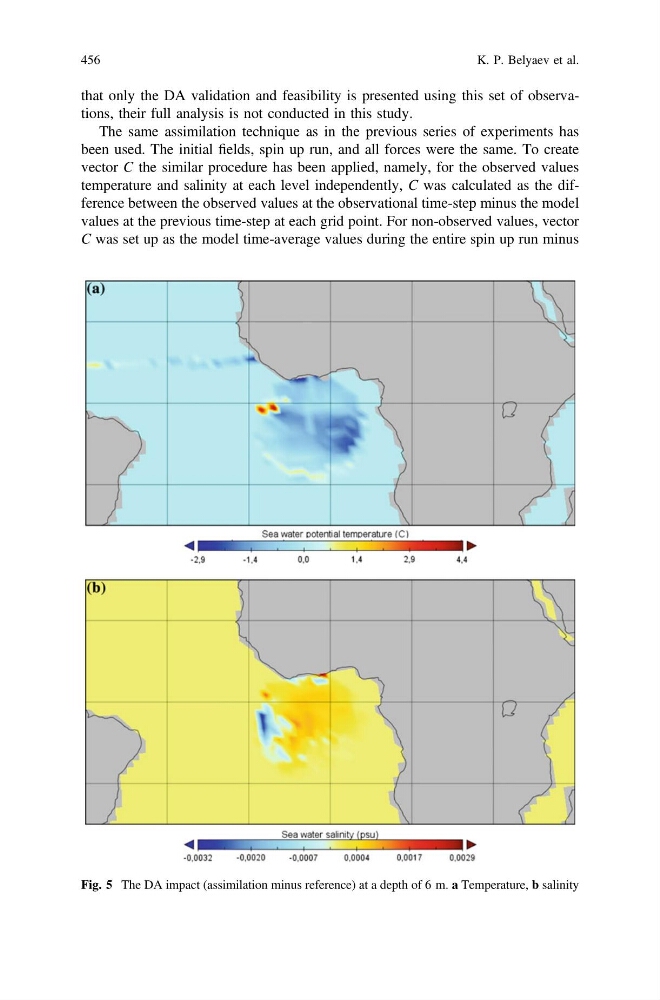
Fig. 5 The DA impact (assimilation minus reference) at a depth of 6 m. a Temperature, b salinity
456
K. P. Belyaev et al.
The same assimilation technique as in the previous series of experiments has
been used. The initial fields, spin up run, and all forces were the same. To create
vector C the similar procedure has been applied, namely, for the observed values
temperature and salinity at each level independently, C was calculated as the difference between the observed values at the observational time-step minus the model
values at the previous time-step at each grid point. For non-observed values, vector
C was set up as the model time-average values during the entire spin up run minus
Fig. 5 The DA impact (assimilation minus reference) at a depth of 6 m. a Temperature, b salinity
456
K. P. Belyaev et al.