

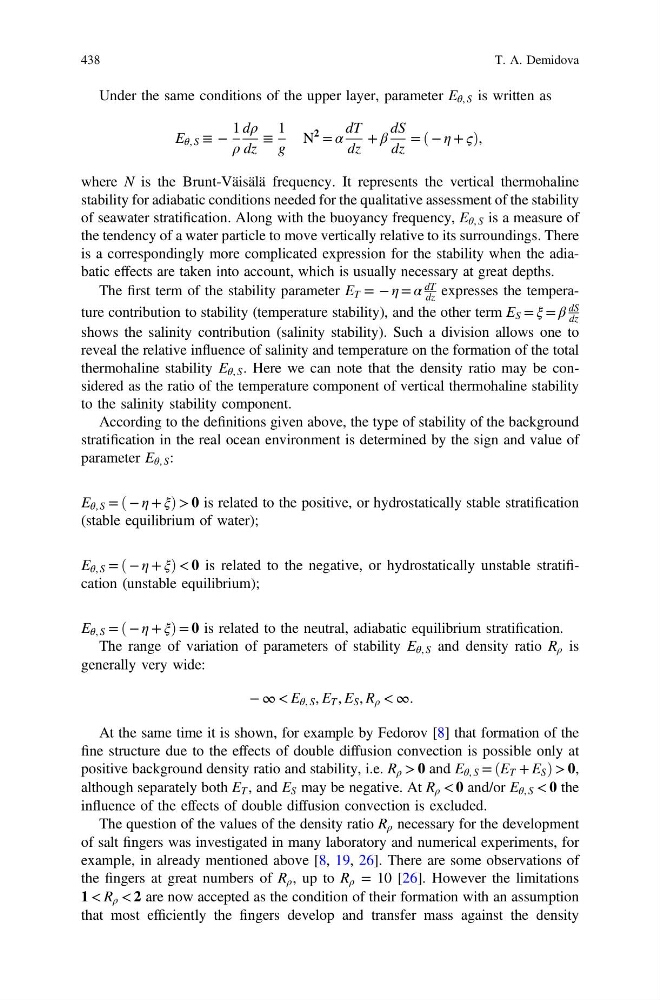
Under the same conditions of the upper layer, parameter E θ, S is written as
E θ, S ≡ −
1
ρ
dρ
dz
≡
1
g
N
2 = α
dT
dz
+ β
dS
dz
= ð − η + ςÞ,
where N is the Brunt-Väisälä frequency. It represents the vertical thermohaline
stability for adiabatic conditions needed for the qualitative assessment of the stability
of seawater stratification. Along with the buoyancy frequency, E θ, S is a measure of
the tendency of a water particle to move vertically relative to its surroundings. There
is a correspondingly more complicated expression for the stability when the adiabatic effects are taken into account, which is usually necessary at great depths.
The first term of the stability parameter E T = − η = α
dT
dz expresses the temperature contribution to stability (temperature stability), and the other term E S = ξ = β
dS
dz
shows the salinity contribution (salinity stability). Such a division allows one to
reveal the relative influence of salinity and temperature on the formation of the total
thermohaline stability E θ, S . Here we can note that the density ratio may be considered as the ratio of the temperature component of vertical thermohaline stability
to the salinity stability component.
According to the definitions given above, the type of stability of the background
stratification in the real ocean environment is determined by the sign and value of
parameter E θ, S :
E θ, S = ð − η + ξÞ > 0 is related to the positive, or hydrostatically stable stratification
(stable equilibrium of water);
E θ, S = ð − η + ξÞ < 0 is related to the negative, or hydrostatically unstable stratification (unstable equilibrium);
E θ, S = ð − η + ξÞ = 0 is related to the neutral, adiabatic equilibrium stratification.
The range of variation of parameters of stability E θ, S and density ratio R ρ is
generally very wide:
− ∞ < E θ, S , E T , E S , R ρ < ∞.
At the same time it is shown, for example by Fedorov [8] that formation of the
fine structure due to the effects of double diffusion convection is possible only at
positive background density ratio and stability, i.e. R ρ > 0 and E θ, S = ðE T + E S Þ > 0,
although separately both E T , and E S may be negative. At R ρ < 0 and/or E θ, S < 0 the
influence of the effects of double diffusion convection is excluded.
The question of the values of the density ratio R ρ necessary for the development
of salt fingers was investigated in many laboratory and numerical experiments, for
example, in already mentioned above [8, 19, 26]. There are some observations of
the fingers at great numbers of R ρ , up to R ρ = 10 [26]. However the limitations
1 < R ρ < 2 are now accepted as the condition of their formation with an assumption
that most efficiently the fingers develop and transfer mass against the density
438
T. A. Demidova
E θ, S ≡ −
1
ρ
dρ
dz
≡
1
g
N
2 = α
dT
dz
+ β
dS
dz
= ð − η + ςÞ,
where N is the Brunt-Väisälä frequency. It represents the vertical thermohaline
stability for adiabatic conditions needed for the qualitative assessment of the stability
of seawater stratification. Along with the buoyancy frequency, E θ, S is a measure of
the tendency of a water particle to move vertically relative to its surroundings. There
is a correspondingly more complicated expression for the stability when the adiabatic effects are taken into account, which is usually necessary at great depths.
The first term of the stability parameter E T = − η = α
dT
dz expresses the temperature contribution to stability (temperature stability), and the other term E S = ξ = β
dS
dz
shows the salinity contribution (salinity stability). Such a division allows one to
reveal the relative influence of salinity and temperature on the formation of the total
thermohaline stability E θ, S . Here we can note that the density ratio may be considered as the ratio of the temperature component of vertical thermohaline stability
to the salinity stability component.
According to the definitions given above, the type of stability of the background
stratification in the real ocean environment is determined by the sign and value of
parameter E θ, S :
E θ, S = ð − η + ξÞ > 0 is related to the positive, or hydrostatically stable stratification
(stable equilibrium of water);
E θ, S = ð − η + ξÞ < 0 is related to the negative, or hydrostatically unstable stratification (unstable equilibrium);
E θ, S = ð − η + ξÞ = 0 is related to the neutral, adiabatic equilibrium stratification.
The range of variation of parameters of stability E θ, S and density ratio R ρ is
generally very wide:
− ∞ < E θ, S , E T , E S , R ρ < ∞.
At the same time it is shown, for example by Fedorov [8] that formation of the
fine structure due to the effects of double diffusion convection is possible only at
positive background density ratio and stability, i.e. R ρ > 0 and E θ, S = ðE T + E S Þ > 0,
although separately both E T , and E S may be negative. At R ρ < 0 and/or E θ, S < 0 the
influence of the effects of double diffusion convection is excluded.
The question of the values of the density ratio R ρ necessary for the development
of salt fingers was investigated in many laboratory and numerical experiments, for
example, in already mentioned above [8, 19, 26]. There are some observations of
the fingers at great numbers of R ρ , up to R ρ = 10 [26]. However the limitations
1 < R ρ < 2 are now accepted as the condition of their formation with an assumption
that most efficiently the fingers develop and transfer mass against the density
438
T. A. Demidova