

Under the conditions when the stabilizing contribution to a density gradient is
provided by the gradients of temperature and salinity, any disturbances decay over
time owing to the stable state. The other situation is observed when one of the
components (temperature or salinity) has the vertical gradient that destabilizes the
density gradient. In such a case, the potential energy of the unstable component,
which is released owing to the double diffusion, leads to continuing intensification
of any (even initially small) disturbances of the thermohaline fields over time.
Those disturbances manifest themselves in the form of thin and fine structures of
the fields.
Intense development of stepwise structures in the thermocline below the core
borders of the EUC, revealed from our measurements, gave us additional grounds
for deeper consideration of the question about the reality of the double diffusion
convective mixing during the time period of our experiments. The detection and
identification of intervals of probable double diffusion in the form of salt fingers
was provided with the use of diagnosis of the types of stratification and thermohaline instability. The vertical thermohaline stability parameter and the density ratio
were computed from the CTD casts, and the relationship of both parameters were
considered.
Double diffusion condition criteria. It was found from numerous experiments,
that the intensity of formation of the elements of temperature and salinity fine
structure is determined by the background of the vertical distributions of these
parameters. This fact became the basis for parameterization of the fine structure of
the thermohaline fields. Following [3, 9] we will consider, as the qualitative criteria,
the interrelation between the density ratio R ρ and vertical stability parameter E θ, S
taking into account the background gradients and their signs.
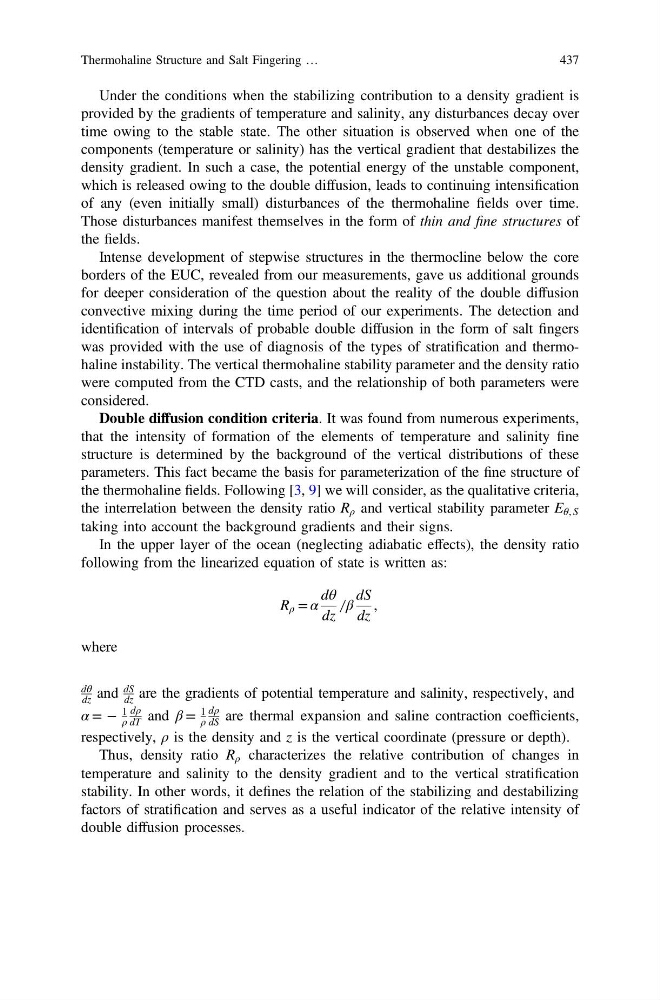
In the upper layer of the ocean (neglecting adiabatic effects), the density ratio
following from the linearized equation of state is written as:
R ρ = α
dθ
dz
̸ β
dS
dz
,
where
dθ
dz and
dS
dz are the gradients of potential temperature and salinity, respectively, and
α = −
1
ρ
dρ
dT and β =
1
ρ
dρ
dS are thermal expansion and saline contraction coefficients,
respectively, ρ is the density and z is the vertical coordinate (pressure or depth).
Thus, density ratio R ρ characterizes the relative contribution of changes in
temperature and salinity to the density gradient and to the vertical stratification
stability. In other words, it defines the relation of the stabilizing and destabilizing
factors of stratification and serves as a useful indicator of the relative intensity of
double diffusion processes.
Thermohaline Structure and Salt Fingering …
437
provided by the gradients of temperature and salinity, any disturbances decay over
time owing to the stable state. The other situation is observed when one of the
components (temperature or salinity) has the vertical gradient that destabilizes the
density gradient. In such a case, the potential energy of the unstable component,
which is released owing to the double diffusion, leads to continuing intensification
of any (even initially small) disturbances of the thermohaline fields over time.
Those disturbances manifest themselves in the form of thin and fine structures of
the fields.
Intense development of stepwise structures in the thermocline below the core
borders of the EUC, revealed from our measurements, gave us additional grounds
for deeper consideration of the question about the reality of the double diffusion
convective mixing during the time period of our experiments. The detection and
identification of intervals of probable double diffusion in the form of salt fingers
was provided with the use of diagnosis of the types of stratification and thermohaline instability. The vertical thermohaline stability parameter and the density ratio
were computed from the CTD casts, and the relationship of both parameters were
considered.
Double diffusion condition criteria. It was found from numerous experiments,
that the intensity of formation of the elements of temperature and salinity fine
structure is determined by the background of the vertical distributions of these
parameters. This fact became the basis for parameterization of the fine structure of
the thermohaline fields. Following [3, 9] we will consider, as the qualitative criteria,
the interrelation between the density ratio R ρ and vertical stability parameter E θ, S
taking into account the background gradients and their signs.
In the upper layer of the ocean (neglecting adiabatic effects), the density ratio
following from the linearized equation of state is written as:
R ρ = α
dθ
dz
̸ β
dS
dz
,
where
dθ
dz and
dS
dz are the gradients of potential temperature and salinity, respectively, and
α = −
1
ρ
dρ
dT and β =
1
ρ
dρ
dS are thermal expansion and saline contraction coefficients,
respectively, ρ is the density and z is the vertical coordinate (pressure or depth).
Thus, density ratio R ρ characterizes the relative contribution of changes in
temperature and salinity to the density gradient and to the vertical stratification
stability. In other words, it defines the relation of the stabilizing and destabilizing
factors of stratification and serves as a useful indicator of the relative intensity of
double diffusion processes.
Thermohaline Structure and Salt Fingering …
437