

Generation of submesoscale cyclonic eddies occurs, in particular, in the cases of
southeastward currents on the shelf associated with the passage of coastal mesoscale anticyclonic eddies that results in the cyclonic shear between the eddy and the
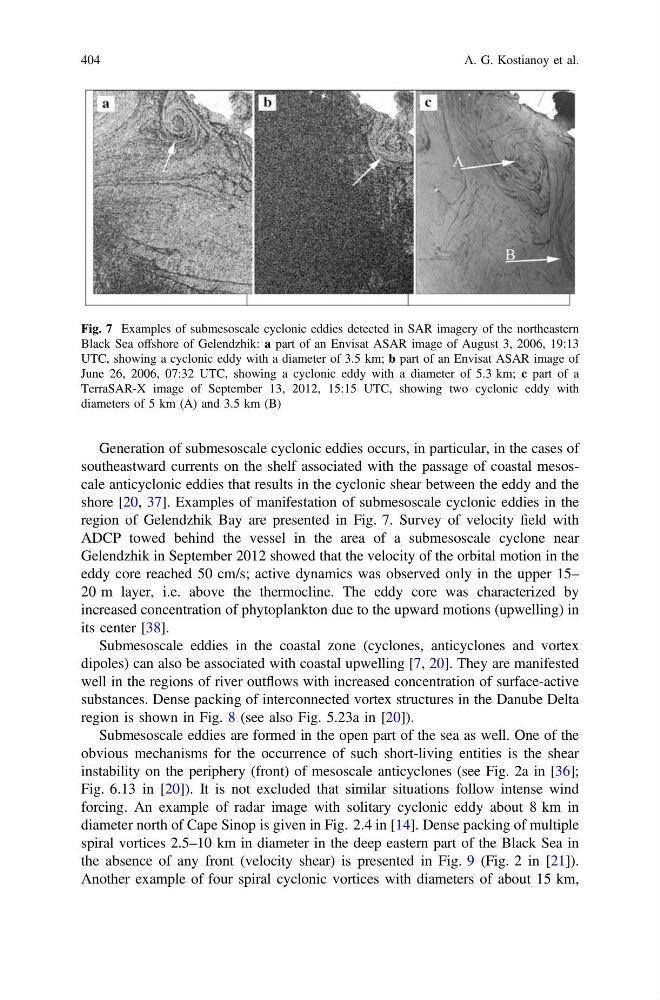
shore [20, 37]. Examples of manifestation of submesoscale cyclonic eddies in the
region of Gelendzhik Bay are presented in Fig. 7. Survey of velocity field with
ADCP towed behind the vessel in the area of a submesoscale cyclone near
Gelendzhik in September 2012 showed that the velocity of the orbital motion in the
eddy core reached 50 cm/s; active dynamics was observed only in the upper 15–
20 m layer, i.e. above the thermocline. The eddy core was characterized by
increased concentration of phytoplankton due to the upward motions (upwelling) in
its center [38].
Submesoscale eddies in the coastal zone (cyclones, anticyclones and vortex
dipoles) can also be associated with coastal upwelling [7, 20]. They are manifested
well in the regions of river outflows with increased concentration of surface-active
substances. Dense packing of interconnected vortex structures in the Danube Delta
region is shown in Fig. 8 (see also Fig. 5.23a in [20]).
Submesoscale eddies are formed in the open part of the sea as well. One of the
obvious mechanisms for the occurrence of such short-living entities is the shear
instability on the periphery (front) of mesoscale anticyclones (see Fig. 2a in [36];
Fig. 6.13 in [20]). It is not excluded that similar situations follow intense wind
forcing. An example of radar image with solitary cyclonic eddy about 8 km in
diameter north of Cape Sinop is given in Fig. 2.4 in [14]. Dense packing of multiple
spiral vortices 2.5–10 km in diameter in the deep eastern part of the Black Sea in
the absence of any front (velocity shear) is presented in Fig. 9 (Fig. 2 in [21]).
Another example of four spiral cyclonic vortices with diameters of about 15 km,
Fig. 7 Examples of submesoscale cyclonic eddies detected in SAR imagery of the northeastern
Black Sea offshore of Gelendzhik: a part of an Envisat ASAR image of August 3, 2006, 19:13
UTC, showing a cyclonic eddy with a diameter of 3.5 km; b part of an Envisat ASAR image of
June 26, 2006, 07:32 UTC, showing a cyclonic eddy with a diameter of 5.3 km; c part of a
TerraSAR-X image of September 13, 2012, 15:15 UTC, showing two cyclonic eddy with
diameters of 5 km (A) and 3.5 km (B)
404
A. G. Kostianoy et al.
southeastward currents on the shelf associated with the passage of coastal mesoscale anticyclonic eddies that results in the cyclonic shear between the eddy and the
shore [20, 37]. Examples of manifestation of submesoscale cyclonic eddies in the
region of Gelendzhik Bay are presented in Fig. 7. Survey of velocity field with
ADCP towed behind the vessel in the area of a submesoscale cyclone near
Gelendzhik in September 2012 showed that the velocity of the orbital motion in the
eddy core reached 50 cm/s; active dynamics was observed only in the upper 15–
20 m layer, i.e. above the thermocline. The eddy core was characterized by
increased concentration of phytoplankton due to the upward motions (upwelling) in
its center [38].
Submesoscale eddies in the coastal zone (cyclones, anticyclones and vortex
dipoles) can also be associated with coastal upwelling [7, 20]. They are manifested
well in the regions of river outflows with increased concentration of surface-active
substances. Dense packing of interconnected vortex structures in the Danube Delta
region is shown in Fig. 8 (see also Fig. 5.23a in [20]).
Submesoscale eddies are formed in the open part of the sea as well. One of the
obvious mechanisms for the occurrence of such short-living entities is the shear
instability on the periphery (front) of mesoscale anticyclones (see Fig. 2a in [36];
Fig. 6.13 in [20]). It is not excluded that similar situations follow intense wind
forcing. An example of radar image with solitary cyclonic eddy about 8 km in
diameter north of Cape Sinop is given in Fig. 2.4 in [14]. Dense packing of multiple
spiral vortices 2.5–10 km in diameter in the deep eastern part of the Black Sea in
the absence of any front (velocity shear) is presented in Fig. 9 (Fig. 2 in [21]).
Another example of four spiral cyclonic vortices with diameters of about 15 km,
Fig. 7 Examples of submesoscale cyclonic eddies detected in SAR imagery of the northeastern
Black Sea offshore of Gelendzhik: a part of an Envisat ASAR image of August 3, 2006, 19:13
UTC, showing a cyclonic eddy with a diameter of 3.5 km; b part of an Envisat ASAR image of
June 26, 2006, 07:32 UTC, showing a cyclonic eddy with a diameter of 5.3 km; c part of a
TerraSAR-X image of September 13, 2012, 15:15 UTC, showing two cyclonic eddy with
diameters of 5 km (A) and 3.5 km (B)
404
A. G. Kostianoy et al.