

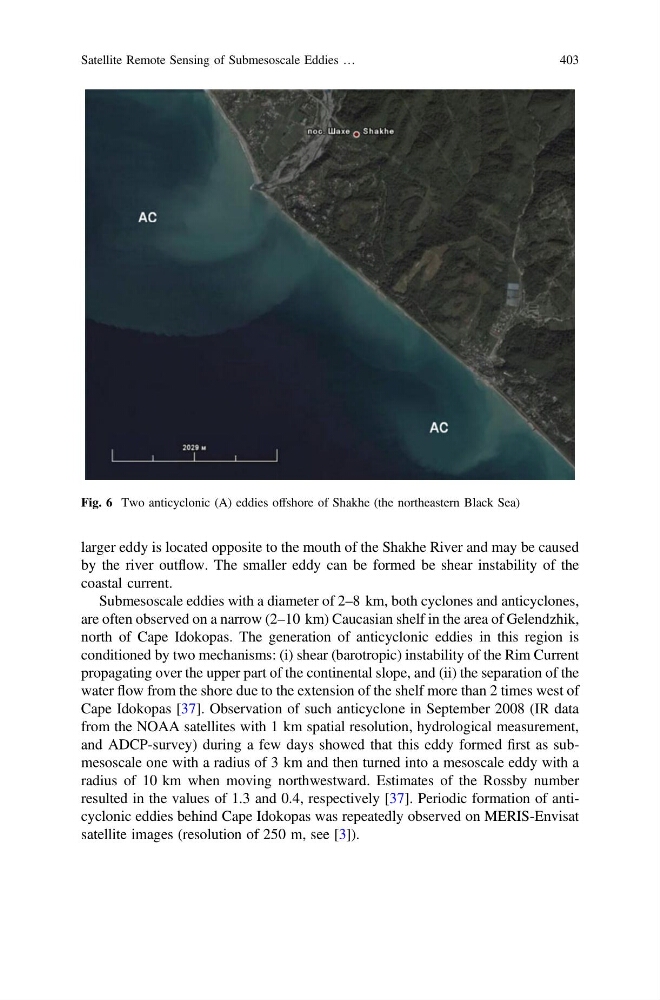
larger eddy is located opposite to the mouth of the Shakhe River and may be caused
by the river outflow. The smaller eddy can be formed be shear instability of the
coastal current.
Submesoscale eddies with a diameter of 2–8 km, both cyclones and anticyclones,
are often observed on a narrow (2–10 km) Caucasian shelf in the area of Gelendzhik,
north of Cape Idokopas. The generation of anticyclonic eddies in this region is
conditioned by two mechanisms: (i) shear (barotropic) instability of the Rim Current
propagating over the upper part of the continental slope, and (ii) the separation of the
water flow from the shore due to the extension of the shelf more than 2 times west of
Cape Idokopas [37]. Observation of such anticyclone in September 2008 (IR data
from the NOAA satellites with 1 km spatial resolution, hydrological measurement,
and ADCP-survey) during a few days showed that this eddy formed first as submesoscale one with a radius of 3 km and then turned into a mesoscale eddy with a
radius of 10 km when moving northwestward. Estimates of the Rossby number
resulted in the values of 1.3 and 0.4, respectively [37]. Periodic formation of anticyclonic eddies behind Cape Idokopas was repeatedly observed on MERIS-Envisat
satellite images (resolution of 250 m, see [3]).
Fig. 6 Two anticyclonic (A) eddies offshore of Shakhe (the northeastern Black Sea)
Satellite Remote Sensing of Submesoscale Eddies …
403
by the river outflow. The smaller eddy can be formed be shear instability of the
coastal current.
Submesoscale eddies with a diameter of 2–8 km, both cyclones and anticyclones,
are often observed on a narrow (2–10 km) Caucasian shelf in the area of Gelendzhik,
north of Cape Idokopas. The generation of anticyclonic eddies in this region is
conditioned by two mechanisms: (i) shear (barotropic) instability of the Rim Current
propagating over the upper part of the continental slope, and (ii) the separation of the
water flow from the shore due to the extension of the shelf more than 2 times west of
Cape Idokopas [37]. Observation of such anticyclone in September 2008 (IR data
from the NOAA satellites with 1 km spatial resolution, hydrological measurement,
and ADCP-survey) during a few days showed that this eddy formed first as submesoscale one with a radius of 3 km and then turned into a mesoscale eddy with a
radius of 10 km when moving northwestward. Estimates of the Rossby number
resulted in the values of 1.3 and 0.4, respectively [37]. Periodic formation of anticyclonic eddies behind Cape Idokopas was repeatedly observed on MERIS-Envisat
satellite images (resolution of 250 m, see [3]).
Fig. 6 Two anticyclonic (A) eddies offshore of Shakhe (the northeastern Black Sea)
Satellite Remote Sensing of Submesoscale Eddies …
403