

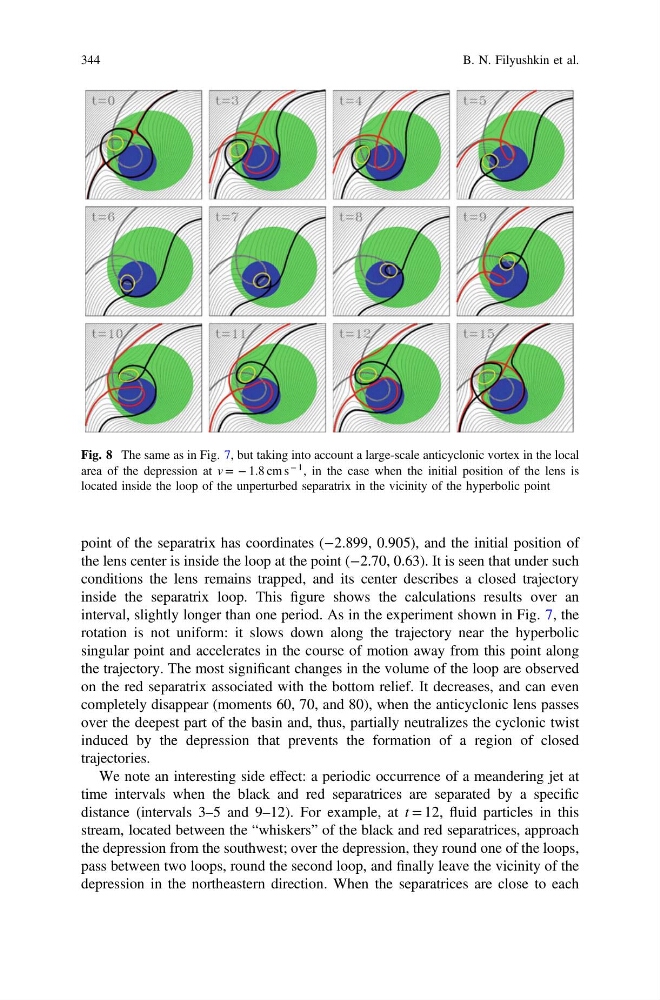
point of the separatrix has coordinates (−2.899, 0.905), and the initial position of
the lens center is inside the loop at the point (−2.70, 0.63). It is seen that under such
conditions the lens remains trapped, and its center describes a closed trajectory
inside the separatrix loop. This figure shows the calculations results over an
interval, slightly longer than one period. As in the experiment shown in Fig. 7, the
rotation is not uniform: it slows down along the trajectory near the hyperbolic
singular point and accelerates in the course of motion away from this point along
the trajectory. The most significant changes in the volume of the loop are observed
on the red separatrix associated with the bottom relief. It decreases, and can even
completely disappear (moments 60, 70, and 80), when the anticyclonic lens passes
over the deepest part of the basin and, thus, partially neutralizes the cyclonic twist
induced by the depression that prevents the formation of a region of closed
trajectories.
We note an interesting side effect: a periodic occurrence of a meandering jet at
time intervals when the black and red separatrices are separated by a specific
distance (intervals 3–5 and 9–12). For example, at t = 12, fluid particles in this
stream, located between the “whiskers” of the black and red separatrices, approach
the depression from the southwest; over the depression, they round one of the loops,
pass between two loops, round the second loop, and finally leave the vicinity of the
depression in the northeastern direction. When the separatrices are close to each
Fig. 8 The same as in Fig. 7, but taking into account a large-scale anticyclonic vortex in the local
area of the depression at v = − 1.8 cm s
− 1 , in the case when the initial position of the lens is
located inside the loop of the unperturbed separatrix in the vicinity of the hyperbolic point
344
B. N. Filyushkin et al.
the lens center is inside the loop at the point (−2.70, 0.63). It is seen that under such
conditions the lens remains trapped, and its center describes a closed trajectory
inside the separatrix loop. This figure shows the calculations results over an
interval, slightly longer than one period. As in the experiment shown in Fig. 7, the
rotation is not uniform: it slows down along the trajectory near the hyperbolic
singular point and accelerates in the course of motion away from this point along
the trajectory. The most significant changes in the volume of the loop are observed
on the red separatrix associated with the bottom relief. It decreases, and can even
completely disappear (moments 60, 70, and 80), when the anticyclonic lens passes
over the deepest part of the basin and, thus, partially neutralizes the cyclonic twist
induced by the depression that prevents the formation of a region of closed
trajectories.
We note an interesting side effect: a periodic occurrence of a meandering jet at
time intervals when the black and red separatrices are separated by a specific
distance (intervals 3–5 and 9–12). For example, at t = 12, fluid particles in this
stream, located between the “whiskers” of the black and red separatrices, approach
the depression from the southwest; over the depression, they round one of the loops,
pass between two loops, round the second loop, and finally leave the vicinity of the
depression in the northeastern direction. When the separatrices are close to each
Fig. 8 The same as in Fig. 7, but taking into account a large-scale anticyclonic vortex in the local
area of the depression at v = − 1.8 cm s
− 1 , in the case when the initial position of the lens is
located inside the loop of the unperturbed separatrix in the vicinity of the hyperbolic point
344
B. N. Filyushkin et al.