

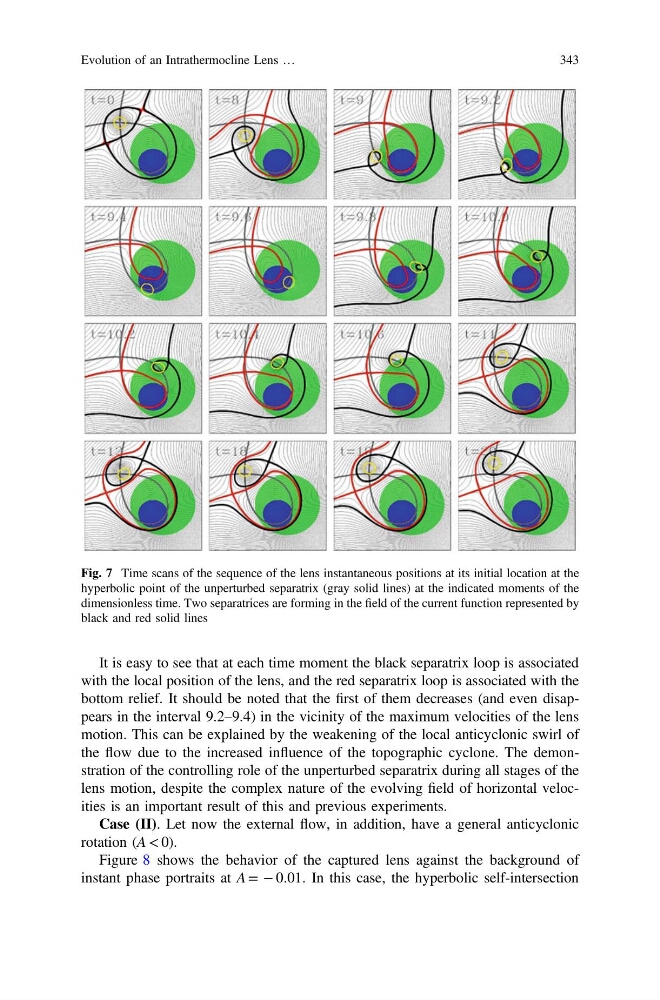
It is easy to see that at each time moment the black separatrix loop is associated
with the local position of the lens, and the red separatrix loop is associated with the
bottom relief. It should be noted that the first of them decreases (and even disappears in the interval 9.2–9.4) in the vicinity of the maximum velocities of the lens
motion. This can be explained by the weakening of the local anticyclonic swirl of
the flow due to the increased influence of the topographic cyclone. The demonstration of the controlling role of the unperturbed separatrix during all stages of the
lens motion, despite the complex nature of the evolving field of horizontal velocities is an important result of this and previous experiments.
Case (II). Let now the external flow, in addition, have a general anticyclonic
rotation (A < 0).
Figure 8 shows the behavior of the captured lens against the background of
instant phase portraits at A = − 0.01. In this case, the hyperbolic self-intersection
Fig. 7 Time scans of the sequence of the lens instantaneous positions at its initial location at the
hyperbolic point of the unperturbed separatrix (gray solid lines) at the indicated moments of the
dimensionless time. Two separatrices are forming in the field of the current function represented by
black and red solid lines
Evolution of an Intrathermocline Lens …
343
with the local position of the lens, and the red separatrix loop is associated with the
bottom relief. It should be noted that the first of them decreases (and even disappears in the interval 9.2–9.4) in the vicinity of the maximum velocities of the lens
motion. This can be explained by the weakening of the local anticyclonic swirl of
the flow due to the increased influence of the topographic cyclone. The demonstration of the controlling role of the unperturbed separatrix during all stages of the
lens motion, despite the complex nature of the evolving field of horizontal velocities is an important result of this and previous experiments.
Case (II). Let now the external flow, in addition, have a general anticyclonic
rotation (A < 0).
Figure 8 shows the behavior of the captured lens against the background of
instant phase portraits at A = − 0.01. In this case, the hyperbolic self-intersection
Fig. 7 Time scans of the sequence of the lens instantaneous positions at its initial location at the
hyperbolic point of the unperturbed separatrix (gray solid lines) at the indicated moments of the
dimensionless time. Two separatrices are forming in the field of the current function represented by
black and red solid lines
Evolution of an Intrathermocline Lens …
343