

We will also assume that the unperturbed external field consists of a combination of
a homogeneous flow with horizontal velocities U, V, and a large-scale quasistationary anticyclonic vortex with characteristic azimuthal velocity A.
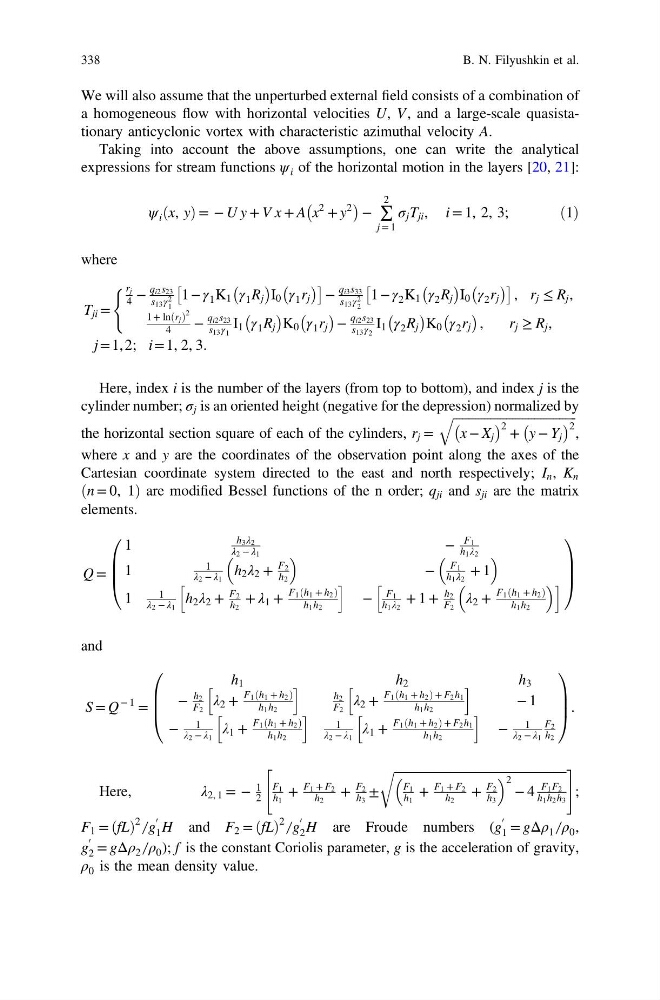
Taking into account the above assumptions, one can write the analytical
expressions for stream functions ψ i of the horizontal motion in the layers [20, 21]:
ψ i ðx, yÞ = − U y + V x + A x
2 + y
2
À
Á − ∑
2
j = 1
σ j T ji , i = 1, 2, 3;
ð1Þ
where
T ji =
r j
4 −
q i2 s 23
s 13 γ 2
1
1 − γ 1 K 1 γ 1 R j
À
Á
I 0 γ 1 r j
À Á
Â
à −
q i3 s 33
s 13 γ 2
2
1 − γ 2 K 1 γ 2 R j
À
Á
I 0 γ 2 r j
À Á
Â
Ã
, r j ≤ R j ,
1 + lnðr j Þ
2
4
−
q i2 s 23
s 13 γ 1
I 1 γ 1 R j
À
Á
K 0 γ 1 r j
À Á −
q i2 s 23
s 13 γ 2
I 1 γ 2 R j
À
Á
K 0 γ 2 r j
À Á
,
r j ≥ R j ,
(
j = 1, 2; i =1, 2, 3.
Here, index i is the number of the layers (from top to bottom), and index j is the
cylinder number; σ j is an oriented height (negative for the depression) normalized by
the horizontal section square of each of the cylinders, r j =
ffiffiffiffiffiffiffiffiffiffiffiffiffiffiffiffiffiffiffiffiffiffiffiffiffiffiffiffiffiffiffiffiffiffiffiffiffiffiffi ffi
x − X j
À
Á 2 + y − Y j
À
Á 2
q
,
where x and y are the coordinates of the observation point along the axes of the
Cartesian coordinate system directed to the east and north respectively; I n , K n
ðn = 0, 1Þ are modified Bessel functions of the n order; q ji and s ji are the matrix
elements.
Q =
1
h 3 λ 2
λ 2 − λ 1
−
F 1
h 1 λ 2
1
1
λ 2 − λ 1
h 2 λ 2 +
F 2
h 2
−
F 1
h 1 λ 2
+ 1
1
1
λ 2 − λ 1
h 2 λ 2 +
F 2
h 2
+ λ 1 +
F 1 h 1 + h 2
ð
Þ
h 1 h 2
h
i
−
F 1
h 1 λ 2
+ 1 +
h 2
F 2
λ 2 +
F 1 h 1 + h 2
ð
Þ
h 1 h 2
h
i
0
B
B
@
1
C
C
A
and
S = Q
− 1 =
h 1
h 2
h 3
−
h 2
F 2
λ 2 +
F 1 h 1 + h 2
ð
Þ
h 1 h 2
h
i
h 2
F 2
λ 2 +
F 1 h 1 + h 2
ð
Þ+ F 2 h 1
h 1 h 2
h
i
− 1
−
1
λ 2 − λ 1
λ 1 +
F 1 h 1 + h 2
ð
Þ
h 1 h 2
h
i
1
λ 2 − λ 1
λ 1 +
F 1 h 1 + h 2
ð
Þ+ F 2 h 1
h 1 h 2
h
i
−
1
λ 2 − λ 1
F 2
h 2
0
B
B
@
1
C
C
A .
Here,
λ 2, 1 = −
1
2
F 1
h 1
+
F 1 + F 2
h 2
+
F 2
h 3
±
ffiffiffiffiffiffiffiffiffiffiffiffiffiffiffiffiffiffiffiffiffiffiffiffiffiffiffiffiffiffiffiffiffiffiffiffiffiffiffiffiffiffiffiffiffiffiffiffiffiffiffiffiffiffiffi ffi
F 1
h 1
+
F 1 + F 2
h 2
+
F 2
h 3
2 − 4
F 1 F 2
h 1 h 2 h 3
r
"
#
;
F 1 = ðfLÞ
2 ̸ g
0
1 H and F 2 = ðfLÞ
2 ̸ g
0
2 H are Froude numbers (g
0
1 = gΔρ 1 ̸ ρ 0 ,
g
0
2 = gΔρ 2 ̸ ρ 0 ); f is the constant Coriolis parameter, g is the acceleration of gravity,
ρ 0 is the mean density value.
338
B. N. Filyushkin et al.
a homogeneous flow with horizontal velocities U, V, and a large-scale quasistationary anticyclonic vortex with characteristic azimuthal velocity A.
Taking into account the above assumptions, one can write the analytical
expressions for stream functions ψ i of the horizontal motion in the layers [20, 21]:
ψ i ðx, yÞ = − U y + V x + A x
2 + y
2
À
Á − ∑
2
j = 1
σ j T ji , i = 1, 2, 3;
ð1Þ
where
T ji =
r j
4 −
q i2 s 23
s 13 γ 2
1
1 − γ 1 K 1 γ 1 R j
À
Á
I 0 γ 1 r j
À Á
Â
à −
q i3 s 33
s 13 γ 2
2
1 − γ 2 K 1 γ 2 R j
À
Á
I 0 γ 2 r j
À Á
Â
Ã
, r j ≤ R j ,
1 + lnðr j Þ
2
4
−
q i2 s 23
s 13 γ 1
I 1 γ 1 R j
À
Á
K 0 γ 1 r j
À Á −
q i2 s 23
s 13 γ 2
I 1 γ 2 R j
À
Á
K 0 γ 2 r j
À Á
,
r j ≥ R j ,
(
j = 1, 2; i =1, 2, 3.
Here, index i is the number of the layers (from top to bottom), and index j is the
cylinder number; σ j is an oriented height (negative for the depression) normalized by
the horizontal section square of each of the cylinders, r j =
ffiffiffiffiffiffiffiffiffiffiffiffiffiffiffiffiffiffiffiffiffiffiffiffiffiffiffiffiffiffiffiffiffiffiffiffiffiffiffi ffi
x − X j
À
Á 2 + y − Y j
À
Á 2
q
,
where x and y are the coordinates of the observation point along the axes of the
Cartesian coordinate system directed to the east and north respectively; I n , K n
ðn = 0, 1Þ are modified Bessel functions of the n order; q ji and s ji are the matrix
elements.
Q =
1
h 3 λ 2
λ 2 − λ 1
−
F 1
h 1 λ 2
1
1
λ 2 − λ 1
h 2 λ 2 +
F 2
h 2
−
F 1
h 1 λ 2
+ 1
1
1
λ 2 − λ 1
h 2 λ 2 +
F 2
h 2
+ λ 1 +
F 1 h 1 + h 2
ð
Þ
h 1 h 2
h
i
−
F 1
h 1 λ 2
+ 1 +
h 2
F 2
λ 2 +
F 1 h 1 + h 2
ð
Þ
h 1 h 2
h
i
0
B
B
@
1
C
C
A
and
S = Q
− 1 =
h 1
h 2
h 3
−
h 2
F 2
λ 2 +
F 1 h 1 + h 2
ð
Þ
h 1 h 2
h
i
h 2
F 2
λ 2 +
F 1 h 1 + h 2
ð
Þ+ F 2 h 1
h 1 h 2
h
i
− 1
−
1
λ 2 − λ 1
λ 1 +
F 1 h 1 + h 2
ð
Þ
h 1 h 2
h
i
1
λ 2 − λ 1
λ 1 +
F 1 h 1 + h 2
ð
Þ+ F 2 h 1
h 1 h 2
h
i
−
1
λ 2 − λ 1
F 2
h 2
0
B
B
@
1
C
C
A .
Here,
λ 2, 1 = −
1
2
F 1
h 1
+
F 1 + F 2
h 2
+
F 2
h 3
±
ffiffiffiffiffiffiffiffiffiffiffiffiffiffiffiffiffiffiffiffiffiffiffiffiffiffiffiffiffiffiffiffiffiffiffiffiffiffiffiffiffiffiffiffiffiffiffiffiffiffiffiffiffiffiffi ffi
F 1
h 1
+
F 1 + F 2
h 2
+
F 2
h 3
2 − 4
F 1 F 2
h 1 h 2 h 3
r
"
#
;
F 1 = ðfLÞ
2 ̸ g
0
1 H and F 2 = ðfLÞ
2 ̸ g
0
2 H are Froude numbers (g
0
1 = gΔρ 1 ̸ ρ 0 ,
g
0
2 = gΔρ 2 ̸ ρ 0 ); f is the constant Coriolis parameter, g is the acceleration of gravity,
ρ 0 is the mean density value.
338
B. N. Filyushkin et al.