

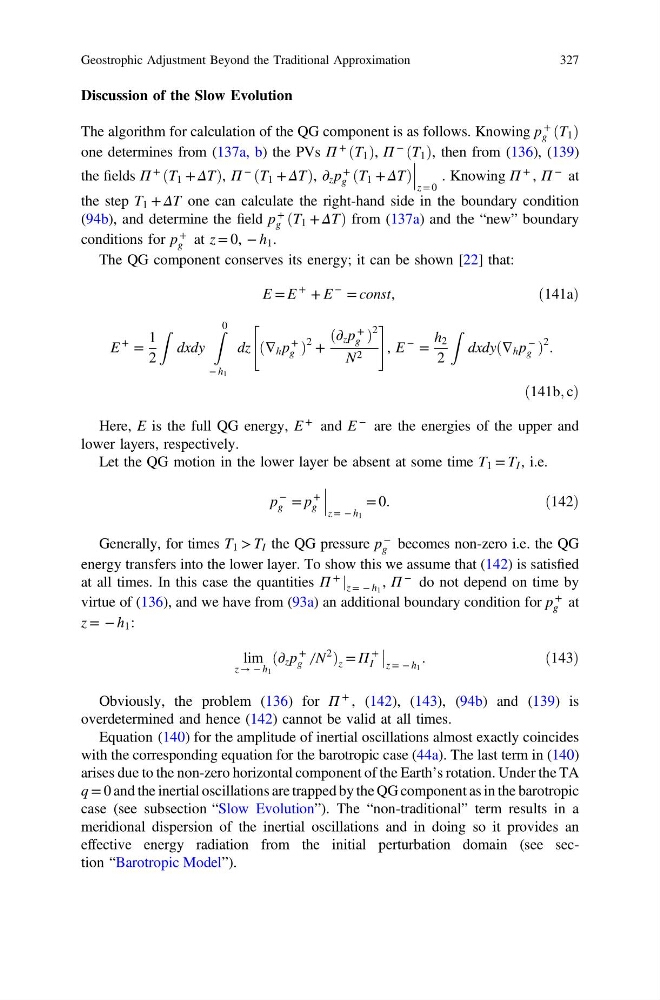
Discussion of the Slow Evolution
The algorithm for calculation of the QG component is as follows. Knowing p
+
g ðT 1 Þ
one determines from (137a, b) the PVs Π
+
ðT 1 Þ, Π
−
ðT 1 Þ, then from (136), (139)
the fields Π
+
ðT 1 + ΔTÞ, Π
−
ðT 1 + ΔTÞ, ∂ z p
+
g ðT 1 + ΔTÞ
z = 0
. Knowing Π
+ , Π
− at
the step T 1 + ΔT one can calculate the right-hand side in the boundary condition
(94b), and determine the field p
+
g ðT 1 + ΔTÞ from (137a) and the “new” boundary
conditions for p
+
g at z = 0, − h 1 .
The QG component conserves its energy; it can be shown [22] that:
E = E
+ + E
− = const,
ð141aÞ
E
+ =
1
2
Z
dxdy
Z 0
− h 1
dz ð∇ h p
+
g Þ
2 +
ð∂ z p
+
g Þ
2
N 2
"
#
, E
− =
h 2
2
Z
dxdyð∇ h p
−
g Þ
2 .
ð141b; cÞ
Here, E is the full QG energy, E
+ and E
− are the energies of the upper and
lower layers, respectively.
Let the QG motion in the lower layer be absent at some time T 1 = T I , i.e.
p
−
g = p
+
g
z = − h 1
= 0.
ð142Þ
Generally, for times T 1 > T I the QG pressure p
−
g becomes non-zero i.e. the QG
energy transfers into the lower layer. To show this we assume that (142) is satisfied
at all times. In this case the quantities Π
+
j z = − h 1 , Π
− do not depend on time by
virtue of (136), and we have from (93a) an additional boundary condition for p
+
g at
z = − h 1 :
lim
z → − h 1
ð∂ z p
+
g ̸ N
2
Þ z = Π
+
I
z = − h 1
.
ð143Þ
Obviously, the problem (136) for Π
+ , (142), (143), (94b) and (139) is
overdetermined and hence (142) cannot be valid at all times.
Equation (140) for the amplitude of inertial oscillations almost exactly coincides
with the corresponding equation for the barotropic case (44a). The last term in (140)
arises due to the non-zero horizontal component of the Earth’s rotation. Under the TA
q = 0 and the inertial oscillations are trapped by the QG component as in the barotropic
case (see subsection “Slow Evolution”). The “non-traditional” term results in a
meridional dispersion of the inertial oscillations and in doing so it provides an
effective energy radiation from the initial perturbation domain (see section “Barotropic Model”).
Geostrophic Adjustment Beyond the Traditional Approximation
327
The algorithm for calculation of the QG component is as follows. Knowing p
+
g ðT 1 Þ
one determines from (137a, b) the PVs Π
+
ðT 1 Þ, Π
−
ðT 1 Þ, then from (136), (139)
the fields Π
+
ðT 1 + ΔTÞ, Π
−
ðT 1 + ΔTÞ, ∂ z p
+
g ðT 1 + ΔTÞ
z = 0
. Knowing Π
+ , Π
− at
the step T 1 + ΔT one can calculate the right-hand side in the boundary condition
(94b), and determine the field p
+
g ðT 1 + ΔTÞ from (137a) and the “new” boundary
conditions for p
+
g at z = 0, − h 1 .
The QG component conserves its energy; it can be shown [22] that:
E = E
+ + E
− = const,
ð141aÞ
E
+ =
1
2
Z
dxdy
Z 0
− h 1
dz ð∇ h p
+
g Þ
2 +
ð∂ z p
+
g Þ
2
N 2
"
#
, E
− =
h 2
2
Z
dxdyð∇ h p
−
g Þ
2 .
ð141b; cÞ
Here, E is the full QG energy, E
+ and E
− are the energies of the upper and
lower layers, respectively.
Let the QG motion in the lower layer be absent at some time T 1 = T I , i.e.
p
−
g = p
+
g
z = − h 1
= 0.
ð142Þ
Generally, for times T 1 > T I the QG pressure p
−
g becomes non-zero i.e. the QG
energy transfers into the lower layer. To show this we assume that (142) is satisfied
at all times. In this case the quantities Π
+
j z = − h 1 , Π
− do not depend on time by
virtue of (136), and we have from (93a) an additional boundary condition for p
+
g at
z = − h 1 :
lim
z → − h 1
ð∂ z p
+
g ̸ N
2
Þ z = Π
+
I
z = − h 1
.
ð143Þ
Obviously, the problem (136) for Π
+ , (142), (143), (94b) and (139) is
overdetermined and hence (142) cannot be valid at all times.
Equation (140) for the amplitude of inertial oscillations almost exactly coincides
with the corresponding equation for the barotropic case (44a). The last term in (140)
arises due to the non-zero horizontal component of the Earth’s rotation. Under the TA
q = 0 and the inertial oscillations are trapped by the QG component as in the barotropic
case (see subsection “Slow Evolution”). The “non-traditional” term results in a
meridional dispersion of the inertial oscillations and in doing so it provides an
effective energy radiation from the initial perturbation domain (see section “Barotropic Model”).
Geostrophic Adjustment Beyond the Traditional Approximation
327