

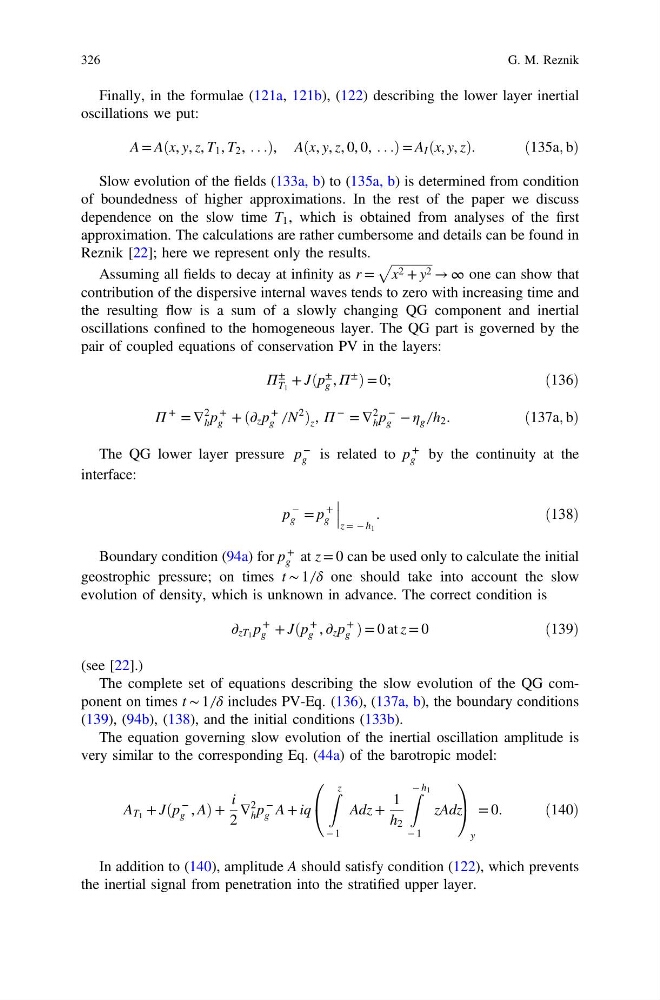
Finally, in the formulae (121a, 121b), (122) describing the lower layer inertial
oscillations we put:
A = Aðx, y, z, T 1 , T 2 , . . .Þ, Aðx, y, z, 0, 0, . . .Þ = A I ðx, y, zÞ.
ð135a; bÞ
Slow evolution of the fields (133a, b) to (135a, b) is determined from condition
of boundedness of higher approximations. In the rest of the paper we discuss
dependence on the slow time T 1 , which is obtained from analyses of the first
approximation. The calculations are rather cumbersome and details can be found in
Reznik [22]; here we represent only the results.
Assuming all fields to decay at infinity as r =
ffiffiffiffiffiffiffiffiffiffiffiffiffi
x 2 + y 2
p
→ ∞ one can show that
contribution of the dispersive internal waves tends to zero with increasing time and
the resulting flow is a sum of a slowly changing QG component and inertial
oscillations confined to the homogeneous layer. The QG part is governed by the
pair of coupled equations of conservation PV in the layers:
Π
±
T 1
+ Jðp
±
g , Π
±
Þ = 0;
ð136Þ
Π
+ = ∇
2
h p
+
g + ð∂ z p
+
g ̸ N
2
Þ z , Π
− = ∇
2
h p
−
g − η g ̸ h 2 .
ð137a; bÞ
The QG lower layer pressure p
−
g is related to p
+
g by the continuity at the
interface:
p
−
g = p
+
g
z = − h 1
.
ð138Þ
Boundary condition (94a) for p
+
g at z = 0 can be used only to calculate the initial
geostrophic pressure; on times t ∼ 1 ̸ δ one should take into account the slow
evolution of density, which is unknown in advance. The correct condition is
∂ zT 1 p
+
g + Jðp
+
g , ∂ z p
+
g Þ = 0 at z = 0
ð139Þ
(see [22].)
The complete set of equations describing the slow evolution of the QG component on times t ∼ 1 ̸ δ includes PV-Eq. (136), (137a, b), the boundary conditions
(139), (94b), (138), and the initial conditions (133b).
The equation governing slow evolution of the inertial oscillation amplitude is
very similar to the corresponding Eq. (44a) of the barotropic model:
A T 1 + Jðp
−
g , AÞ +
i
2
∇
2
h p
−
g A + iq
Z z
− 1
Adz +
1
h 2
Z − h 1
− 1
zAdz
0
@
1
A
y
= 0.
ð140Þ
In addition to (140), amplitude A should satisfy condition (122), which prevents
the inertial signal from penetration into the stratified upper layer.
326
G. M. Reznik
oscillations we put:
A = Aðx, y, z, T 1 , T 2 , . . .Þ, Aðx, y, z, 0, 0, . . .Þ = A I ðx, y, zÞ.
ð135a; bÞ
Slow evolution of the fields (133a, b) to (135a, b) is determined from condition
of boundedness of higher approximations. In the rest of the paper we discuss
dependence on the slow time T 1 , which is obtained from analyses of the first
approximation. The calculations are rather cumbersome and details can be found in
Reznik [22]; here we represent only the results.
Assuming all fields to decay at infinity as r =
ffiffiffiffiffiffiffiffiffiffiffiffiffi
x 2 + y 2
p
→ ∞ one can show that
contribution of the dispersive internal waves tends to zero with increasing time and
the resulting flow is a sum of a slowly changing QG component and inertial
oscillations confined to the homogeneous layer. The QG part is governed by the
pair of coupled equations of conservation PV in the layers:
Π
±
T 1
+ Jðp
±
g , Π
±
Þ = 0;
ð136Þ
Π
+ = ∇
2
h p
+
g + ð∂ z p
+
g ̸ N
2
Þ z , Π
− = ∇
2
h p
−
g − η g ̸ h 2 .
ð137a; bÞ
The QG lower layer pressure p
−
g is related to p
+
g by the continuity at the
interface:
p
−
g = p
+
g
z = − h 1
.
ð138Þ
Boundary condition (94a) for p
+
g at z = 0 can be used only to calculate the initial
geostrophic pressure; on times t ∼ 1 ̸ δ one should take into account the slow
evolution of density, which is unknown in advance. The correct condition is
∂ zT 1 p
+
g + Jðp
+
g , ∂ z p
+
g Þ = 0 at z = 0
ð139Þ
(see [22].)
The complete set of equations describing the slow evolution of the QG component on times t ∼ 1 ̸ δ includes PV-Eq. (136), (137a, b), the boundary conditions
(139), (94b), (138), and the initial conditions (133b).
The equation governing slow evolution of the inertial oscillation amplitude is
very similar to the corresponding Eq. (44a) of the barotropic model:
A T 1 + Jðp
−
g , AÞ +
i
2
∇
2
h p
−
g A + iq
Z z
− 1
Adz +
1
h 2
Z − h 1
− 1
zAdz
0
@
1
A
y
= 0.
ð140Þ
In addition to (140), amplitude A should satisfy condition (122), which prevents
the inertial signal from penetration into the stratified upper layer.
326
G. M. Reznik