

U = −
e
− it
h 2
Z − h 1
− 1
U
−
aI dz + U, U = −
1
h 2
Z 0
− h 1
U
+
a dz, U s, c = 0.
ð119a; b; cÞ
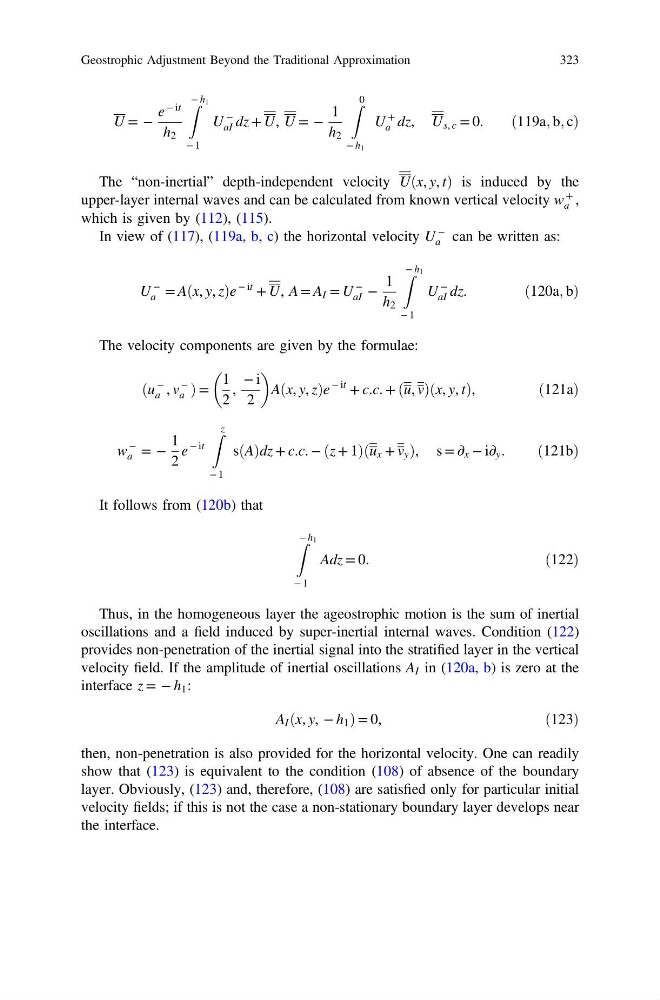
The “non-inertial” depth-independent velocity Uðx, y, tÞ is induced by the
upper-layer internal waves and can be calculated from known vertical velocity w
+
a ,
which is given by (112), (115).
In view of (117), (119a, b, c) the horizontal velocity U
−
a can be written as:
U
−
a = Aðx, y, zÞe
− it + U, A = A I = U
−
aI −
1
h 2
Z − h 1
− 1
U
−
aI dz.
ð120a; bÞ
The velocity components are given by the formulae:
ðu
−
a , v
−
a Þ =
1
2
,
− i
2
Aðx, y, zÞe
− it + c.c. + ðu, vÞðx, y, tÞ,
ð121aÞ
w
−
a = −
1
2
e
− it
Z z
− 1
sðAÞdz + c.c. − ðz + 1Þðu x + v y Þ, s=∂ x − i∂ y .
ð121bÞ
It follows from (120b) that
Z − h 1
− 1
Adz = 0.
ð122Þ
Thus, in the homogeneous layer the ageostrophic motion is the sum of inertial
oscillations and a field induced by super-inertial internal waves. Condition (122)
provides non-penetration of the inertial signal into the stratified layer in the vertical
velocity field. If the amplitude of inertial oscillations A I in (120a, b) is zero at the
interface z = − h 1 :
A I ðx, y, − h 1 Þ = 0,
ð123Þ
then, non-penetration is also provided for the horizontal velocity. One can readily
show that (123) is equivalent to the condition (108) of absence of the boundary
layer. Obviously, (123) and, therefore, (108) are satisfied only for particular initial
velocity fields; if this is not the case a non-stationary boundary layer develops near
the interface.
Geostrophic Adjustment Beyond the Traditional Approximation
323
e
− it
h 2
Z − h 1
− 1
U
−
aI dz + U, U = −
1
h 2
Z 0
− h 1
U
+
a dz, U s, c = 0.
ð119a; b; cÞ
The “non-inertial” depth-independent velocity Uðx, y, tÞ is induced by the
upper-layer internal waves and can be calculated from known vertical velocity w
+
a ,
which is given by (112), (115).
In view of (117), (119a, b, c) the horizontal velocity U
−
a can be written as:
U
−
a = Aðx, y, zÞe
− it + U, A = A I = U
−
aI −
1
h 2
Z − h 1
− 1
U
−
aI dz.
ð120a; bÞ
The velocity components are given by the formulae:
ðu
−
a , v
−
a Þ =
1
2
,
− i
2
Aðx, y, zÞe
− it + c.c. + ðu, vÞðx, y, tÞ,
ð121aÞ
w
−
a = −
1
2
e
− it
Z z
− 1
sðAÞdz + c.c. − ðz + 1Þðu x + v y Þ, s=∂ x − i∂ y .
ð121bÞ
It follows from (120b) that
Z − h 1
− 1
Adz = 0.
ð122Þ
Thus, in the homogeneous layer the ageostrophic motion is the sum of inertial
oscillations and a field induced by super-inertial internal waves. Condition (122)
provides non-penetration of the inertial signal into the stratified layer in the vertical
velocity field. If the amplitude of inertial oscillations A I in (120a, b) is zero at the
interface z = − h 1 :
A I ðx, y, − h 1 Þ = 0,
ð123Þ
then, non-penetration is also provided for the horizontal velocity. One can readily
show that (123) is equivalent to the condition (108) of absence of the boundary
layer. Obviously, (123) and, therefore, (108) are satisfied only for particular initial
velocity fields; if this is not the case a non-stationary boundary layer develops near
the interface.
Geostrophic Adjustment Beyond the Traditional Approximation
323