

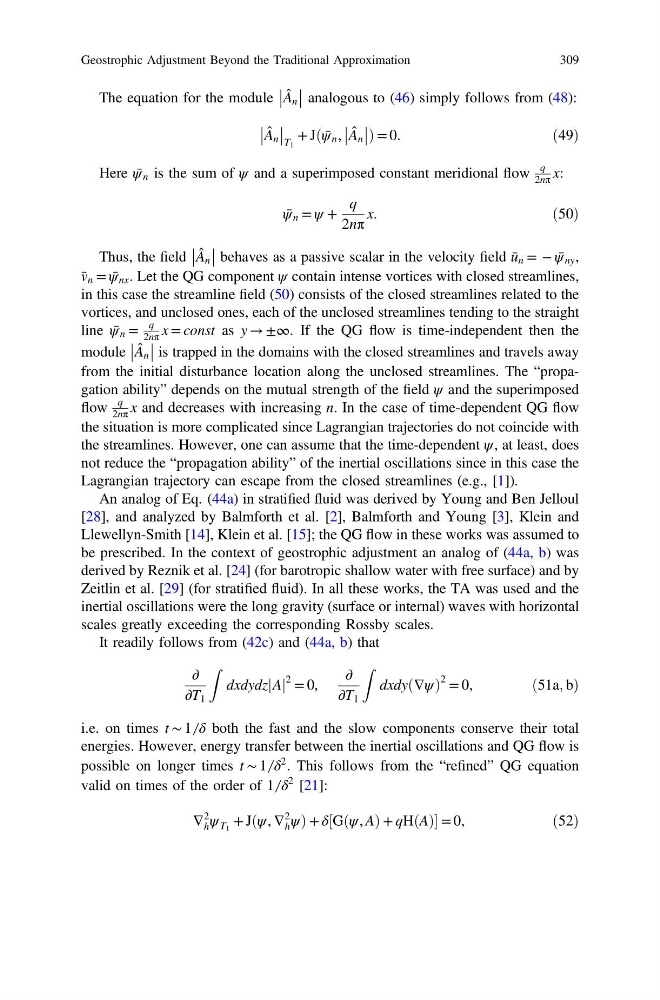
The equation for the module A ̂ n
analogous to (46) simply follows from (48):
A ̂ n
T 1
+ Jðψ̄ n , A ̂
n
Þ = 0.
ð49Þ
Here ψ̄ n is the sum of ψ and a superimposed constant meridional flow
q
2nπ x:
ψ̄ n = ψ +
q
2nπ
x.
ð50Þ
Thus, the field A ̂
n
behaves as a passive scalar in the velocity field ū n = − ψ̄ ny ,
v̄ n = ψ̄ nx . Let the QG component ψ contain intense vortices with closed streamlines,
in this case the streamline field (50) consists of the closed streamlines related to the
vortices, and unclosed ones, each of the unclosed streamlines tending to the straight
line ψ̄ n =
q
2nπ x = const as y → ±∞. If the QG flow is time-independent then the
module A ̂
n
is trapped in the domains with the closed streamlines and travels away
from the initial disturbance location along the unclosed streamlines. The “propagation ability” depends on the mutual strength of the field ψ and the superimposed
flow
q
2nπ x and decreases with increasing n. In the case of time-dependent QG flow
the situation is more complicated since Lagrangian trajectories do not coincide with
the streamlines. However, one can assume that the time-dependent ψ, at least, does
not reduce the “propagation ability” of the inertial oscillations since in this case the
Lagrangian trajectory can escape from the closed streamlines (e.g., [1]).
An analog of Eq. (44a) in stratified fluid was derived by Young and Ben Jelloul
[28], and analyzed by Balmforth et al. [2], Balmforth and Young [3], Klein and
Llewellyn-Smith [14], Klein et al. [15]; the QG flow in these works was assumed to
be prescribed. In the context of geostrophic adjustment an analog of (44a, b) was
derived by Reznik et al. [24] (for barotropic shallow water with free surface) and by
Zeitlin et al. [29] (for stratified fluid). In all these works, the TA was used and the
inertial oscillations were the long gravity (surface or internal) waves with horizontal
scales greatly exceeding the corresponding Rossby scales.
It readily follows from (42c) and (44a, b) that
∂
∂T 1
Z
dxdydz A
j j
2 = 0,
∂
∂T 1
Z
dxdyð∇ψÞ
2 = 0,
ð51a; bÞ
i.e. on times t ∼ 1 ̸ δ both the fast and the slow components conserve their total
energies. However, energy transfer between the inertial oscillations and QG flow is
possible on longer times t ∼ 1 ̸ δ
2 . This follows from the “refined” QG equation
valid on times of the order of 1 ̸ δ
2 [21]:
∇
2
h ψ T 1 + Jðψ, ∇
2
h ψÞ + δ½Gðψ, AÞ + qHðAÞ = 0,
ð52Þ
Geostrophic Adjustment Beyond the Traditional Approximation
309
analogous to (46) simply follows from (48):
A ̂ n
T 1
+ Jðψ̄ n , A ̂
n
Þ = 0.
ð49Þ
Here ψ̄ n is the sum of ψ and a superimposed constant meridional flow
q
2nπ x:
ψ̄ n = ψ +
q
2nπ
x.
ð50Þ
Thus, the field A ̂
n
behaves as a passive scalar in the velocity field ū n = − ψ̄ ny ,
v̄ n = ψ̄ nx . Let the QG component ψ contain intense vortices with closed streamlines,
in this case the streamline field (50) consists of the closed streamlines related to the
vortices, and unclosed ones, each of the unclosed streamlines tending to the straight
line ψ̄ n =
q
2nπ x = const as y → ±∞. If the QG flow is time-independent then the
module A ̂
n
is trapped in the domains with the closed streamlines and travels away
from the initial disturbance location along the unclosed streamlines. The “propagation ability” depends on the mutual strength of the field ψ and the superimposed
flow
q
2nπ x and decreases with increasing n. In the case of time-dependent QG flow
the situation is more complicated since Lagrangian trajectories do not coincide with
the streamlines. However, one can assume that the time-dependent ψ, at least, does
not reduce the “propagation ability” of the inertial oscillations since in this case the
Lagrangian trajectory can escape from the closed streamlines (e.g., [1]).
An analog of Eq. (44a) in stratified fluid was derived by Young and Ben Jelloul
[28], and analyzed by Balmforth et al. [2], Balmforth and Young [3], Klein and
Llewellyn-Smith [14], Klein et al. [15]; the QG flow in these works was assumed to
be prescribed. In the context of geostrophic adjustment an analog of (44a, b) was
derived by Reznik et al. [24] (for barotropic shallow water with free surface) and by
Zeitlin et al. [29] (for stratified fluid). In all these works, the TA was used and the
inertial oscillations were the long gravity (surface or internal) waves with horizontal
scales greatly exceeding the corresponding Rossby scales.
It readily follows from (42c) and (44a, b) that
∂
∂T 1
Z
dxdydz A
j j
2 = 0,
∂
∂T 1
Z
dxdyð∇ψÞ
2 = 0,
ð51a; bÞ
i.e. on times t ∼ 1 ̸ δ both the fast and the slow components conserve their total
energies. However, energy transfer between the inertial oscillations and QG flow is
possible on longer times t ∼ 1 ̸ δ
2 . This follows from the “refined” QG equation
valid on times of the order of 1 ̸ δ
2 [21]:
∇
2
h ψ T 1 + Jðψ, ∇
2
h ψÞ + δ½Gðψ, AÞ + qHðAÞ = 0,
ð52Þ
Geostrophic Adjustment Beyond the Traditional Approximation
309