

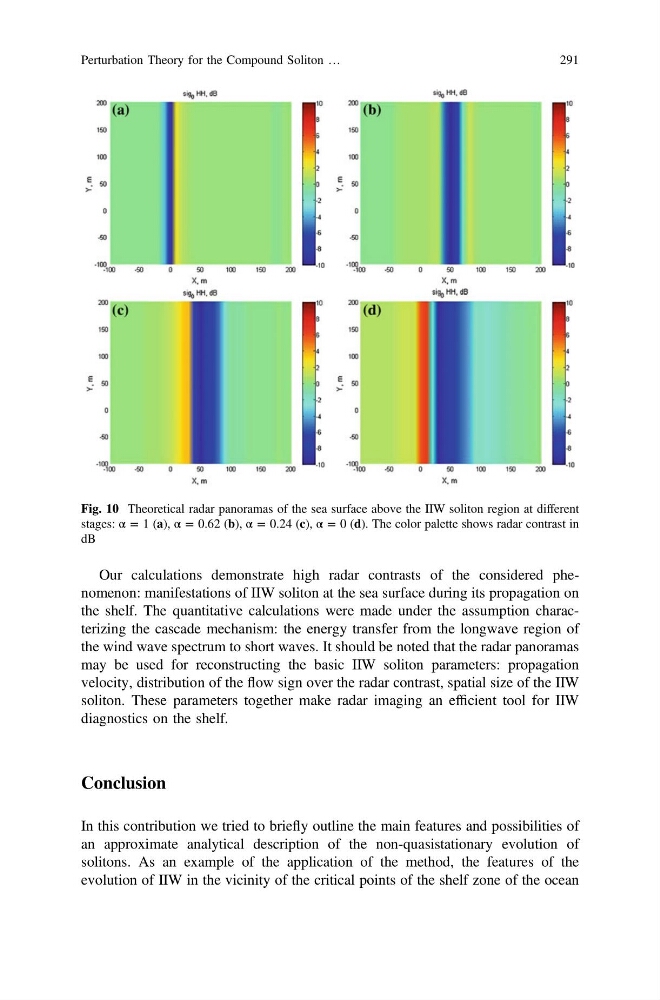
Our calculations demonstrate high radar contrasts of the considered phenomenon: manifestations of IIW soliton at the sea surface during its propagation on
the shelf. The quantitative calculations were made under the assumption characterizing the cascade mechanism: the energy transfer from the longwave region of
the wind wave spectrum to short waves. It should be noted that the radar panoramas
may be used for reconstructing the basic IIW soliton parameters: propagation
velocity, distribution of the flow sign over the radar contrast, spatial size of the IIW
soliton. These parameters together make radar imaging an efficient tool for IIW
diagnostics on the shelf.
Conclusion
In this contribution we tried to briefly outline the main features and possibilities of
an approximate analytical description of the non-quasistationary evolution of
solitons. As an example of the application of the method, the features of the
evolution of IIW in the vicinity of the critical points of the shelf zone of the ocean
Fig. 10 Theoretical radar panoramas of the sea surface above the IIW soliton region at different
stages: α = 1 (a), α = 0.62 (b), α = 0.24 (c), α = 0 (d). The color palette shows radar contrast in
dB
Perturbation Theory for the Compound Soliton …
291
the shelf. The quantitative calculations were made under the assumption characterizing the cascade mechanism: the energy transfer from the longwave region of
the wind wave spectrum to short waves. It should be noted that the radar panoramas
may be used for reconstructing the basic IIW soliton parameters: propagation
velocity, distribution of the flow sign over the radar contrast, spatial size of the IIW
soliton. These parameters together make radar imaging an efficient tool for IIW
diagnostics on the shelf.
Conclusion
In this contribution we tried to briefly outline the main features and possibilities of
an approximate analytical description of the non-quasistationary evolution of
solitons. As an example of the application of the method, the features of the
evolution of IIW in the vicinity of the critical points of the shelf zone of the ocean
Fig. 10 Theoretical radar panoramas of the sea surface above the IIW soliton region at different
stages: α = 1 (a), α = 0.62 (b), α = 0.24 (c), α = 0 (d). The color palette shows radar contrast in
dB
Perturbation Theory for the Compound Soliton …
291