

One can see that the narrow soliton of reverse polarity arising behind the front of
the wide soliton has a different amplitude and a different velocity (this is important!). During the motion on the crest of the wide soliton it acquires an additional
phase shift which increases as the size of the wide soliton increases as well as the
difference in velocities increases. Clearly, such singularity does not appear when the
velocities of solitons have opposite polarities and coincide for slow solitons. This
case is realized for the solitons of the Gardner equation. Thus, the proposed
approach permits the distributed problem to be reduced to a system of ordinary
differential equations and even the wave nature of the interacting structures (finite
velocity of perturbation propagation, deformation of the shape, phase shifts, etc.)
can be taken into account. The developed theory was used for describing the
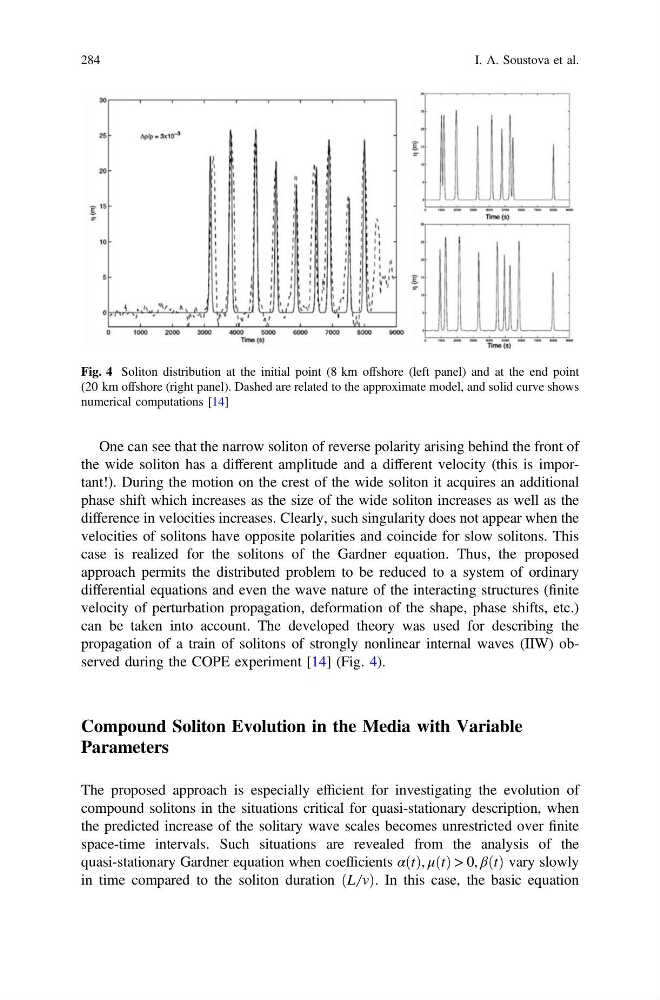
propagation of a train of solitons of strongly nonlinear internal waves (IIW) observed during the COPE experiment [14] (Fig. 4).
Compound Soliton Evolution in the Media with Variable
Parameters
The proposed approach is especially efficient for investigating the evolution of
compound solitons in the situations critical for quasi-stationary description, when
the predicted increase of the solitary wave scales becomes unrestricted over finite
space-time intervals. Such situations are revealed from the analysis of the
quasi-stationary Gardner equation when coefficients α t
ð Þ, μ t
ð Þ > 0, β t
ð Þ vary slowly
in time compared to the soliton duration L ̸ v
ð Þ. In this case, the basic equation
Fig. 4 Soliton distribution at the initial point (8 km offshore (left panel) and at the end point
(20 km offshore (right panel). Dashed are related to the approximate model, and solid curve shows
numerical computations [14]
284
I. A. Soustova et al.
the wide soliton has a different amplitude and a different velocity (this is important!). During the motion on the crest of the wide soliton it acquires an additional
phase shift which increases as the size of the wide soliton increases as well as the
difference in velocities increases. Clearly, such singularity does not appear when the
velocities of solitons have opposite polarities and coincide for slow solitons. This
case is realized for the solitons of the Gardner equation. Thus, the proposed
approach permits the distributed problem to be reduced to a system of ordinary
differential equations and even the wave nature of the interacting structures (finite
velocity of perturbation propagation, deformation of the shape, phase shifts, etc.)
can be taken into account. The developed theory was used for describing the
propagation of a train of solitons of strongly nonlinear internal waves (IIW) observed during the COPE experiment [14] (Fig. 4).
Compound Soliton Evolution in the Media with Variable
Parameters
The proposed approach is especially efficient for investigating the evolution of
compound solitons in the situations critical for quasi-stationary description, when
the predicted increase of the solitary wave scales becomes unrestricted over finite
space-time intervals. Such situations are revealed from the analysis of the
quasi-stationary Gardner equation when coefficients α t
ð Þ, μ t
ð Þ > 0, β t
ð Þ vary slowly
in time compared to the soliton duration L ̸ v
ð Þ. In this case, the basic equation
Fig. 4 Soliton distribution at the initial point (8 km offshore (left panel) and at the end point
(20 km offshore (right panel). Dashed are related to the approximate model, and solid curve shows
numerical computations [14]
284
I. A. Soustova et al.