

276
I. Gankevich and A. Degtyarev
0.0
0.2
0.4
0.6
0.8
1.0
OpenCL
Wavy surface size
Time, s
g 1
g 2
FFT
Copy
128
256
512 1024
128
256
512 1024
0
4
8
1 2
1 6
2 0
OpenMP
Wavy surface size
Time, s
g 1
g 2
FFT
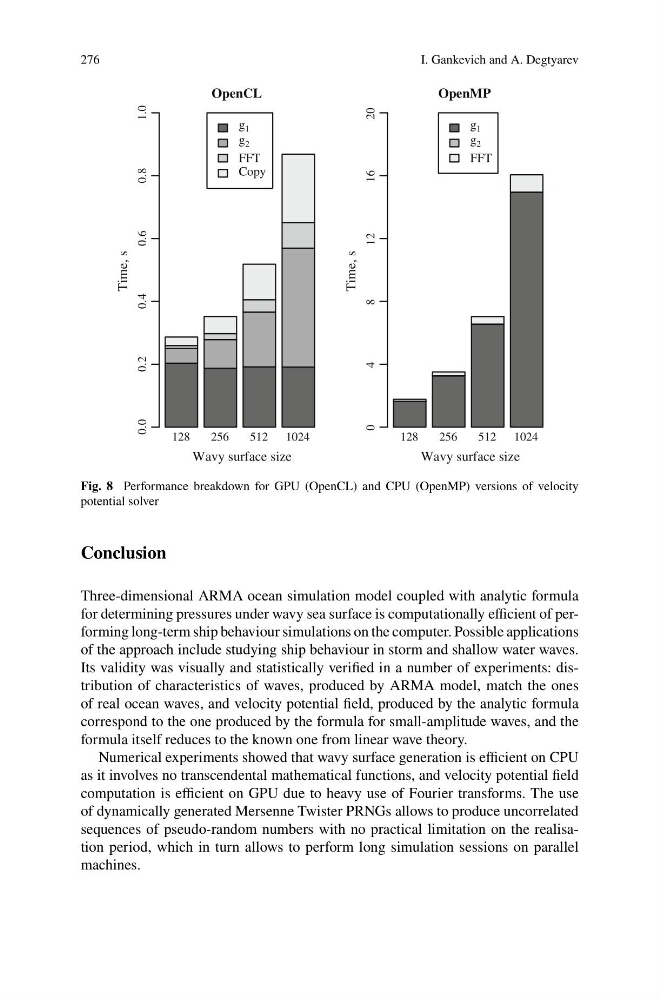
Fig. 8 Performance breakdown for GPU (OpenCL) and CPU (OpenMP) versions of velocity
potential solver
Conclusion
Three-dimensional ARMA ocean simulation model coupled with analytic formula
for determining pressures under wavy sea surface is computationally efficient of performing long-term ship behaviour simulations on the computer. Possible applications
of the approach include studying ship behaviour in storm and shallow water waves.
Its validity was visually and statistically verified in a number of experiments: distribution of characteristics of waves, produced by ARMA model, match the ones
of real ocean waves, and velocity potential field, produced by the analytic formula
correspond to the one produced by the formula for small-amplitude waves, and the
formula itself reduces to the known one from linear wave theory.
Numerical experiments showed that wavy surface generation is efficient on CPU
as it involves no transcendental mathematical functions, and velocity potential field
computation is efficient on GPU due to heavy use of Fourier transforms. The use
of dynamically generated Mersenne Twister PRNGs allows to produce uncorrelated
sequences of pseudo-random numbers with no practical limitation on the realisation period, which in turn allows to perform long simulation sessions on parallel
machines.
I. Gankevich and A. Degtyarev
0.0
0.2
0.4
0.6
0.8
1.0
OpenCL
Wavy surface size
Time, s
g 1
g 2
FFT
Copy
128
256
512 1024
128
256
512 1024
0
4
8
1 2
1 6
2 0
OpenMP
Wavy surface size
Time, s
g 1
g 2
FFT
Fig. 8 Performance breakdown for GPU (OpenCL) and CPU (OpenMP) versions of velocity
potential solver
Conclusion
Three-dimensional ARMA ocean simulation model coupled with analytic formula
for determining pressures under wavy sea surface is computationally efficient of performing long-term ship behaviour simulations on the computer. Possible applications
of the approach include studying ship behaviour in storm and shallow water waves.
Its validity was visually and statistically verified in a number of experiments: distribution of characteristics of waves, produced by ARMA model, match the ones
of real ocean waves, and velocity potential field, produced by the analytic formula
correspond to the one produced by the formula for small-amplitude waves, and the
formula itself reduces to the known one from linear wave theory.
Numerical experiments showed that wavy surface generation is efficient on CPU
as it involves no transcendental mathematical functions, and velocity potential field
computation is efficient on GPU due to heavy use of Fourier transforms. The use
of dynamically generated Mersenne Twister PRNGs allows to produce uncorrelated
sequences of pseudo-random numbers with no practical limitation on the realisation period, which in turn allows to perform long simulation sessions on parallel
machines.