

264
I. Gankevich and A. Degtyarev
equals to the change of velocity potential derivative along the wavy surface normal
(∇í µí¼ ⋅ n).
Inverse problem of hydrodynamics consists in solving this system of equations
for í µí¼. In this formulation dynamic boundary condition becomes an explicit formula
to determine pressure field using velocity potential derivatives obtained from the
remaining equations. So, from mathematical point of view inverse problem of hydrodynamics reduces to Laplace equation with mixed boundary condition—Robin problem.
Two-Dimensional Case
Formula for Infinite Depth Fluid
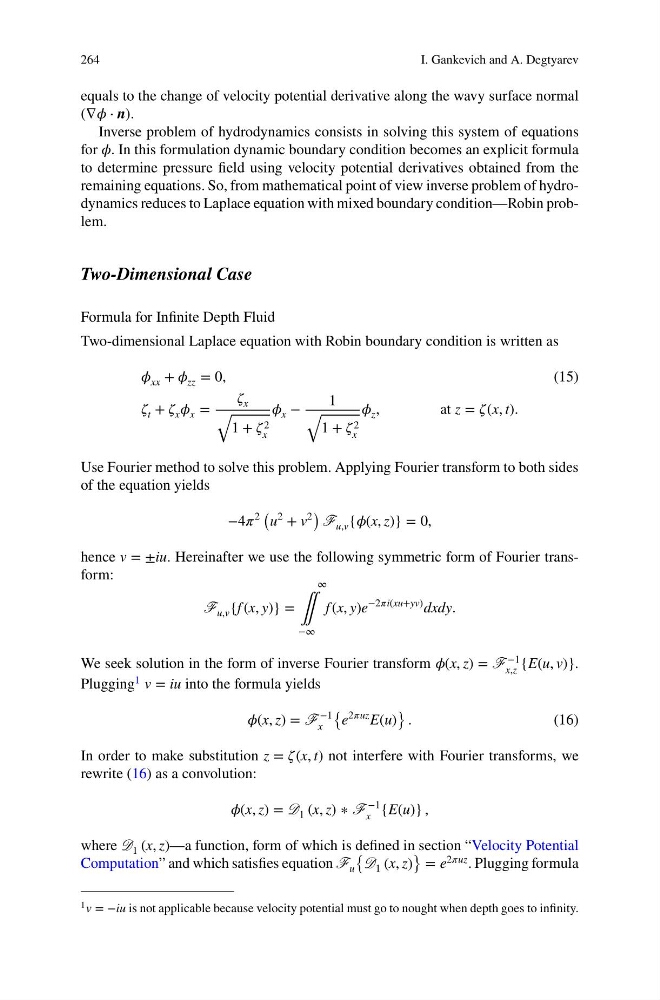
Two-dimensional Laplace equation with Robin boundary condition is written as
í µí¼ xx + í µí¼ zz = 0,
(15)
í µí¼ t + í µí¼ x í µí¼ x =
í µí¼ x
√
1 + í µí¼ 2
x
í µí¼ x −
1
√
1 + í µí¼ 2
x
í µí¼ z ,
at z = í µí¼ (x, t).
Use Fourier method to solve this problem. Applying Fourier transform to both sides
of the equation yields
−4í µí¼
2
(
u
2
+ v
2
) F u,v {í µí¼(x, z)} = 0,
hence v = ±iu. Hereinafter we use the following symmetric form of Fourier transform:
F u,v {f (x, y)} =
∞
∬
−∞
f (x, y)e
−2í µí¼i(xu+yv) dxdy.
We seek solution in the form of inverse Fourier transform í µí¼(x, z) = F
−1
x,z {E(u, v)}.
Plugging
1 v = iu into the formula yields
í µí¼(x, z) = F
−1
x
{
e
2í µí¼uz E(u)
} .
(16)
In order to make substitution z = í µí¼ (x, t) not interfere with Fourier transforms, we
rewrite (16) as a convolution:
í µí¼(x, z) = D 1 (x, z) ∗ F
−1
x {E(u)} ,
where D 1 (x, z)—a function, form of which is defined in section “Velocity Potential
Computation” and which satisfies equation F u
{ D 1 (x, z)
} = e 2í µí¼uz . Plugging formula
1 v = −iu is not applicable because velocity potential must go to nought when depth goes to infinity.
I. Gankevich and A. Degtyarev
equals to the change of velocity potential derivative along the wavy surface normal
(∇í µí¼ ⋅ n).
Inverse problem of hydrodynamics consists in solving this system of equations
for í µí¼. In this formulation dynamic boundary condition becomes an explicit formula
to determine pressure field using velocity potential derivatives obtained from the
remaining equations. So, from mathematical point of view inverse problem of hydrodynamics reduces to Laplace equation with mixed boundary condition—Robin problem.
Two-Dimensional Case
Formula for Infinite Depth Fluid
Two-dimensional Laplace equation with Robin boundary condition is written as
í µí¼ xx + í µí¼ zz = 0,
(15)
í µí¼ t + í µí¼ x í µí¼ x =
í µí¼ x
√
1 + í µí¼ 2
x
í µí¼ x −
1
√
1 + í µí¼ 2
x
í µí¼ z ,
at z = í µí¼ (x, t).
Use Fourier method to solve this problem. Applying Fourier transform to both sides
of the equation yields
−4í µí¼
2
(
u
2
+ v
2
) F u,v {í µí¼(x, z)} = 0,
hence v = ±iu. Hereinafter we use the following symmetric form of Fourier transform:
F u,v {f (x, y)} =
∞
∬
−∞
f (x, y)e
−2í µí¼i(xu+yv) dxdy.
We seek solution in the form of inverse Fourier transform í µí¼(x, z) = F
−1
x,z {E(u, v)}.
Plugging
1 v = iu into the formula yields
í µí¼(x, z) = F
−1
x
{
e
2í µí¼uz E(u)
} .
(16)
In order to make substitution z = í µí¼ (x, t) not interfere with Fourier transforms, we
rewrite (16) as a convolution:
í µí¼(x, z) = D 1 (x, z) ∗ F
−1
x {E(u)} ,
where D 1 (x, z)—a function, form of which is defined in section “Velocity Potential
Computation” and which satisfies equation F u
{ D 1 (x, z)
} = e 2í µí¼uz . Plugging formula
1 v = −iu is not applicable because velocity potential must go to nought when depth goes to infinity.