

Simulation of Standing and Propagating Sea Waves . . .
263
algebraic, and the solution is written as inverse Fourier transform of some function
(which may contain Fourier transforms of other functions). Since, it is not possible
to write analytic forms of these Fourier transforms in all cases, unique solutions are
found and their behaviour is studied in different domains instead. At the same time,
computing discrete Fourier transforms on the computer is possible for any discretely
defined function and efficient when using FFT algorithms. These algorithms use
symmetry of complex exponentials to decrease asymptotic complexity from O(n 2 )
to O(n log 2 n). So, even if general solution contains Fourier transforms of unknown
functions, they still can be computed numerically, and FFT family of algorithms
makes this approach efficient.
Alternative approach to solve a PDE is to reduce it to difference equations,
which are solved by constructing various numerical schemes. This approach leads
to approximate solution, and asymptotic complexity of corresponding algorithms
is comparable to that of FFT. For example, stationary elliptic PDE transforms to
implicit numerical scheme which is solved by iterative method on each step of which
a tridiagonal or five-diagonal system of algebraic equations is solved via Thomas
algorithm. Asymptotic complexity of this approach is O(nm), where n—number of
wavy surface grid points, m—number of iterations. Despite their wide spread, iterative algorithms are inefficient on parallel computer architectures; in particular, their
mapping to co-processors may involve copying data in and out of the co-processor
in each iteration, which negatively affects their performance. At the same time, high
number of Fourier transforms in the solution is an advantage, rather than a disadvantage. First, solutions obtained by Fourier method are explicit, hence their implementations scales with the large number of parallel computer cores. Second, there
are implementations of FFT optimised for different processor architectures as well
as co-processors (GPU, MIC) which makes it easy to get high performance on any
computing platform. These advantages substantiate the choice of Fourier method to
obtain explicit analytic solution to the problem of determining pressures under wavy
ocean surface.
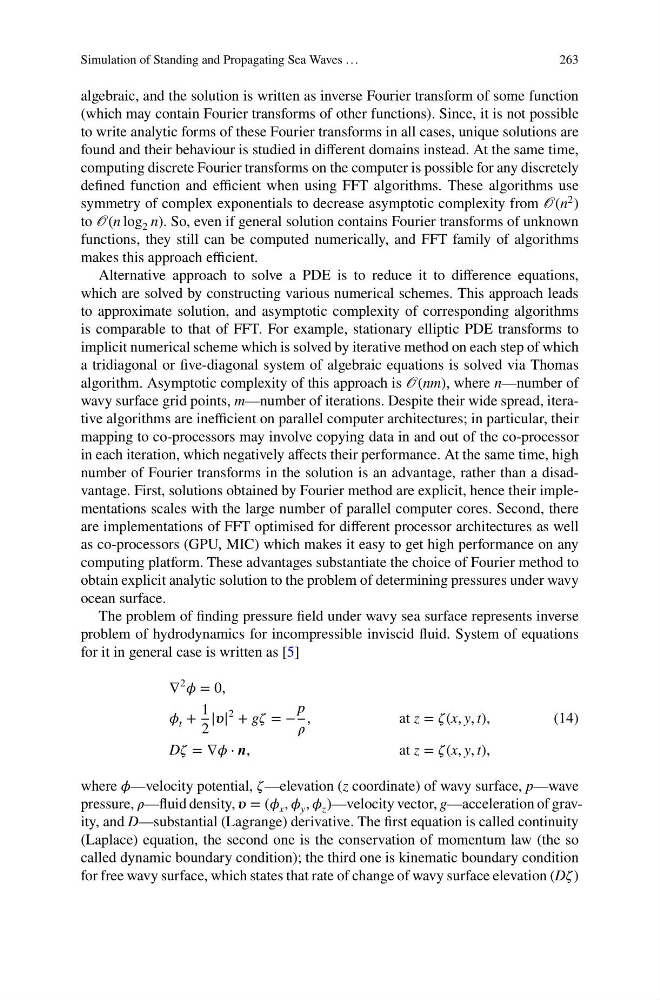
The problem of finding pressure field under wavy sea surface represents inverse
problem of hydrodynamics for incompressible inviscid fluid. System of equations
for it in general case is written as [5]
∇
2
í µí¼ = 0,
í µí¼ t +
1
2
|í µí½|
2
+ gí µí¼ = −
p
í µí¼
,
at z = í µí¼ (x, y, t),
(14)
Dí µí¼ = ∇í µí¼ ⋅ n,
at z = í µí¼ (x, y, t),
where í µí¼—velocity potential, í µí¼ —elevation (z coordinate) of wavy surface, p—wave
pressure, í µí¼—fluid density, í µí½ = (í µí¼ x , í µí¼ y , í µí¼ z )—velocity vector, g—acceleration of gravity, and D—substantial (Lagrange) derivative. The first equation is called continuity
(Laplace) equation, the second one is the conservation of momentum law (the so
called dynamic boundary condition); the third one is kinematic boundary condition
for free wavy surface, which states that rate of change of wavy surface elevation (Dí µí¼ )
263
algebraic, and the solution is written as inverse Fourier transform of some function
(which may contain Fourier transforms of other functions). Since, it is not possible
to write analytic forms of these Fourier transforms in all cases, unique solutions are
found and their behaviour is studied in different domains instead. At the same time,
computing discrete Fourier transforms on the computer is possible for any discretely
defined function and efficient when using FFT algorithms. These algorithms use
symmetry of complex exponentials to decrease asymptotic complexity from O(n 2 )
to O(n log 2 n). So, even if general solution contains Fourier transforms of unknown
functions, they still can be computed numerically, and FFT family of algorithms
makes this approach efficient.
Alternative approach to solve a PDE is to reduce it to difference equations,
which are solved by constructing various numerical schemes. This approach leads
to approximate solution, and asymptotic complexity of corresponding algorithms
is comparable to that of FFT. For example, stationary elliptic PDE transforms to
implicit numerical scheme which is solved by iterative method on each step of which
a tridiagonal or five-diagonal system of algebraic equations is solved via Thomas
algorithm. Asymptotic complexity of this approach is O(nm), where n—number of
wavy surface grid points, m—number of iterations. Despite their wide spread, iterative algorithms are inefficient on parallel computer architectures; in particular, their
mapping to co-processors may involve copying data in and out of the co-processor
in each iteration, which negatively affects their performance. At the same time, high
number of Fourier transforms in the solution is an advantage, rather than a disadvantage. First, solutions obtained by Fourier method are explicit, hence their implementations scales with the large number of parallel computer cores. Second, there
are implementations of FFT optimised for different processor architectures as well
as co-processors (GPU, MIC) which makes it easy to get high performance on any
computing platform. These advantages substantiate the choice of Fourier method to
obtain explicit analytic solution to the problem of determining pressures under wavy
ocean surface.
The problem of finding pressure field under wavy sea surface represents inverse
problem of hydrodynamics for incompressible inviscid fluid. System of equations
for it in general case is written as [5]
∇
2
í µí¼ = 0,
í µí¼ t +
1
2
|í µí½|
2
+ gí µí¼ = −
p
í µí¼
,
at z = í µí¼ (x, y, t),
(14)
Dí µí¼ = ∇í µí¼ ⋅ n,
at z = í µí¼ (x, y, t),
where í µí¼—velocity potential, í µí¼ —elevation (z coordinate) of wavy surface, p—wave
pressure, í µí¼—fluid density, í µí½ = (í µí¼ x , í µí¼ y , í µí¼ z )—velocity vector, g—acceleration of gravity, and D—substantial (Lagrange) derivative. The first equation is called continuity
(Laplace) equation, the second one is the conservation of momentum law (the so
called dynamic boundary condition); the third one is kinematic boundary condition
for free wavy surface, which states that rate of change of wavy surface elevation (Dí µí¼ )