

for instance). Its origin is caused by the uplift of the interface upstream of the sill, in
this case to the east, forced by the marked increase of the outflow of Mediterranean
waters during this phase of the tidal cycle. As a result, most of the water column
over CS consists of Mediterranean water that leaves a rather flat signal in CSN and
CSS temperature and salinity records (Fig. 6a).
During this tidal phase, a hydraulic jump on the westwern side of CS is regularly
formed [10, 11, 13], whose subsequent release when the current slackens originates
the well-known large amplitude internal wave train that progresses into the
Mediterranean Sea. Such an energetic process must leave recognizable footprints in
CS velocity observations, regardless of whether or not it leaves any in temperature
and/or salinity. The enhanced high-frequency variability of the ADCP series during
this tidal phase confirms the expectations, especially in CSS where the contrast with
the little variability registered during the ebb tide is striking (Fig. 5b). The
high-frequency variability in CSN is less organized with a pattern that remains
partially concealed by the noise. Most of the relevant information comes, thus, from
CSS where the following description focuses.
Figure 8 shows a three-day zoom to highlight some relevant features, some of them
quite obvious as the mentioned ebb-flood dissimilarity or, again, the diurnal inequality.
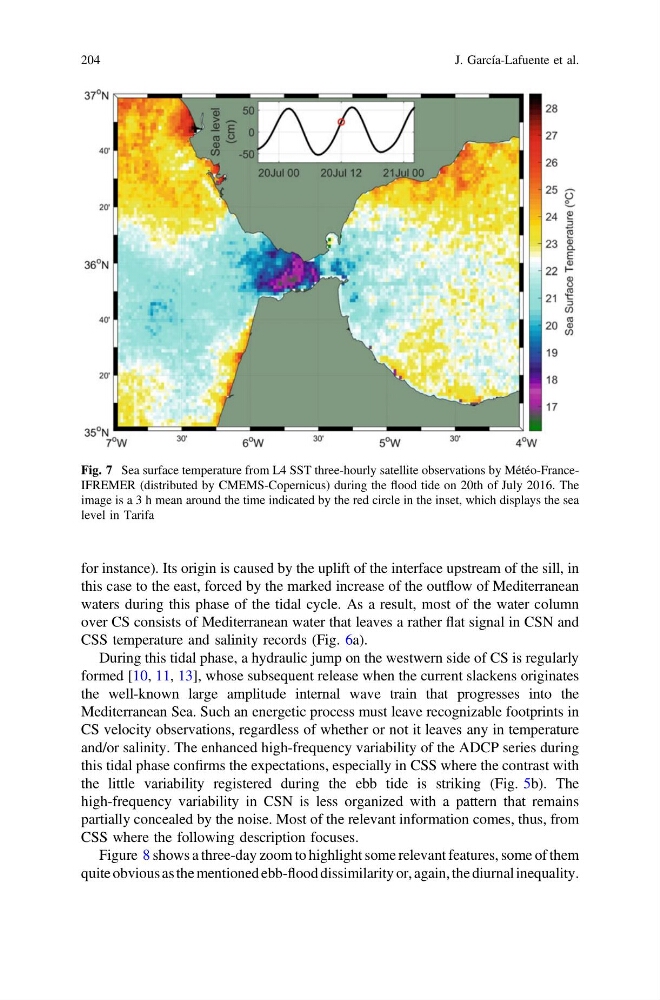
Fig. 7 Sea surface temperature from L4 SST three-hourly satellite observations by Météo-FranceIFREMER (distributed by CMEMS-Copernicus) during the flood tide on 20th of July 2016. The
image is a 3 h mean around the time indicated by the red circle in the inset, which displays the sea
level in Tarifa
204
J. García-Lafuente et al.
this case to the east, forced by the marked increase of the outflow of Mediterranean
waters during this phase of the tidal cycle. As a result, most of the water column
over CS consists of Mediterranean water that leaves a rather flat signal in CSN and
CSS temperature and salinity records (Fig. 6a).
During this tidal phase, a hydraulic jump on the westwern side of CS is regularly
formed [10, 11, 13], whose subsequent release when the current slackens originates
the well-known large amplitude internal wave train that progresses into the
Mediterranean Sea. Such an energetic process must leave recognizable footprints in
CS velocity observations, regardless of whether or not it leaves any in temperature
and/or salinity. The enhanced high-frequency variability of the ADCP series during
this tidal phase confirms the expectations, especially in CSS where the contrast with
the little variability registered during the ebb tide is striking (Fig. 5b). The
high-frequency variability in CSN is less organized with a pattern that remains
partially concealed by the noise. Most of the relevant information comes, thus, from
CSS where the following description focuses.
Figure 8 shows a three-day zoom to highlight some relevant features, some of them
quite obvious as the mentioned ebb-flood dissimilarity or, again, the diurnal inequality.
Fig. 7 Sea surface temperature from L4 SST three-hourly satellite observations by Météo-FranceIFREMER (distributed by CMEMS-Copernicus) during the flood tide on 20th of July 2016. The
image is a 3 h mean around the time indicated by the red circle in the inset, which displays the sea
level in Tarifa
204
J. García-Lafuente et al.