

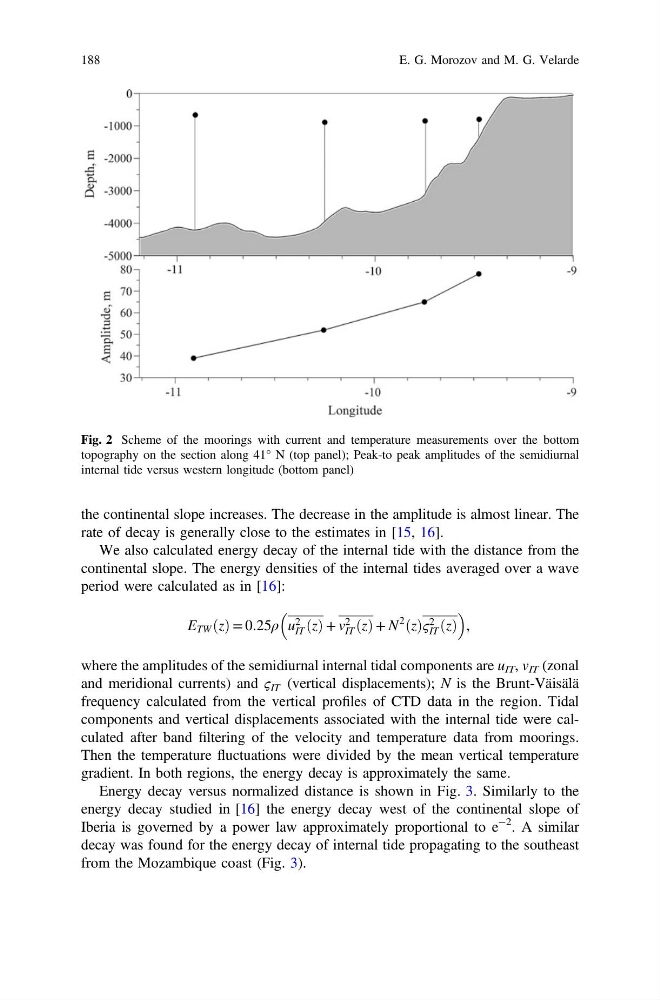
the continental slope increases. The decrease in the amplitude is almost linear. The
rate of decay is generally close to the estimates in [15, 16].
We also calculated energy decay of the internal tide with the distance from the
continental slope. The energy densities of the internal tides averaged over a wave
period were calculated as in [16]:
E TW z
ð Þ = 0.25ρ u 2
IT z
ð Þ + v 2
IT z
ð Þ + N
2 z
ð Þς 2
IT z
ð Þ
,
where the amplitudes of the semidiurnal internal tidal components are u IT , v IT (zonal
and meridional currents) and ς IT (vertical displacements); N is the Brunt-Väisälä
frequency calculated from the vertical profiles of CTD data in the region. Tidal
components and vertical displacements associated with the internal tide were calculated after band filtering of the velocity and temperature data from moorings.
Then the temperature fluctuations were divided by the mean vertical temperature
gradient. In both regions, the energy decay is approximately the same.
Energy decay versus normalized distance is shown in Fig. 3. Similarly to the
energy decay studied in [16] the energy decay west of the continental slope of
Iberia is governed by a power law approximately proportional to e
−2 . A similar
decay was found for the energy decay of internal tide propagating to the southeast
from the Mozambique coast (Fig. 3).
Fig. 2 Scheme of the moorings with current and temperature measurements over the bottom
topography on the section along 41° N (top panel); Peak-to peak amplitudes of the semidiurnal
internal tide versus western longitude (bottom panel)
188
E. G. Morozov and M. G. Velarde
rate of decay is generally close to the estimates in [15, 16].
We also calculated energy decay of the internal tide with the distance from the
continental slope. The energy densities of the internal tides averaged over a wave
period were calculated as in [16]:
E TW z
ð Þ = 0.25ρ u 2
IT z
ð Þ + v 2
IT z
ð Þ + N
2 z
ð Þς 2
IT z
ð Þ
,
where the amplitudes of the semidiurnal internal tidal components are u IT , v IT (zonal
and meridional currents) and ς IT (vertical displacements); N is the Brunt-Väisälä
frequency calculated from the vertical profiles of CTD data in the region. Tidal
components and vertical displacements associated with the internal tide were calculated after band filtering of the velocity and temperature data from moorings.
Then the temperature fluctuations were divided by the mean vertical temperature
gradient. In both regions, the energy decay is approximately the same.
Energy decay versus normalized distance is shown in Fig. 3. Similarly to the
energy decay studied in [16] the energy decay west of the continental slope of
Iberia is governed by a power law approximately proportional to e
−2 . A similar
decay was found for the energy decay of internal tide propagating to the southeast
from the Mozambique coast (Fig. 3).
Fig. 2 Scheme of the moorings with current and temperature measurements over the bottom
topography on the section along 41° N (top panel); Peak-to peak amplitudes of the semidiurnal
internal tide versus western longitude (bottom panel)
188
E. G. Morozov and M. G. Velarde