

172
L. R. M. Maas et al.
(a)
(c)
(b)
(d)
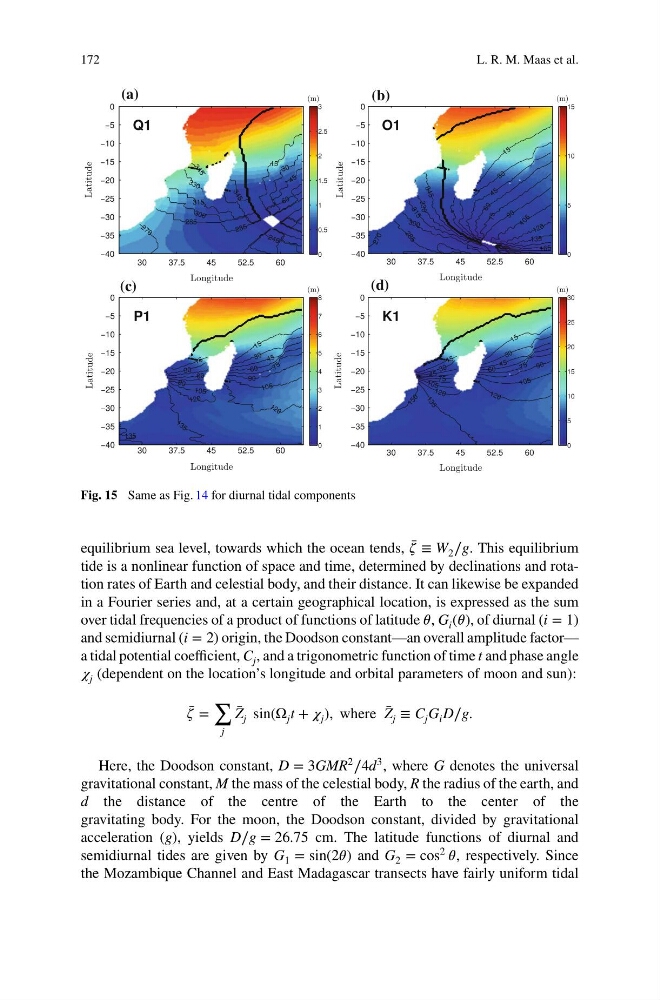
Fig. 15 Same as Fig. 14 for diurnal tidal components
equilibrium sea level, towards which the ocean tends, ̄
í µí¼ ≡ W 2 ∕g. This equilibrium
tide is a nonlinear function of space and time, determined by declinations and rotation rates of Earth and celestial body, and their distance. It can likewise be expanded
in a Fourier series and, at a certain geographical location, is expressed as the sum
over tidal frequencies of a product of functions of latitude í µí¼, G i (í µí¼), of diurnal (i = 1)
and semidiurnal (i = 2) origin, the Doodson constant—an overall amplitude factor—
a tidal potential coefficient, C j , and a trigonometric function of time t and phase angle
í µí¼ j (dependent on the location’s longitude and orbital parameters of moon and sun):
̄
í µí¼ =
∑
j
̄
Z j sin(Ω j t + í µí¼ j ), where ̄
Z j ≡ C j G i D∕g.
Here, the Doodson constant, D = 3GMR
2
∕4d
3 , where G denotes the universal
gravitational constant, M the mass of the celestial body, R the radius of the earth, and
d the distance of the centre of the Earth to the center of the
gravitating body. For the moon, the Doodson constant, divided by gravitational
acceleration (g), yields D∕g = 26.75 cm. The latitude functions of diurnal and
semidiurnal tides are given by G 1 = sin(2í µí¼) and G 2 = cos 2 í µí¼, respectively. Since
the Mozambique Channel and East Madagascar transects have fairly uniform tidal
L. R. M. Maas et al.
(a)
(c)
(b)
(d)
Fig. 15 Same as Fig. 14 for diurnal tidal components
equilibrium sea level, towards which the ocean tends, ̄
í µí¼ ≡ W 2 ∕g. This equilibrium
tide is a nonlinear function of space and time, determined by declinations and rotation rates of Earth and celestial body, and their distance. It can likewise be expanded
in a Fourier series and, at a certain geographical location, is expressed as the sum
over tidal frequencies of a product of functions of latitude í µí¼, G i (í µí¼), of diurnal (i = 1)
and semidiurnal (i = 2) origin, the Doodson constant—an overall amplitude factor—
a tidal potential coefficient, C j , and a trigonometric function of time t and phase angle
í µí¼ j (dependent on the location’s longitude and orbital parameters of moon and sun):
̄
í µí¼ =
∑
j
̄
Z j sin(Ω j t + í µí¼ j ), where ̄
Z j ≡ C j G i D∕g.
Here, the Doodson constant, D = 3GMR
2
∕4d
3 , where G denotes the universal
gravitational constant, M the mass of the celestial body, R the radius of the earth, and
d the distance of the centre of the Earth to the center of the
gravitating body. For the moon, the Doodson constant, divided by gravitational
acceleration (g), yields D∕g = 26.75 cm. The latitude functions of diurnal and
semidiurnal tides are given by G 1 = sin(2í µí¼) and G 2 = cos 2 í µí¼, respectively. Since
the Mozambique Channel and East Madagascar transects have fairly uniform tidal