

underneath North-Atlantic Bottom Water on its trajectory from the (south) western
to the (north) eastern Atlantic Basin. When the tidal phase is in the direction of the
large-scale flow, KHI have a vertical extent of 10–20 m. Half a tidal period later
when the phase is directed against the large-scale flow KHI exceed 100 m
vertically.
In all these KHI observed in the deep ocean, the roll-up stage of initial KH
billows seems to be limited to half a turn, resembling half a Rankine vortex [44],
before collapse. This is somewhat different than found in laboratory experiments
(e.g., [63]) and numerical modelling (e.g., [15, 64]). As a rare exception,
near-surface ocean optic [65] and acoustic observations [66] show a roll-up.
Although the lack of deep-ocean observations of multiple scale billow roll-up is
presently unknown, it may have to do with the large Reynolds numbers associated
with the turbulent environment above sloping topography, causing a rapid collapse
of the billows.
Some Temperature Statistics
The largest overturns observed have a vertical length scale of about 100 m [62] and
a time scale of just less than the buoyancy period [32]. The latter is commensurate
the expectation that the buoyancy frequency is a natural scale separator between
irreversible turbulent overturning and internal wave motions. As for the interpretation of (moored) temperature observations as a tracer for density variations, this
information is useful to help distinguishing between genuine turbulent overturning
and partially salinity compensated intrusions. The difference in shapes of apparent
and turbulent temperature instabilities is also used for distinction.
A further distinction and determination is obtained from temperature scalar
statistics [18]. In particular are we interested in the distinction between passive
scalar, shear-dominated turbulence and active scalar, convection dominated
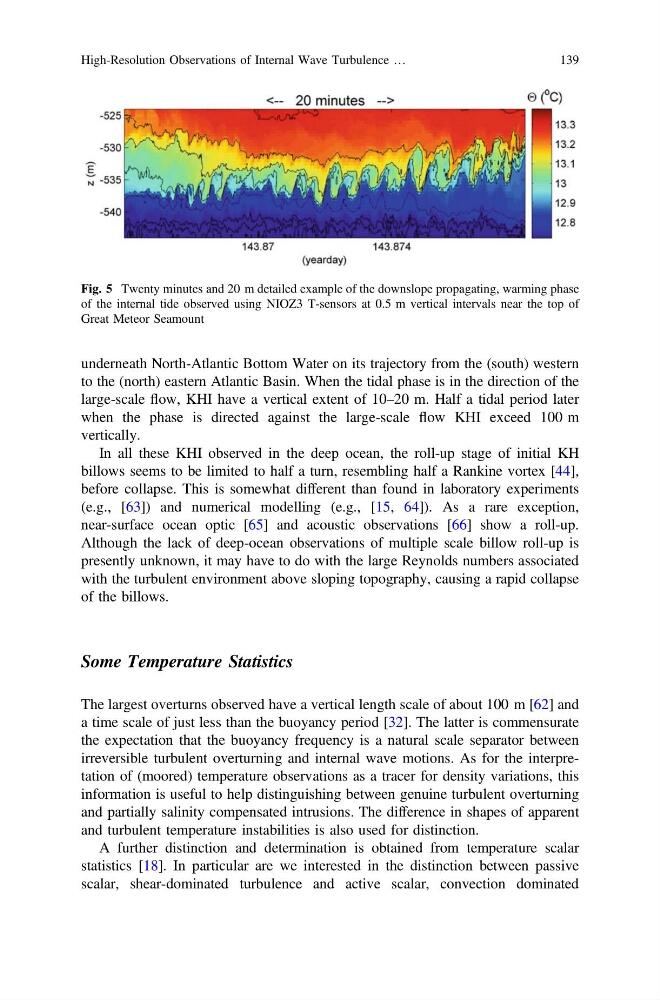
Fig. 5 Twenty minutes and 20 m detailed example of the downslope propagating, warming phase
of the internal tide observed using NIOZ3 T-sensors at 0.5 m vertical intervals near the top of
Great Meteor Seamount
High-Resolution Observations of Internal Wave Turbulence …
139
to the (north) eastern Atlantic Basin. When the tidal phase is in the direction of the
large-scale flow, KHI have a vertical extent of 10–20 m. Half a tidal period later
when the phase is directed against the large-scale flow KHI exceed 100 m
vertically.
In all these KHI observed in the deep ocean, the roll-up stage of initial KH
billows seems to be limited to half a turn, resembling half a Rankine vortex [44],
before collapse. This is somewhat different than found in laboratory experiments
(e.g., [63]) and numerical modelling (e.g., [15, 64]). As a rare exception,
near-surface ocean optic [65] and acoustic observations [66] show a roll-up.
Although the lack of deep-ocean observations of multiple scale billow roll-up is
presently unknown, it may have to do with the large Reynolds numbers associated
with the turbulent environment above sloping topography, causing a rapid collapse
of the billows.
Some Temperature Statistics
The largest overturns observed have a vertical length scale of about 100 m [62] and
a time scale of just less than the buoyancy period [32]. The latter is commensurate
the expectation that the buoyancy frequency is a natural scale separator between
irreversible turbulent overturning and internal wave motions. As for the interpretation of (moored) temperature observations as a tracer for density variations, this
information is useful to help distinguishing between genuine turbulent overturning
and partially salinity compensated intrusions. The difference in shapes of apparent
and turbulent temperature instabilities is also used for distinction.
A further distinction and determination is obtained from temperature scalar
statistics [18]. In particular are we interested in the distinction between passive
scalar, shear-dominated turbulence and active scalar, convection dominated
Fig. 5 Twenty minutes and 20 m detailed example of the downslope propagating, warming phase
of the internal tide observed using NIOZ3 T-sensors at 0.5 m vertical intervals near the top of
Great Meteor Seamount
High-Resolution Observations of Internal Wave Turbulence …
139