

can use one of the methods of the geometrical optics, i.e., the “traveling wave”
method, and the weakly dispersion approximation in the form of the corresponding
local asymptotics to seek the representation of the phase function argument σ in the
form σ = αðt, x, yÞðSðt, x, yÞ − ε tÞε
− a ; here function Sðt, x, yÞ describes the wave
front position. It is found by solving the eikonal equation ∇
2 S = c
− 2
ðx, y, tÞ, where
cðt, x, yÞ is the maximal IGW group velocity of the corresponding wave mode, i.e.,
the first term in the expansion of the dispersion curve at zero. Function αðt, x, yÞ (the
second term of the dispersion curve expansion) describes the space-time evolution
of the pulse width of non-harmonic Airy or Fresnel waves and can be found from
some conservation laws along the eikonal equation characteristics whose specific
form is determined by the physical conditions of the problems under study.
Further we compare the analytic results with the results of the analysis of
measurements of IGW variability in a real medium with horizontally varying
characteristics, namely, in the Northwest Pacific, according to the data recorded by
moorings in the “Megapolygon” experiment in the Northwest Pacific. The measurements of the currents and the temperature recorded by the “Megapolygon” moorings allowed us to study the variability of tidal internal waves over the
area of 460 × 520 km. The length of the tidal internal wave was calculated by
integration of the basic IGW spectral equation with the real depth distribution of the
Vaisala-Brunt frequency and with zero boundary conditions at the ocean surface
and the ocean floor taking into account the Earth’s rotation. The wave length of the
first mode in the “Megapolygon” area is equal approximately to 130 km, the wave
length near the Emperor Ridge is greater (167 km), and it is equal to 156 km at a
distance of 2000 km to the east. The wave propagation direction is also very stable
and varies from 240° to 300°, which corresponds to the actual wave propagation to
the west and northwest from the Emperor Ridge. Some diffraction of tidal internal
waves was observed in the “Megapolygon” study site, i.e., the direction of wave
propagation varied from the northwest in the southeast of the site and to the west in
its northwest part [5].
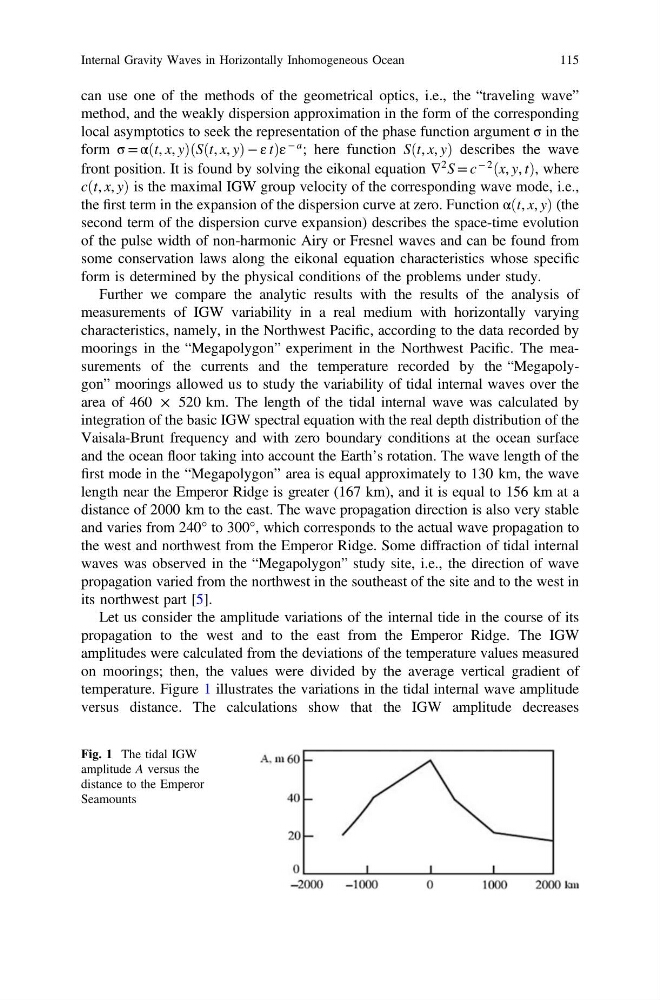
Let us consider the amplitude variations of the internal tide in the course of its
propagation to the west and to the east from the Emperor Ridge. The IGW
amplitudes were calculated from the deviations of the temperature values measured
on moorings; then, the values were divided by the average vertical gradient of
temperature. Figure 1 illustrates the variations in the tidal internal wave amplitude
versus distance. The calculations show that the IGW amplitude decreases
Fig. 1 The tidal IGW
amplitude A versus the
distance to the Emperor
Seamounts
Internal Gravity Waves in Horizontally Inhomogeneous Ocean
115
method, and the weakly dispersion approximation in the form of the corresponding
local asymptotics to seek the representation of the phase function argument σ in the
form σ = αðt, x, yÞðSðt, x, yÞ − ε tÞε
− a ; here function Sðt, x, yÞ describes the wave
front position. It is found by solving the eikonal equation ∇
2 S = c
− 2
ðx, y, tÞ, where
cðt, x, yÞ is the maximal IGW group velocity of the corresponding wave mode, i.e.,
the first term in the expansion of the dispersion curve at zero. Function αðt, x, yÞ (the
second term of the dispersion curve expansion) describes the space-time evolution
of the pulse width of non-harmonic Airy or Fresnel waves and can be found from
some conservation laws along the eikonal equation characteristics whose specific
form is determined by the physical conditions of the problems under study.
Further we compare the analytic results with the results of the analysis of
measurements of IGW variability in a real medium with horizontally varying
characteristics, namely, in the Northwest Pacific, according to the data recorded by
moorings in the “Megapolygon” experiment in the Northwest Pacific. The measurements of the currents and the temperature recorded by the “Megapolygon” moorings allowed us to study the variability of tidal internal waves over the
area of 460 × 520 km. The length of the tidal internal wave was calculated by
integration of the basic IGW spectral equation with the real depth distribution of the
Vaisala-Brunt frequency and with zero boundary conditions at the ocean surface
and the ocean floor taking into account the Earth’s rotation. The wave length of the
first mode in the “Megapolygon” area is equal approximately to 130 km, the wave
length near the Emperor Ridge is greater (167 km), and it is equal to 156 km at a
distance of 2000 km to the east. The wave propagation direction is also very stable
and varies from 240° to 300°, which corresponds to the actual wave propagation to
the west and northwest from the Emperor Ridge. Some diffraction of tidal internal
waves was observed in the “Megapolygon” study site, i.e., the direction of wave
propagation varied from the northwest in the southeast of the site and to the west in
its northwest part [5].
Let us consider the amplitude variations of the internal tide in the course of its
propagation to the west and to the east from the Emperor Ridge. The IGW
amplitudes were calculated from the deviations of the temperature values measured
on moorings; then, the values were divided by the average vertical gradient of
temperature. Figure 1 illustrates the variations in the tidal internal wave amplitude
versus distance. The calculations show that the IGW amplitude decreases
Fig. 1 The tidal IGW
amplitude A versus the
distance to the Emperor
Seamounts
Internal Gravity Waves in Horizontally Inhomogeneous Ocean
115