

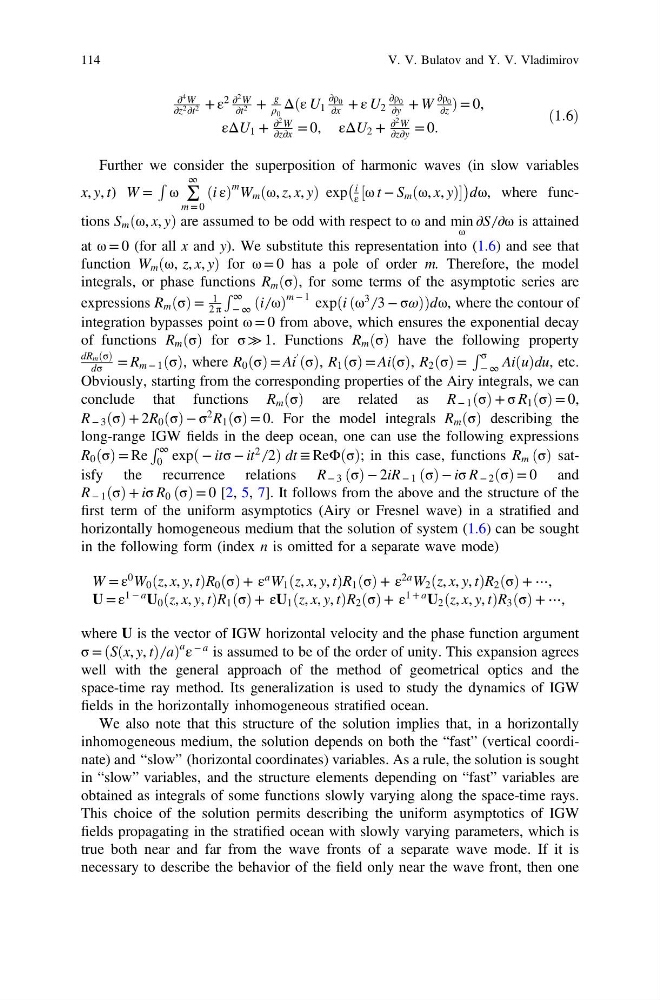
∂
4 W
∂z 2 ∂t 2 + ε
2 ∂
2 W
∂t 2 +
g
ρ 0
Δðε U 1
∂ρ 0
∂x + ε U 2
∂ρ 0
∂y + W
∂ρ 0
∂z Þ = 0,
εΔU 1 +
∂
2 W
∂z∂x = 0, εΔU 2 +
∂
2 W
∂z∂y = 0.
ð1:6Þ
Further we consider the superposition of harmonic waves (in slow variables
x, y, t) W =
R ω ∑
∞
m = 0
ði εÞ
m W m ðω, z, x, yÞ exp
i
ε ω t − S m ðω, x, yÞ
½
À
Á
dω, where functions S m ðω, x, yÞ are assumed to be odd with respect to ω and min
ω
∂S ̸ ∂ω is attained
at ω = 0 (for all x and y). We substitute this representation into (1.6) and see that
function W m ðω, z, x, yÞ for ω = 0 has a pole of order m. Therefore, the model
integrals, or phase functions R m ðσÞ, for some terms of the asymptotic series are
expressions R m ðσÞ =
1
2 π
R ∞
− ∞ i ̸ ω
ð Þ
m − 1 exp i ðω
3
̸ 3 − σωÞ
ð
Þ dω, where the contour of
integration bypasses point ω = 0 from above, which ensures the exponential decay
of functions R m ðσÞ for σ ≫ 1. Functions R m ðσÞ have the following property
dR m ðσÞ
dσ = R m − 1 ðσÞ, where R 0 ðσÞ = Ai
′
ðσÞ, R 1 ðσÞ = AiðσÞ, R 2 ðσÞ =
R σ
− ∞ AiðuÞdu, etc.
Obviously, starting from the corresponding properties of the Airy integrals, we can
conclude that functions R m ðσÞ are related as R − 1 ðσÞ + σ R 1 ðσÞ = 0,
R − 3 ðσÞ + 2R 0 ðσÞ − σ
2 R 1 ðσÞ = 0. For the model integrals R m ðσÞ describing the
long-range IGW fields in the deep ocean, one can use the following expressions
R 0 ðσÞ = Re
R ∞
0 exp − itσ − it
2
̸ 2
ð
Þdt ≡ ReΦðσÞ; in this case, functions R m ðσÞ satisfy the recurrence relations R − 3 ðσÞ − 2iR − 1 ðσÞ − iσ R − 2 ðσÞ = 0 and
R − 1 ðσÞ + iσ R 0 ðσÞ = 0 [2, 5, 7]. It follows from the above and the structure of the
first term of the uniform asymptotics (Airy or Fresnel wave) in a stratified and
horizontally homogeneous medium that the solution of system (1.6) can be sought
in the following form (index n is omitted for a separate wave mode)
W = ε
0 W 0 ðz, x, y, tÞR 0 ðσÞ + ε
a W 1 ðz, x, y, tÞR 1 ðσÞ + ε
2a W 2 ðz, x, y, tÞR 2 ðσÞ + ⋯,
U = ε
1 − a U 0 ðz, x, y, tÞR 1 ðσÞ + εU 1 ðz, x, y, tÞR 2 ðσÞ + ε
1 + a U 2 ðz, x, y, tÞR 3 ðσÞ + ⋯,
where U is the vector of IGW horizontal velocity and the phase function argument
σ = Sðx, y, tÞ ̸ a
ð
Þ
a ε
− a is assumed to be of the order of unity. This expansion agrees
well with the general approach of the method of geometrical optics and the
space-time ray method. Its generalization is used to study the dynamics of IGW
fields in the horizontally inhomogeneous stratified ocean.
We also note that this structure of the solution implies that, in a horizontally
inhomogeneous medium, the solution depends on both the “fast” (vertical coordinate) and “slow” (horizontal coordinates) variables. As a rule, the solution is sought
in “slow” variables, and the structure elements depending on “fast” variables are
obtained as integrals of some functions slowly varying along the space-time rays.
This choice of the solution permits describing the uniform asymptotics of IGW
fields propagating in the stratified ocean with slowly varying parameters, which is
true both near and far from the wave fronts of a separate wave mode. If it is
necessary to describe the behavior of the field only near the wave front, then one
114
V. V. Bulatov and Y. V. Vladimirov
4 W
∂z 2 ∂t 2 + ε
2 ∂
2 W
∂t 2 +
g
ρ 0
Δðε U 1
∂ρ 0
∂x + ε U 2
∂ρ 0
∂y + W
∂ρ 0
∂z Þ = 0,
εΔU 1 +
∂
2 W
∂z∂x = 0, εΔU 2 +
∂
2 W
∂z∂y = 0.
ð1:6Þ
Further we consider the superposition of harmonic waves (in slow variables
x, y, t) W =
R ω ∑
∞
m = 0
ði εÞ
m W m ðω, z, x, yÞ exp
i
ε ω t − S m ðω, x, yÞ
½
À
Á
dω, where functions S m ðω, x, yÞ are assumed to be odd with respect to ω and min
ω
∂S ̸ ∂ω is attained
at ω = 0 (for all x and y). We substitute this representation into (1.6) and see that
function W m ðω, z, x, yÞ for ω = 0 has a pole of order m. Therefore, the model
integrals, or phase functions R m ðσÞ, for some terms of the asymptotic series are
expressions R m ðσÞ =
1
2 π
R ∞
− ∞ i ̸ ω
ð Þ
m − 1 exp i ðω
3
̸ 3 − σωÞ
ð
Þ dω, where the contour of
integration bypasses point ω = 0 from above, which ensures the exponential decay
of functions R m ðσÞ for σ ≫ 1. Functions R m ðσÞ have the following property
dR m ðσÞ
dσ = R m − 1 ðσÞ, where R 0 ðσÞ = Ai
′
ðσÞ, R 1 ðσÞ = AiðσÞ, R 2 ðσÞ =
R σ
− ∞ AiðuÞdu, etc.
Obviously, starting from the corresponding properties of the Airy integrals, we can
conclude that functions R m ðσÞ are related as R − 1 ðσÞ + σ R 1 ðσÞ = 0,
R − 3 ðσÞ + 2R 0 ðσÞ − σ
2 R 1 ðσÞ = 0. For the model integrals R m ðσÞ describing the
long-range IGW fields in the deep ocean, one can use the following expressions
R 0 ðσÞ = Re
R ∞
0 exp − itσ − it
2
̸ 2
ð
Þdt ≡ ReΦðσÞ; in this case, functions R m ðσÞ satisfy the recurrence relations R − 3 ðσÞ − 2iR − 1 ðσÞ − iσ R − 2 ðσÞ = 0 and
R − 1 ðσÞ + iσ R 0 ðσÞ = 0 [2, 5, 7]. It follows from the above and the structure of the
first term of the uniform asymptotics (Airy or Fresnel wave) in a stratified and
horizontally homogeneous medium that the solution of system (1.6) can be sought
in the following form (index n is omitted for a separate wave mode)
W = ε
0 W 0 ðz, x, y, tÞR 0 ðσÞ + ε
a W 1 ðz, x, y, tÞR 1 ðσÞ + ε
2a W 2 ðz, x, y, tÞR 2 ðσÞ + ⋯,
U = ε
1 − a U 0 ðz, x, y, tÞR 1 ðσÞ + εU 1 ðz, x, y, tÞR 2 ðσÞ + ε
1 + a U 2 ðz, x, y, tÞR 3 ðσÞ + ⋯,
where U is the vector of IGW horizontal velocity and the phase function argument
σ = Sðx, y, tÞ ̸ a
ð
Þ
a ε
− a is assumed to be of the order of unity. This expansion agrees
well with the general approach of the method of geometrical optics and the
space-time ray method. Its generalization is used to study the dynamics of IGW
fields in the horizontally inhomogeneous stratified ocean.
We also note that this structure of the solution implies that, in a horizontally
inhomogeneous medium, the solution depends on both the “fast” (vertical coordinate) and “slow” (horizontal coordinates) variables. As a rule, the solution is sought
in “slow” variables, and the structure elements depending on “fast” variables are
obtained as integrals of some functions slowly varying along the space-time rays.
This choice of the solution permits describing the uniform asymptotics of IGW
fields propagating in the stratified ocean with slowly varying parameters, which is
true both near and far from the wave fronts of a separate wave mode. If it is
necessary to describe the behavior of the field only near the wave front, then one
114
V. V. Bulatov and Y. V. Vladimirov