

106
V. Liapidevskii and N. Gavrilov
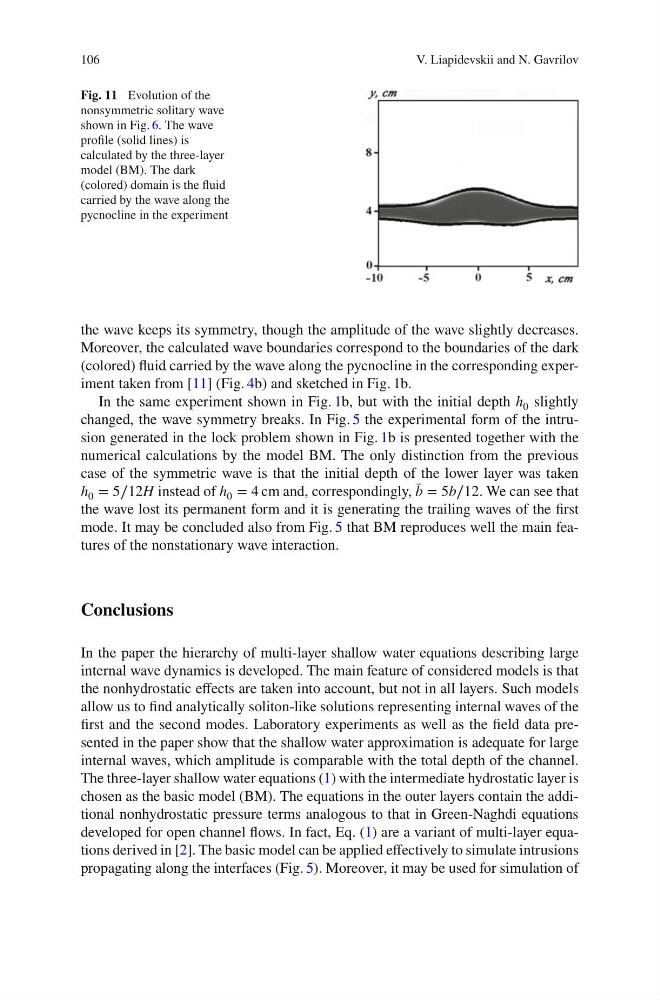
Fig. 11 Evolution of the
nonsymmetric solitary wave
shown in Fig. 6. The wave
profile (solid lines) is
calculated by the three-layer
model (BM). The dark
(colored) domain is the fluid
carried by the wave along the
pycnocline in the experiment
the wave keeps its symmetry, though the amplitude of the wave slightly decreases.
Moreover, the calculated wave boundaries correspond to the boundaries of the dark
(colored) fluid carried by the wave along the pycnocline in the corresponding experiment taken from [11] (Fig. 4b) and sketched in Fig. 1b.
In the same experiment shown in Fig. 1b, but with the initial depth h 0 slightly
changed, the wave symmetry breaks. In Fig. 5 the experimental form of the intrusion generated in the lock problem shown in Fig. 1b is presented together with the
numerical calculations by the model BM. The only distinction from the previous
case of the symmetric wave is that the initial depth of the lower layer was taken
h 0 = 5∕12H instead of h 0 = 4 cm and, correspondingly, ̄
b = 5b∕12. We can see that
the wave lost its permanent form and it is generating the trailing waves of the first
mode. It may be concluded also from Fig. 5 that BM reproduces well the main features of the nonstationary wave interaction.
Conclusions
In the paper the hierarchy of multi-layer shallow water equations describing large
internal wave dynamics is developed. The main feature of considered models is that
the nonhydrostatic effects are taken into account, but not in all layers. Such models
allow us to find analytically soliton-like solutions representing internal waves of the
first and the second modes. Laboratory experiments as well as the field data presented in the paper show that the shallow water approximation is adequate for large
internal waves, which amplitude is comparable with the total depth of the channel.
The three-layer shallow water equations (1) with the intermediate hydrostatic layer is
chosen as the basic model (BM). The equations in the outer layers contain the additional nonhydrostatic pressure terms analogous to that in Green-Naghdi equations
developed for open channel flows. In fact, Eq. (1) are a variant of multi-layer equations derived in [2]. The basic model can be applied effectively to simulate intrusions
propagating along the interfaces (Fig. 5). Moreover, it may be used for simulation of
V. Liapidevskii and N. Gavrilov
Fig. 11 Evolution of the
nonsymmetric solitary wave
shown in Fig. 6. The wave
profile (solid lines) is
calculated by the three-layer
model (BM). The dark
(colored) domain is the fluid
carried by the wave along the
pycnocline in the experiment
the wave keeps its symmetry, though the amplitude of the wave slightly decreases.
Moreover, the calculated wave boundaries correspond to the boundaries of the dark
(colored) fluid carried by the wave along the pycnocline in the corresponding experiment taken from [11] (Fig. 4b) and sketched in Fig. 1b.
In the same experiment shown in Fig. 1b, but with the initial depth h 0 slightly
changed, the wave symmetry breaks. In Fig. 5 the experimental form of the intrusion generated in the lock problem shown in Fig. 1b is presented together with the
numerical calculations by the model BM. The only distinction from the previous
case of the symmetric wave is that the initial depth of the lower layer was taken
h 0 = 5∕12H instead of h 0 = 4 cm and, correspondingly, ̄
b = 5b∕12. We can see that
the wave lost its permanent form and it is generating the trailing waves of the first
mode. It may be concluded also from Fig. 5 that BM reproduces well the main features of the nonstationary wave interaction.
Conclusions
In the paper the hierarchy of multi-layer shallow water equations describing large
internal wave dynamics is developed. The main feature of considered models is that
the nonhydrostatic effects are taken into account, but not in all layers. Such models
allow us to find analytically soliton-like solutions representing internal waves of the
first and the second modes. Laboratory experiments as well as the field data presented in the paper show that the shallow water approximation is adequate for large
internal waves, which amplitude is comparable with the total depth of the channel.
The three-layer shallow water equations (1) with the intermediate hydrostatic layer is
chosen as the basic model (BM). The equations in the outer layers contain the additional nonhydrostatic pressure terms analogous to that in Green-Naghdi equations
developed for open channel flows. In fact, Eq. (1) are a variant of multi-layer equations derived in [2]. The basic model can be applied effectively to simulate intrusions
propagating along the interfaces (Fig. 5). Moreover, it may be used for simulation of