

102
V. Liapidevskii and N. Gavrilov
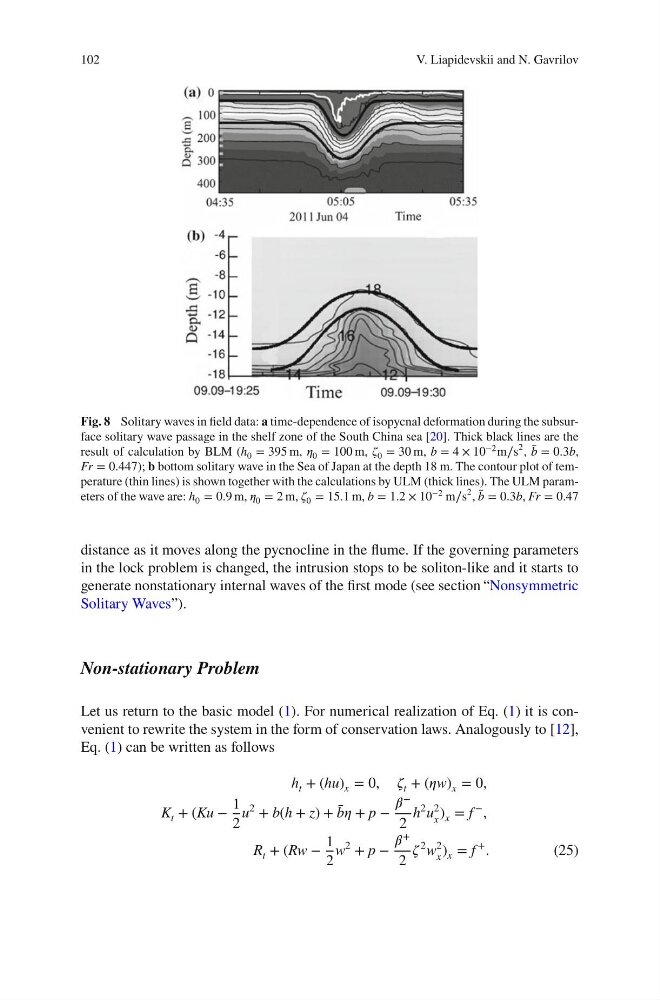
Fig. 8 Solitary waves in field data: a time-dependence of isopycnal deformation during the subsurface solitary wave passage in the shelf zone of the South China sea [20]. Thick black lines are the
result of calculation by BLM (h 0 = 395 m, í µí¼ 0 = 100 m, í µí¼ 0 = 30 m, b = 4 × 10
−2
m∕s
2 , ̄
b = 0.3b,
Fr = 0.447); b bottom solitary wave in the Sea of Japan at the depth 18 m. The contour plot of temperature (thin lines) is shown together with the calculations by ULM (thick lines). The ULM parameters of the wave are: h 0 = 0.9 m, í µí¼ 0 = 2 m, í µí¼ 0 = 15.1 m, b = 1.2 × 10
−2
m∕s
2 , ̄
b = 0.3b, Fr = 0.47
distance as it moves along the pycnocline in the flume. If the governing parameters
in the lock problem is changed, the intrusion stops to be soliton-like and it starts to
generate nonstationary internal waves of the first mode (see section “Nonsymmetric
Solitary Waves”).
Non-stationary Problem
Let us return to the basic model (1). For numerical realization of Eq. (1) it is convenient to rewrite the system in the form of conservation laws. Analogously to [12],
Eq. (1) can be written as follows
h t + (hu) x = 0, í µí¼ t + (í µí¼w) x = 0,
K t + (Ku −
1
2
u
2
+ b(h + z) + ̄
bí µí¼ + p −
í µí»½ −
2
h
2 u
2
x
) x = f
−
,
R t + (Rw −
1
2
w
2
+ p −
í µí»½
+
2
í µí¼
2 w
2
x ) x = f
+
.
(25)
V. Liapidevskii and N. Gavrilov
Fig. 8 Solitary waves in field data: a time-dependence of isopycnal deformation during the subsurface solitary wave passage in the shelf zone of the South China sea [20]. Thick black lines are the
result of calculation by BLM (h 0 = 395 m, í µí¼ 0 = 100 m, í µí¼ 0 = 30 m, b = 4 × 10
−2
m∕s
2 , ̄
b = 0.3b,
Fr = 0.447); b bottom solitary wave in the Sea of Japan at the depth 18 m. The contour plot of temperature (thin lines) is shown together with the calculations by ULM (thick lines). The ULM parameters of the wave are: h 0 = 0.9 m, í µí¼ 0 = 2 m, í µí¼ 0 = 15.1 m, b = 1.2 × 10
−2
m∕s
2 , ̄
b = 0.3b, Fr = 0.47
distance as it moves along the pycnocline in the flume. If the governing parameters
in the lock problem is changed, the intrusion stops to be soliton-like and it starts to
generate nonstationary internal waves of the first mode (see section “Nonsymmetric
Solitary Waves”).
Non-stationary Problem
Let us return to the basic model (1). For numerical realization of Eq. (1) it is convenient to rewrite the system in the form of conservation laws. Analogously to [12],
Eq. (1) can be written as follows
h t + (hu) x = 0, í µí¼ t + (í µí¼w) x = 0,
K t + (Ku −
1
2
u
2
+ b(h + z) + ̄
bí µí¼ + p −
í µí»½ −
2
h
2 u
2
x
) x = f
−
,
R t + (Rw −
1
2
w
2
+ p −
í µí»½
+
2
í µí¼
2 w
2
x ) x = f
+
.
(25)